Rosales Carlos, Uribe-Querol Eileen
Departamento de Inmunología, Instituto de Investigaciones Biomédicas, Universidad Nacional Autónoma de México, 04510 Ciudad de México, Mexico.
División de Estudios de Posgrado e Investigación, Facultad de Odontología, Universidad Nacional Autónoma de México, 04510 Ciudad de México, Mexico.
Biomed Res Int. 2017;2017:9042851. doi: 10.1155/2017/9042851. Epub 2017 Jun 12.
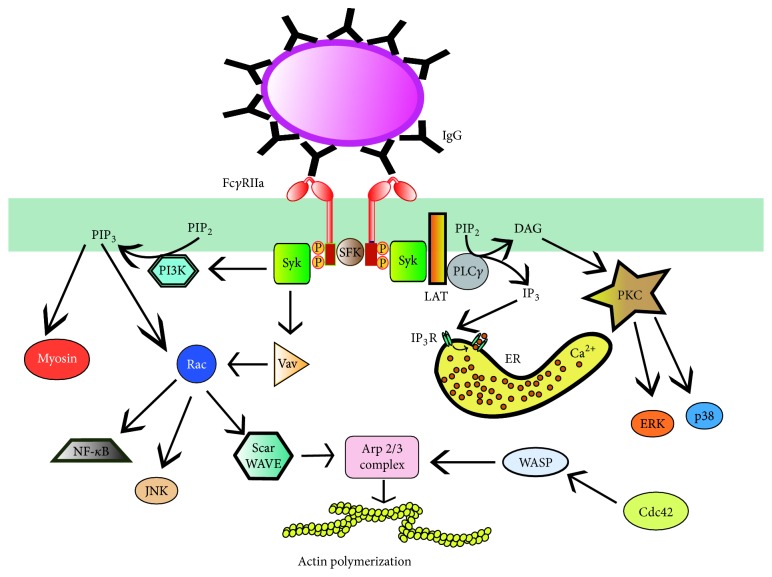
One hundred years have passed since the death of Élie Metchnikoff (1845-1916). He was the first to observe the uptake of particles by cells and realized the importance of this process for the host response to injury and infection. He also was a strong advocate of the role of phagocytosis in cellular immunity, and with this he gave us the basis for our modern understanding of inflammation and the innate and acquired immune responses. Phagocytosis is an elegant but complex process for the ingestion and elimination of pathogens, but it is also important for the elimination of apoptotic cells and hence fundamental for tissue homeostasis. Phagocytosis can be divided into four main steps: (i) recognition of the target particle, (ii) signaling to activate the internalization machinery, (iii) phagosome formation, and (iv) phagolysosome maturation. In recent years, the use of new tools of molecular biology and microscopy has provided new insights into the cellular mechanisms of phagocytosis. In this review, we present a general view of our current knowledge on phagocytosis. We emphasize novel molecular findings, particularly on phagosome formation and maturation, and discuss aspects that remain incompletely understood.
埃利·梅契尼科夫(1845 - 1916)逝世已百年。他是首个观察到细胞摄取颗粒现象的人,并意识到这一过程对于机体对损伤和感染的反应具有重要意义。他还大力倡导吞噬作用在细胞免疫中的作用,由此为我们现代对炎症以及先天性和获得性免疫反应的理解奠定了基础。吞噬作用是一个精巧但复杂的过程,用于摄取和清除病原体,同时对于清除凋亡细胞也很重要,因此是组织稳态的基础。吞噬作用可分为四个主要步骤:(i)识别靶颗粒;(ii)发出信号激活内化机制;(iii)吞噬体形成;(iv)吞噬溶酶体成熟。近年来,分子生物学和显微镜新技术的应用为吞噬作用的细胞机制提供了新见解。在本综述中,我们呈现了当前关于吞噬作用的知识概况。我们着重介绍新的分子发现,特别是关于吞噬体形成和成熟的发现,并讨论仍未完全理解的方面。