Rutstein Sarah E, Ananworanich Jintanat, Fidler Sarah, Johnson Cheryl, Sanders Eduard J, Sued Omar, Saez-Cirion Asier, Pilcher Christopher D, Fraser Christophe, Cohen Myron S, Vitoria Marco, Doherty Meg, Tucker Joseph D
Department of Health Policy and Management, University of North Carolina at Chapel Hill, Chapel Hill, NC, USA.
Division of Infectious Diseases, University of North Carolina at Chapel Hill, Chapel Hill, NC, USA.
J Int AIDS Soc. 2017 Jun 28;20(1):21579. doi: 10.7448/IAS.20.1.21579.
The unchanged global HIV incidence may be related to ignoring acute HIV infection (AHI). This scoping review examines diagnostic, clinical, and public health implications of identifying and treating persons with AHI.
We searched PubMed, in addition to hand-review of key journals identifying research pertaining to AHI detection and treatment. We focused on the relative contribution of AHI to transmission and the diagnostic, clinical, and public health implications. We prioritized research from low- and middle-income countries (LMICs) published in the last fifteen years.
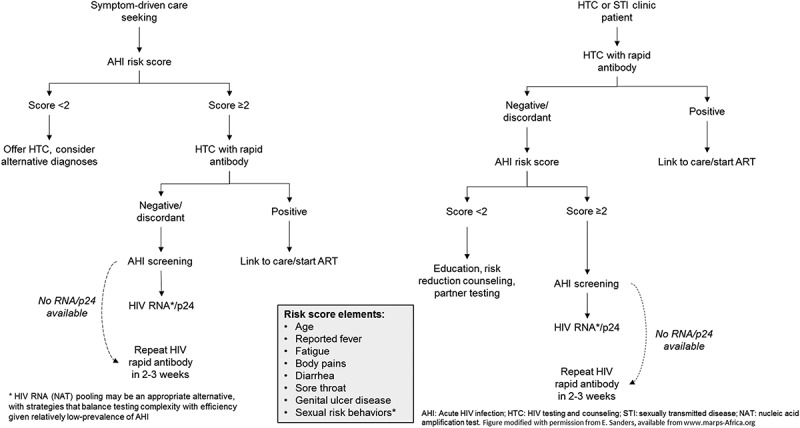
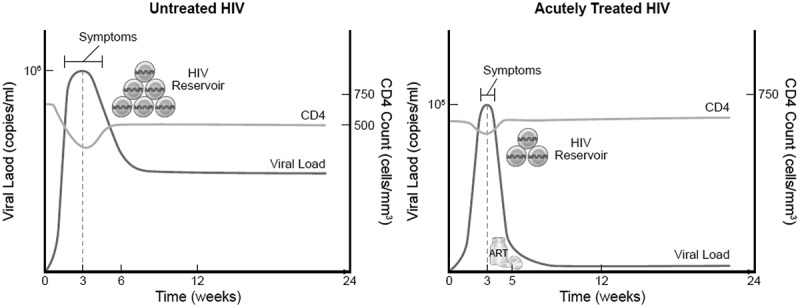
Extensive AHI research and limited routine AHI detection and treatment have begun in LMIC. Diagnostic challenges include ease-of-use, suitability for application and distribution in LMIC, and throughput for high-volume testing. Risk score algorithms have been used in LMIC to screen for AHI among individuals with behavioural and clinical characteristics more often associated with AHI. However, algorithms have not been implemented outside research settings. From a clinical perspective, there are substantial immunological and virological benefits to identifying and treating persons with AHI - evading the irreversible damage to host immune systems and seeding of viral reservoirs that occurs during untreated acute infection. The therapeutic benefits require rapid initiation of antiretrovirals, a logistical challenge in the absence of point-of-care testing. From a public health perspective, AHI diagnosis and treatment is critical to: decrease transmission via viral load reduction and behavioural interventions; improve pre-exposure prophylaxis outcomes by avoiding treatment initiation for HIV-seronegative persons with AHI; and, enhance partner services via notification for persons recently exposed or likely transmitting.
There are undeniable clinical and public health benefits to AHI detection and treatment, but also substantial diagnostic and logistical barriers to implementation and scale-up. Effective early ART initiation may be critical for HIV eradication efforts, but widespread use in LMIC requires simple and accurate diagnostic tools. Implementation research is critical to facilitate sustainable integration of AHI detection and treatment into existing health systems and will be essential for prospective evaluation of testing algorithms, point-of-care diagnostics, and efficacious and effective first-line regimens.
全球艾滋病病毒(HIV)发病率保持不变可能与忽视急性HIV感染(AHI)有关。本综述探讨了识别和治疗AHI患者的诊断、临床及公共卫生意义。
我们检索了PubMed,并对手检关键期刊以确定与AHI检测和治疗相关的研究。我们重点关注AHI对传播的相对贡献以及诊断、临床和公共卫生意义。我们优先考虑过去十五年在低收入和中等收入国家(LMIC)发表的研究。
在LMIC已经开展了广泛的AHI研究,但常规AHI检测和治疗有限。诊断方面的挑战包括易用性、是否适合在LMIC应用和推广以及高通量检测的通量。风险评分算法已在LMIC用于在具有更多与AHI相关行为和临床特征的个体中筛查AHI。然而,这些算法尚未在研究环境之外实施。从临床角度看,识别和治疗AHI患者有显著的免疫学和病毒学益处——避免在未经治疗的急性感染期间对宿主免疫系统造成不可逆转的损害以及病毒库的形成。治疗益处需要迅速启动抗逆转录病毒药物,在缺乏即时检测的情况下这是一个后勤方面的挑战。从公共卫生角度看,AHI诊断和治疗对于以下方面至关重要:通过降低病毒载量和行为干预减少传播;通过避免对AHI的HIV血清阴性者启动治疗改善暴露前预防效果;以及通过对近期暴露或可能传播者的通知加强性伴服务。
AHI检测和治疗有不可否认的临床和公共卫生益处,但在实施和扩大规模方面也存在重大诊断和后勤障碍。有效的早期抗逆转录病毒治疗启动对于HIV根除努力可能至关重要,但在LMIC广泛使用需要简单准确的诊断工具。实施研究对于促进将AHI检测和治疗可持续整合到现有卫生系统至关重要,并且对于前瞻性评估检测算法、即时诊断以及有效和高效的一线治疗方案也必不可少。