Nguyen Phuong H, Sanghvi Tina, Kim Sunny S, Tran Lan M, Afsana Kaosar, Mahmud Zeba, Aktar Bachera, Menon Purnima
Poverty, Health, and Nutrition Division, International Food Policy Research Institute, Washington, DC, United States of America.
Alive & Thrive, Washington, DC, United States of America.
PLoS One. 2017 Jul 10;12(7):e0179873. doi: 10.1371/journal.pone.0179873. eCollection 2017.
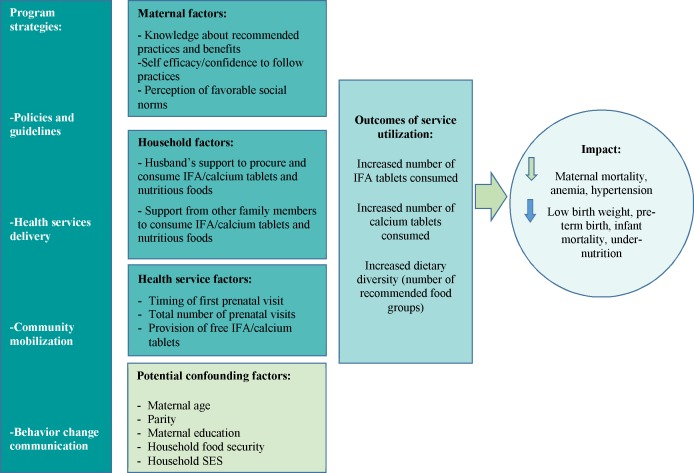
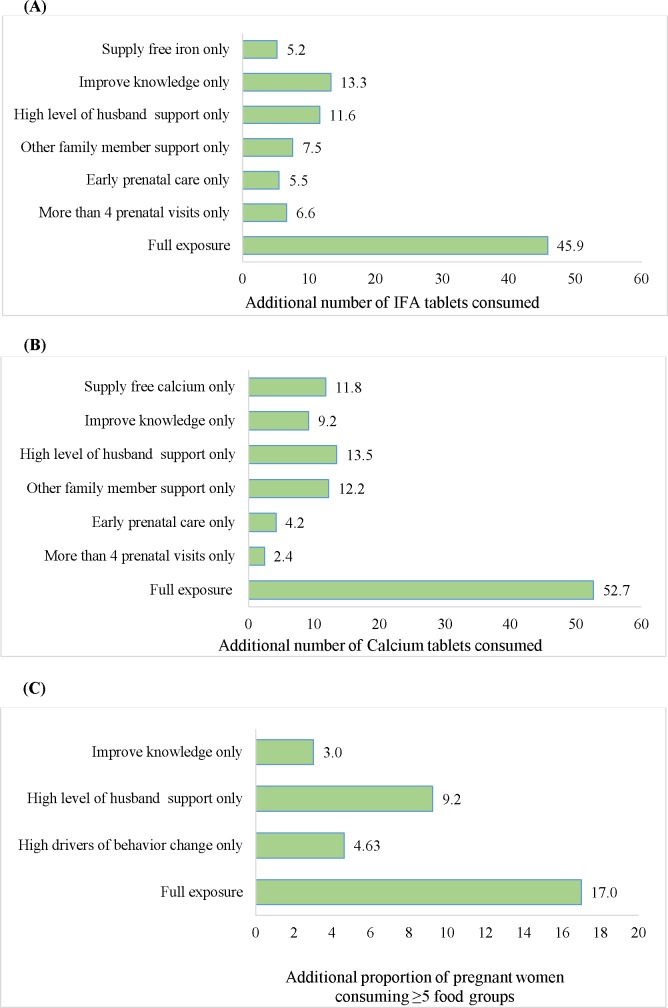
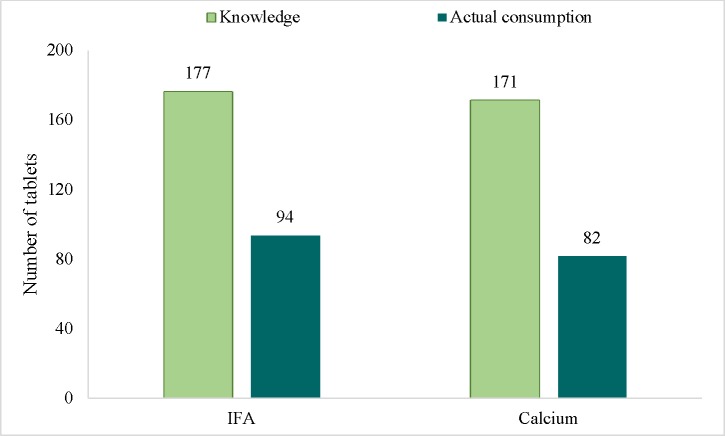
Improving maternal nutrition practices during pregnancy is essential to save lives and improve health outcomes for both mothers and babies. This paper examines the maternal, household, and health service factors influencing maternal nutrition practices in the context of a large scale maternal, newborn, and child health (MNCH) program in Bangladesh. Data were from a household survey of pregnant (n = 600) and recently delivered women (n = 2,000). Multivariate linear and logistic regression analyses were used to examine the determinants of three outcomes: consumption of iron and folic acid (IFA) tablets, calcium tablets, and diverse diets. Women consumed 94 ± 68 IFA and 82 ± 66 calcium tablets (out of 180 as recommended) during pregnancy, and only half of them consumed an adequately diverse diet. Good nutrition knowledge was the key maternal factor associated with higher consumption of IFA (β = 32.5, 95% CI: 19.5, 45.6) and calcium tablets (β ~31.9, 95% CI: 20.9, 43.0) and diverse diet (OR = 1.8, 95% CI: 1.0-3.1), compared to poor knowledge. Women's self-efficacy in achieving the recommended practices and perception of enabling social norms were significantly associated with dietary diversity. At the household level, women who reported a high level of husband's support were more likely to consume IFA (β = 25.0, 95% CI: 18.0, 32.1) and calcium (β = 26.6, 95% CI: 19.4, 33.7) tablets and diverse diet (OR = 1.9, 95% CI: 1.2, 3.3), compared to those who received low support. Health service factors associated with higher intakes of IFA and calcium tablets were early and more prenatal care visits and receipt of free supplements. Combined exposure to several of these factors was attributed to the consumption of an additional 46 IFA and 53 calcium tablets and 17% higher proportions of women consuming diverse diets. Our study shows that improving knowledge, self-efficacy and perceptions of social norms among pregnant women, and increasing husbands' support, early registration in prenatal care, and provision of free supplements will largely improve maternal nutrition practices.
孕期改善孕产妇营养做法对于挽救生命以及改善母亲和婴儿的健康结局至关重要。本文在孟加拉国一项大规模孕产妇、新生儿和儿童健康(MNCH)项目背景下,研究了影响孕产妇营养做法的孕产妇、家庭和卫生服务因素。数据来自对600名孕妇和2000名近期分娩妇女的家庭调查。采用多变量线性和逻辑回归分析来研究三个结果的决定因素:铁和叶酸(IFA)片、钙片的服用情况以及多样化饮食。孕期妇女服用了94±68片IFA和82±66片钙片(推荐量为180片),其中只有一半的妇女饮食足够多样化。与营养知识匮乏的妇女相比,良好的营养知识是与更高的IFA(β=32.5,95%CI:19.5,45.6)和钙片(β~31.9,95%CI:20.9,43.0)服用量以及多样化饮食(OR=1.8,95%CI:1.0 - 3.1)相关的关键孕产妇因素。妇女在实现推荐做法方面的自我效能感以及对有利社会规范的认知与饮食多样性显著相关。在家庭层面,与获得低支持的妇女相比,报告丈夫支持程度高的妇女更有可能服用IFA(β=25.0,95%CI:18.0,32.1)和钙片(β=26.6,95%CI:19.4,33.7)以及多样化饮食(OR=1.9,95%CI:1.2,3.3)。与更高的IFA和钙片摄入量相关的卫生服务因素是更早且更多的产前检查就诊以及免费补充剂的发放。同时接触这些因素中的几个被认为会使额外多服用46片IFA和53片钙片,并且使饮食多样化的妇女比例提高17%。我们的研究表明,提高孕妇的知识、自我效能感和社会规范认知,增加丈夫的支持、尽早进行产前登记以及提供免费补充剂将在很大程度上改善孕产妇营养做法。