James Michaela, Christian Danielle, Scott Samantha, Todd Charlotte, Stratton Gareth, McCoubrey Sarah, Halcox Julian, Audrey Suzanne, Ellins Elizabeth, Brophy Sinead
College of Medicine, Swansea University, Data Science Building, Swansea, SA2 8PP, UK.
Department of Sport and Physical Activity, Edge Hill University, St Helens Road, Ormskirk, Lancs, L39 4QP, UK.
BMC Public Health. 2017 Jul 11;18(1):7. doi: 10.1186/s12889-017-4554-7.
Many teenagers are insufficiently active despite the health benefits of physical activity (PA). There is strong evidence to show that inactivity and low fitness levels increase the risk of non-communicable diseases such as coronary heart disease (CHD), type 2 diabetes and breast and colon cancers (Lee et al. Lancet 380:219-29, 2012). A major barrier facing adolescents is accessibility (e.g. cost and lack of local facilities). The ACTIVE project aims to tackle this barrier through a multi-faceted intervention, giving teenagers vouchers to spend on activities of their choice and empowering young people to improve their fitness and PA levels.
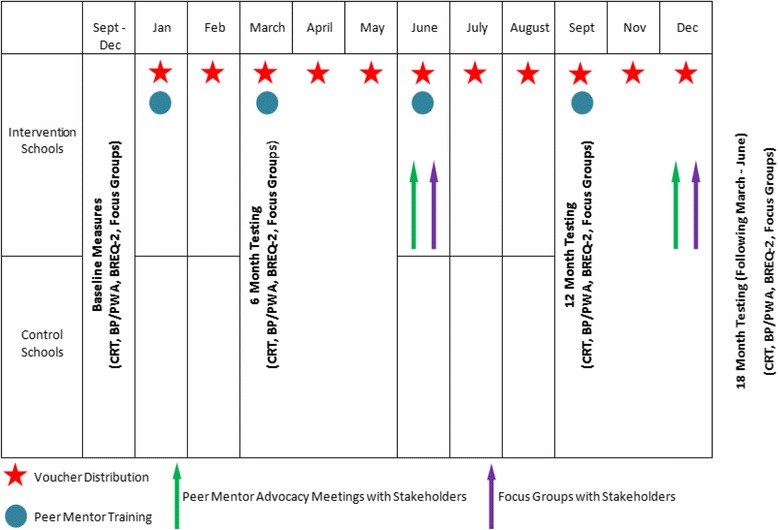
ACTIVE is a mixed methods randomised control trial in 7 secondary schools in Swansea, South Wales. Quantitative and qualitative measures including PA (cooper run test (CRT), accelerometery over 7 days), cardiovascular (CV) measures (blood pressure, pulse wave analysis) and focus groups will be undertaken at 4 separate time points (baseline, 6 months,12 months and follow-up at 18 months). Intervention schools will receive a multi-component intervention involving 12 months of £20 vouchers to spend on physical activities of their choice, a peer mentor scheme and opportunities to attend advocacy meetings. Control schools are encouraged to continue usual practice. The primary aim is to examine the effect of the intervention in improving cardiovascular fitness.
This paper describes the protocol for the ACTIVE randomised control trial, which aims to increase fitness, physical activity and socialisation of teenagers in Swansea, UK via a voucher scheme combined with peer mentoring. Results can contribute to the evidence base on teenage physical activity and, if effective, the intervention has the potential to inform future physical activity interventions and policy.
ISRCTN75594310 (Assigned 06/03/2017).
尽管体育活动对健康有益,但许多青少年的运动量仍不足。有充分证据表明,缺乏运动和身体素质差会增加患冠心病、2型糖尿病以及乳腺癌和结肠癌等非传染性疾病的风险(Lee等人,《柳叶刀》380:219 - 29,2012年)。青少年面临的一个主要障碍是可及性问题(例如费用和当地设施匮乏)。“积极行动”(ACTIVE)项目旨在通过多方面干预来克服这一障碍,为青少年提供代金券用于他们选择的活动,并赋予年轻人提高身体素质和体育活动水平的能力。
“积极行动”是在南威尔士斯旺西的7所中学进行的一项混合方法随机对照试验。将在4个不同时间点(基线、6个月、12个月和18个月随访)进行包括体育活动(库珀跑步测试(CRT)、7天加速度计测量)、心血管(CV)指标(血压、脉搏波分析)和焦点小组在内的定量和定性测量。干预学校将接受一项多成分干预,包括为期12个月、每月20英镑的代金券,可用于他们选择的体育活动、一个同伴指导计划以及参加宣传会议的机会。鼓励对照学校继续照常开展活动。主要目的是研究该干预对改善心血管健康的效果。
本文描述了“积极行动”随机对照试验的方案,该试验旨在通过代金券计划和同伴指导来提高英国斯旺西青少年的身体素质、体育活动水平和社交能力。研究结果可为青少年体育活动的证据库做出贡献,如果有效,该干预措施有可能为未来的体育活动干预和政策提供参考。
ISRCTN75594310(2017年3月6日分配)。