Department of Pediatric Endocrinology, VU University Medical Center, Postbus 7057, 1007 MB Amsterdam, The Netherlands.
Biol Sex Differ. 2017 Jul 11;8(1):23. doi: 10.1186/s13293-017-0144-8.
In adults, hypothalamus-pituitary-adrenal (HPA) axis activity shows sexual dimorphism, and this is thought to be a mechanism underlying sex-specific disease incidence. Evidence is scarce on whether these sex differences are also present in childhood. In a meta-analysis, we recently found that basal (non-stimulated) cortisol in saliva and free cortisol in 24-h urine follow sex-specific patterns. We explored whether these findings could be extended with sex differences in HPA axis reactivity.
From inception to January 2016, PubMed and EMBASE.com were searched for studies that assessed HPA axis reactivity in healthy girls and boys aged ≤18 years. Articles were systematically assessed and reported in the categories: (1) diurnal rhythm, (2) cortisol awakening response (CAR), (3) protocolled social stress tests similar or equal to the Trier Social Stress Test for children (TSST-C), (4) pharmacological (ACTH and CRH) stress tests, and (5) miscellaneous stress tests.
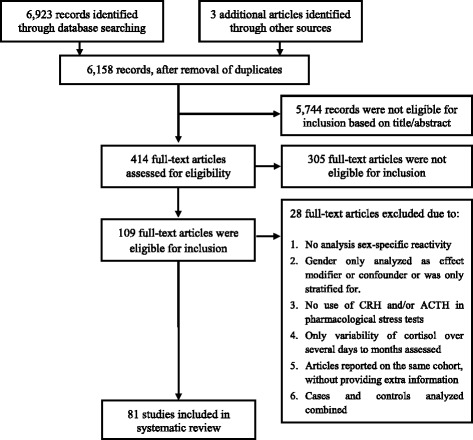
Two independent assessors selected 109 out of 6158 records for full-text screening, of which 81 studies (with a total of 14,591 subjects) were included. Studies showed that girls had a tendency towards a more variable diurnal rhythm (12 out of 29 studies), a higher CAR (8 out of 18 studies), and a stronger cortisol response to social stress tests (9 out of 21 studies). We found no evidence for sex differences in cortisol response after a pharmacological challenge or to miscellaneous stress tests.
Sex differences in HPA axis reactivity appear to be present in childhood, although evidence is not unequivocal. For a better evaluation of sex differences in HPA axis reactivity, standardization of protocols and reports of stress tests is warranted.
在成年人中,下丘脑-垂体-肾上腺(HPA)轴的活动存在性别二态性,这被认为是导致特定性别疾病发病率差异的机制。关于儿童时期是否也存在这些性别差异的证据很少。在一项荟萃分析中,我们最近发现唾液中的基础(非刺激)皮质醇和 24 小时尿液中的游离皮质醇均呈现出性别特异性模式。我们探讨了这些发现是否可以通过 HPA 轴反应性的性别差异来扩展。
从成立到 2016 年 1 月,我们在 PubMed 和 EMBASE.com 上搜索了评估年龄≤18 岁健康女孩和男孩 HPA 轴反应性的研究。文章按照以下类别进行系统评估和报告:(1)昼夜节律,(2)皮质醇觉醒反应(CAR),(3)与儿童特里尔社会应激测试(TSST-C)相似或相等的方案社会应激测试,(4)药理学(ACTH 和 CRH)应激测试,和(5)其他应激测试。
两名独立评估者从 6158 条记录中筛选出 109 条进行全文筛选,其中 81 项研究(共 14591 名受试者)被纳入。研究表明,女孩的昼夜节律波动较大(29 项研究中有 12 项),CAR 较高(18 项研究中有 8 项),对社会应激测试的皮质醇反应较强(21 项研究中有 9 项)。我们没有发现皮质醇对药理学挑战或其他应激测试的反应存在性别差异的证据。
儿童时期 HPA 轴反应性存在性别差异,尽管证据并不明确。为了更好地评估 HPA 轴反应性的性别差异,有必要对方案和应激测试报告进行标准化。