Department of Orthopaedic Surgery, the First Affiliated Hospital of Sun Yat-sen University, 58# Zhongshan 2rd Road, Guangzhou, 510080, China.
Guangdong Provincial Key Laboratory of Orthopedics and Traumatology, Guangdong Province, Guangzhou, 510080, China.
Mol Cancer. 2017 Jul 10;16(1):117. doi: 10.1186/s12943-017-0688-6.
The primary issue arising from prostate cancer (PCa) is its high prevalence to metastasize to bone, which severely affects the quality of life and survival time of PCa patients. miR-210-3p is a well-documented oncogenic miRNA implicated in various aspects of cancer development, progression and metastasis. However, the clinical significance and biological roles of miR-210-3p in PCa bone metastasis remain obscure.
miR-210-3p expression was evaluated by real-time PCR in 68 bone metastatic and 81 non-bone metastatic PCa tissues. The biological roles of miR-210-3p in the bone metastasis of PCa were investigated both in vitro by EMT and Transwell assays, and in vivo using a mouse model of left cardiac ventricle inoculation. Bioinformatics analysis, real-time PCR, western blot and luciferase reporter analysis were applied to discern and examine the relationship between miR-210-3p and its potential targets. RT-PCR was performed to identify the underlying mechanism of miR-210-3p overexpression in bone metastasis of PCa. Clinical correlation of miR-210-3p with its targets was examined in human PCa and metastatic bone tissues.
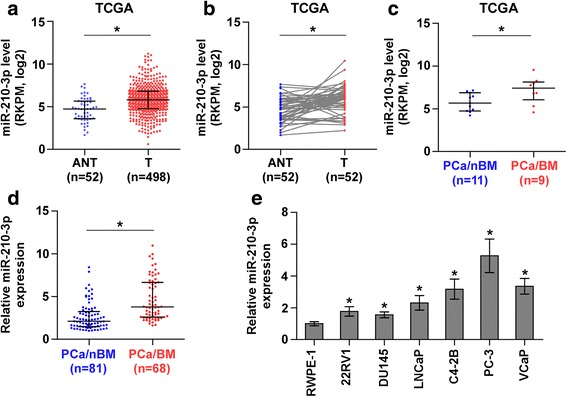
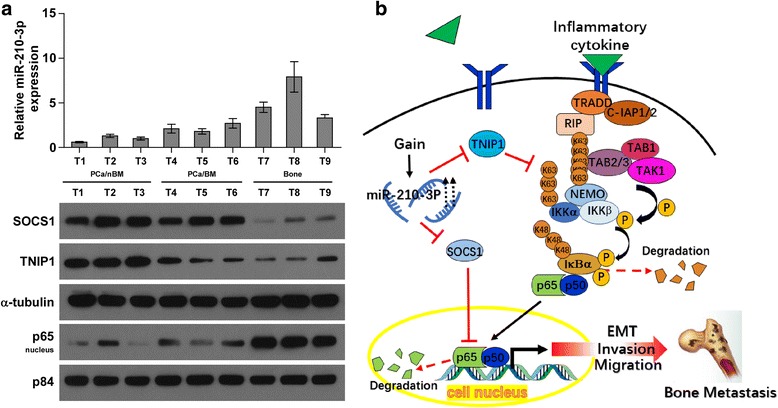
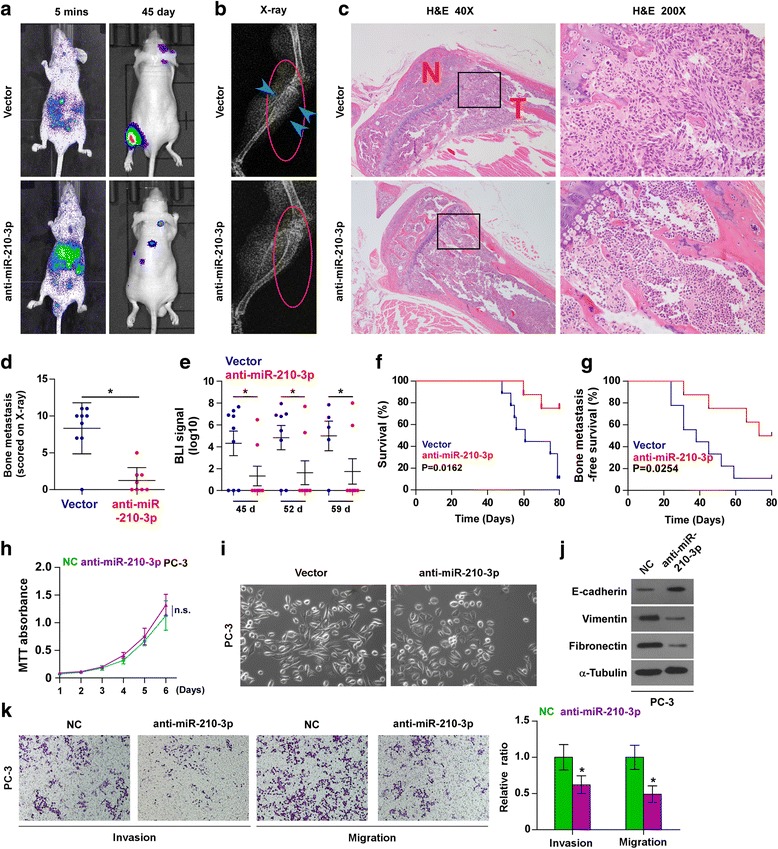
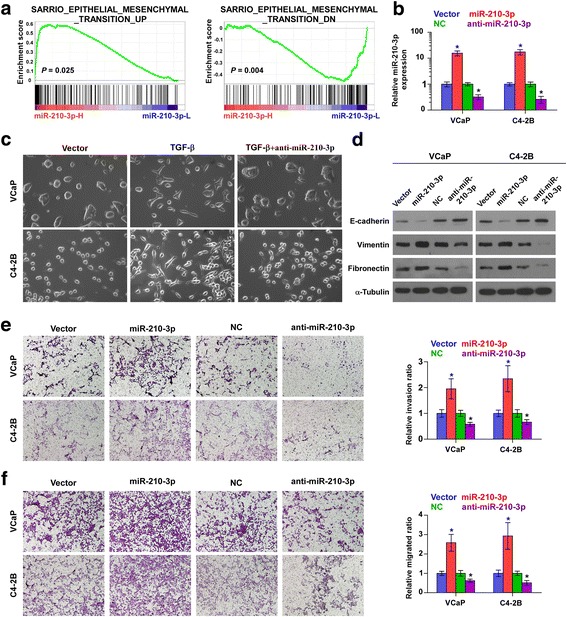
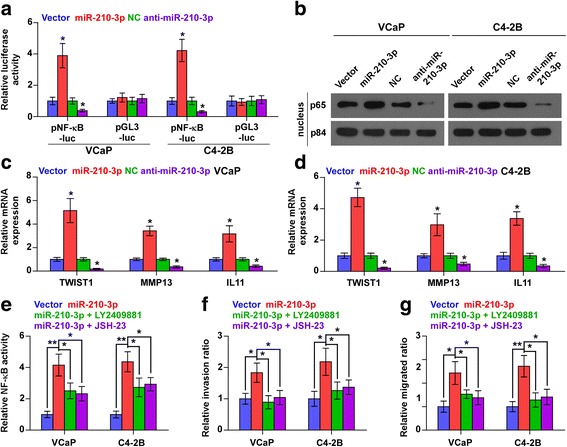
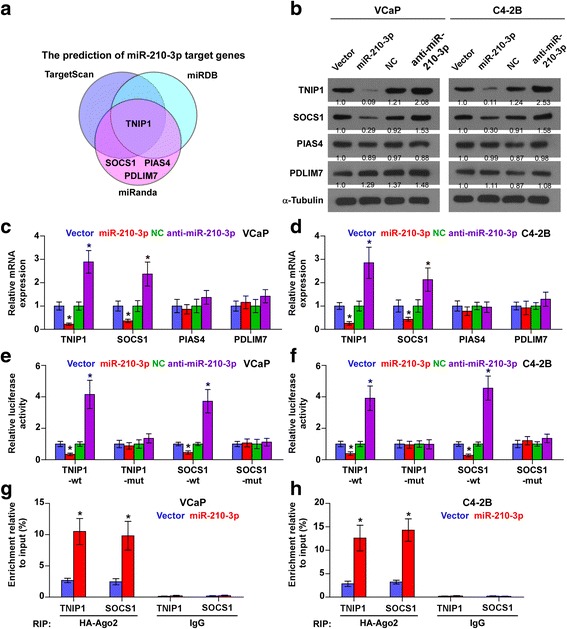
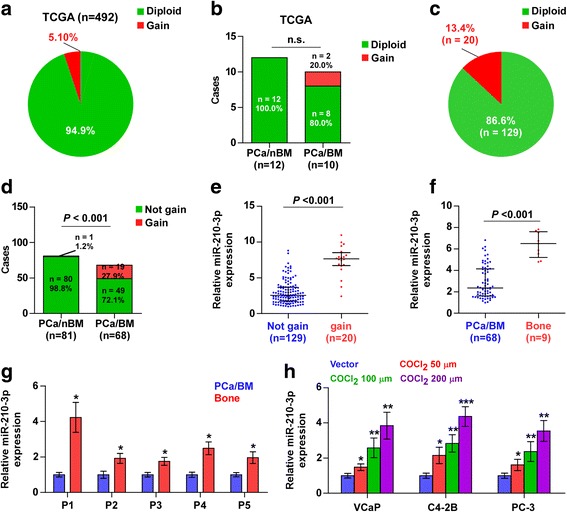
miR-210-3p expression is elevated in bone metastatic PCa tissues compared with non-bone metastatic PCa tissues. Overexpression of miR-210-3p positively correlates with serum PSA levels, Gleason grade and bone metastasis status in PCa patients. Upregulating miR-210-3p enhances, while silencing miR-210-3p represses the EMT, invasion and migration of PCa cells in vitro. Importantly, silencing miR-210-3p significantly inhibits bone metastasis of PC-3 cells in vivo. Our results further demonstrate that miR-210-3p maintains the sustained activation of NF-κB signaling via targeting negative regulators of NF-κB signaling (TNF-α Induced Protein 3 Interacting Protein 1) TNIP1 and (Suppressor Of Cytokine Signaling 1) SOCS1, resulting in EMT, invasion, migration and bone metastasis of PCa cells. Moreover, our results further indicate that recurrent gains (amplification) contribute to miR-210-3p overexpression in a small number of PCa patients. The clinical correlation of miR-210-3p with SOCS1, TNIP1 and NF-κB signaling activity is verified in PCa tissues.
Our findings unravel a novel mechanism for constitutive activation of NF-κB signaling pathway in the bone metastasis of PCa, supporting a functional and clinical significance of epigenetic events in bone metastasis of PCa.
前列腺癌(PCa)的主要问题是其转移到骨骼的高发生率,这严重影响了 PCa 患者的生活质量和生存时间。miR-210-3p 是一种被充分记录的致癌 miRNA,涉及癌症发展、进展和转移的各个方面。然而,miR-210-3p 在 PCa 骨转移中的临床意义和生物学作用仍不清楚。
通过实时 PCR 评估 68 例骨转移和 81 例非骨转移 PCa 组织中的 miR-210-3p 表达。通过 EMT 和 Transwell 测定体外研究 miR-210-3p 在 PCa 骨转移中的生物学作用,并通过左心室接种小鼠模型进行体内研究。应用生物信息学分析、实时 PCR、western blot 和荧光素酶报告分析来识别和检查 miR-210-3p 与其潜在靶标的关系。进行 RT-PCR 以确定 miR-210-3p 在 PCa 骨转移中过度表达的潜在机制。在人 PCa 和转移性骨组织中检查 miR-210-3p 与其靶标的临床相关性。
与非骨转移 PCa 组织相比,miR-210-3p 在骨转移 PCa 组织中表达升高。miR-210-3p 的过表达与 PCa 患者的血清 PSA 水平、Gleason 分级和骨转移状态呈正相关。上调 miR-210-3p 增强,而沉默 miR-210-3p 抑制 PCa 细胞的 EMT、侵袭和迁移。重要的是,沉默 miR-210-3p 显著抑制 PC-3 细胞在体内的骨转移。我们的结果进一步表明,miR-210-3p 通过靶向 NF-κB 信号的负调节剂(TNF-α 诱导蛋白 3 相互作用蛋白 1)TNIP1 和(细胞因子信号转导抑制因子 1)SOCS1 来维持 NF-κB 信号的持续激活,从而导致 PCa 细胞的 EMT、侵袭、迁移和骨转移。此外,我们的结果进一步表明,在少数 PCa 患者中,复发性增益(扩增)导致 miR-210-3p 的过表达。在 PCa 组织中验证了 miR-210-3p 与 SOCS1、TNIP1 和 NF-κB 信号活性的临床相关性。
我们的研究结果揭示了 NF-κB 信号通路在 PCa 骨转移中持续激活的新机制,支持了表观遗传事件在 PCa 骨转移中的功能和临床意义。