Lind Liza, Studahl Marie, Persson Berg Linn, Eriksson Kristina
Department of Rheumatology and Inflammation Research, Sahlgrenska Academy, University of Gothenburg, Gothenburg, Sweden.
Department of Infectious Diseases, Sahlgrenska Academy, University of Gothenburg, Gothenburg, Sweden.
J Neuroinflammation. 2017 Jul 10;14(1):134. doi: 10.1186/s12974-017-0907-5.
The closely related herpes simplex viruses 1 and 2 can cause inflammations of the central nervous system (CNS), where type 1 most often manifest as encephalitis (HSE), and type 2 as meningitis (HSM). HSE is associated with severe neurological complications, while HSM is benign in adults. We proposed that studying the chemokine and cytokine production in cerebrospinal fluid (CSF) and serum could indicate why two closely related viruses exhibit different severity of their accompanied CNS inflammation.
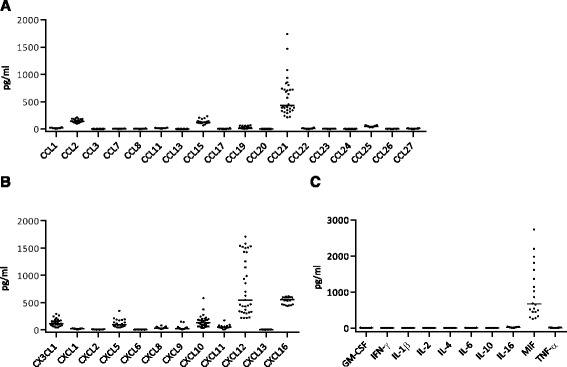
Secretion patterns of 30 chemokines and 10 cytokines in CSF of adult patients with acute HSE (n = 14) and HSM (n = 20) in the initial stage of disease were analyzed and compared to control subjects without viral central nervous system infections and to levels in serum.
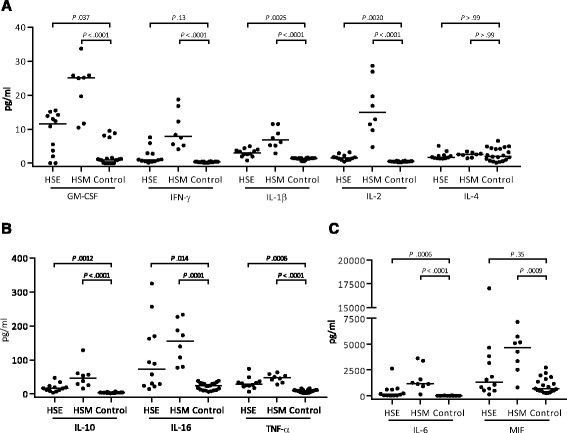
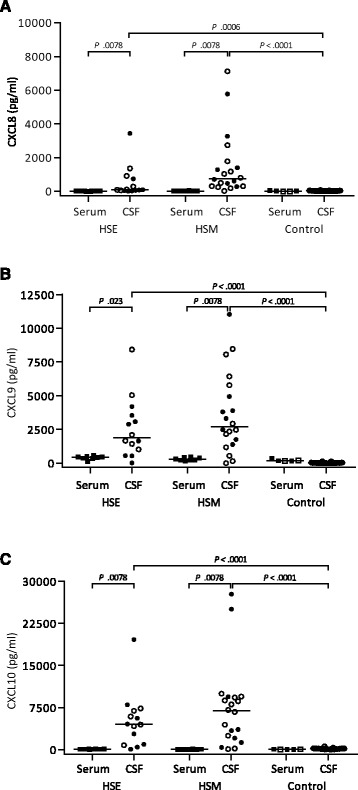
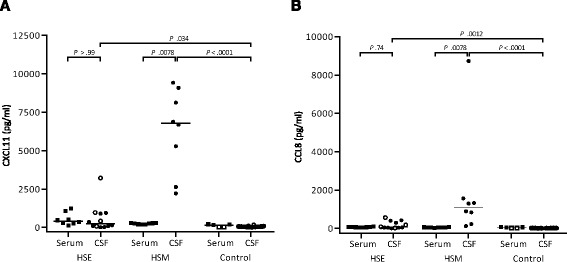
Most measured chemokines and cytokines increased in CSF of HSE and HSM patients. Overall, the CSF chemokine levels were higher in CSF of HSM patients compared to HSE patients. However, only five chemokines reached levels in the CSF that exceeded those in serum facilitating a positive CSF-serum chemokine gradient. Of these, CXCL8, CXCL9, and CXCL10 were present at high levels both in HSE and HSM whereas CXCL11 and CCL8 were present in HSM alone. Several chemokines were also elevated in serum of HSE patients but only one in HSM patients. No chemokine in- or efflux between CSF and serum was indicated as the levels of chemokines in CSF and serum did not correlate.
We show that HSM is associated with a stronger and more diverse inflammatory response in the CNS compared to HSE in the initial stage of disease. The chemokine patterns were distinguished by the exclusive local CNS production of CXCL11 and CCL8 in HSM. Inflammation in HSM appears to be restricted to the CNS whereas HSE also was associated with systemic inflammation.
密切相关的单纯疱疹病毒1型和2型可引起中枢神经系统(CNS)炎症,其中1型最常表现为脑炎(HSE),2型表现为脑膜炎(HSM)。HSE与严重的神经并发症相关,而HSM在成人中是良性的。我们提出,研究脑脊液(CSF)和血清中趋化因子和细胞因子的产生可以表明为什么两种密切相关的病毒在伴随的CNS炎症中表现出不同的严重程度。
分析了成年急性HSE患者(n = 14)和HSM患者(n = 20)疾病初期脑脊液中30种趋化因子和10种细胞因子的分泌模式,并与无病毒性中枢神经系统感染的对照受试者以及血清水平进行比较。
大多数检测的趋化因子和细胞因子在HSE和HSM患者的脑脊液中增加。总体而言,与HSE患者相比,HSM患者脑脊液中的趋化因子水平更高。然而,只有五种趋化因子在脑脊液中的水平超过了血清中的水平,形成了正向的脑脊液-血清趋化因子梯度。其中,CXCL8、CXCL9和CXCL10在HSE和HSM中均高水平存在,而CXCL11和CCL8仅在HSM中存在。几种趋化因子在HSE患者的血清中也升高,但在HSM患者中只有一种升高。由于脑脊液和血清中趋化因子的水平不相关,因此未表明脑脊液和血清之间有趋化因子的流入或流出。
我们表明,在疾病初期,与HSE相比,HSM与中枢神经系统中更强、更多样化的炎症反应相关。趋化因子模式的特点是HSM中CXCL11和CCL8仅在中枢神经系统局部产生。HSM中的炎症似乎仅限于中枢神经系统,而HSE也与全身炎症相关。