Laboratory of Molecular Neuropharmacology and Bioinformatics, Institut de Neurociències and Unitat de Bioestadística, Universitat Autònoma de Barcelona, 08193, Bellaterra, Spain.
Network Biomedical Research Centre on Mental Health (CIBERSAM), Madrid, Spain.
Sci Rep. 2017 Jul 10;7(1):4944. doi: 10.1038/s41598-017-05095-5.
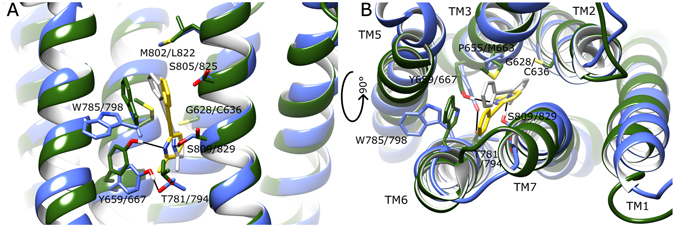
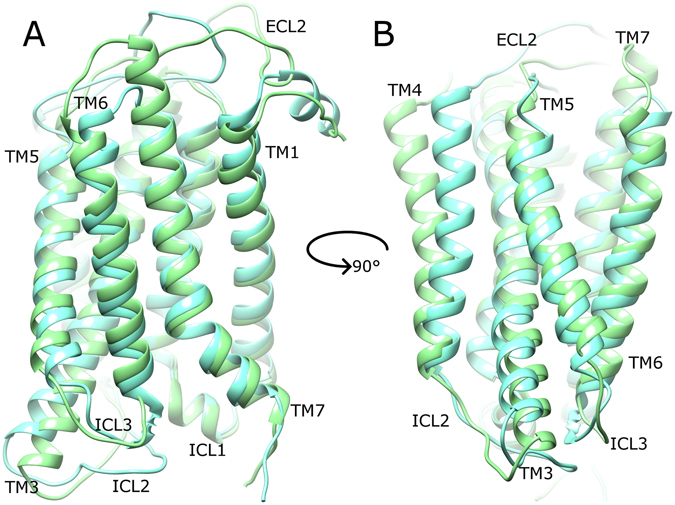
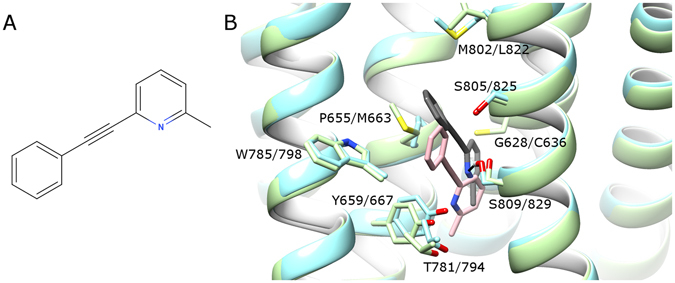
As class C GPCRs and regulators of synaptic activity, human metabotropic glutamate receptors (mGluRs) 4 and 5 are prime targets for allosteric modulation, with mGlu5 inhibition or mGlu4 stimulation potentially treating conditions like chronic pain and Parkinson's disease. As an allosteric modulator that can bind both receptors, 2-Methyl-6-(phenylethynyl)pyridine (MPEP) is able to negatively modulate mGlu5 or positively modulate mGlu4. At a structural level, how it elicits these responses and how mGluRs undergo activation is unclear. Here, we employ homology modelling and 30 µs of atomistic molecular dynamics (MD) simulations to probe allosteric conformational change in mGlu4 and mGlu5, with and without docked MPEP. Our results identify several structural differences between mGlu4 and mGlu5, as well as key differences responsible for MPEP-mediated positive and negative allosteric modulation, respectively. A novel mechanism of mGlu4 activation is revealed, which may apply to all mGluRs in general. This involves conformational changes in TM3, TM4 and TM5, separation of intracellular loop 2 (ICL2) from ICL1/ICL3, and destabilization of the ionic-lock. On the other hand, mGlu5 experiences little disturbance when MPEP binds, maintaining its inactive state with reduced conformational fluctuation. In addition, when MPEP is absent, a lipid molecule can enter the mGlu5 allosteric pocket.
作为 C 类 G 蛋白偶联受体和突触活动的调节剂,人类代谢型谷氨酸受体(mGluRs)4 和 5 是变构调节的主要靶点,mGlu5 抑制或 mGlu4 刺激可能治疗慢性疼痛和帕金森病等疾病。作为一种能够结合两种受体的变构调节剂,2-甲基-6-(苯乙炔基)吡啶(MPEP)能够负向调节 mGlu5 或正向调节 mGlu4。在结构水平上,它如何引发这些反应以及 mGluRs 如何被激活尚不清楚。在这里,我们采用同源建模和 30µs 的原子分子动力学(MD)模拟来探测 mGlu4 和 mGlu5 中的变构构象变化,包括和不包括对接的 MPEP。我们的结果确定了 mGlu4 和 mGlu5 之间的几个结构差异,以及分别负责 MPEP 介导的正变构和负变构调节的关键差异。揭示了 mGlu4 激活的新机制,该机制可能适用于所有 mGluRs 一般情况。这涉及 TM3、TM4 和 TM5 的构象变化、细胞内环 2(ICL2)与 ICL1/ICL3 的分离以及离子锁的失稳。另一方面,当 MPEP 结合时,mGlu5 几乎没有受到干扰,保持其失活状态,构象波动减小。此外,当 MPEP 不存在时,一个脂质分子可以进入 mGlu5 的变构口袋。