Griffiths Emma, Dooley Damion, Graham Morag, Van Domselaar Gary, Brinkman Fiona S L, Hsiao William W L
Department of Molecular Biology and Biochemistry, Simon Fraser University, VancouverBC, Canada.
Department of Pathology and Laboratory Medicine, University of British Columbia, VancouverBC, Canada.
Front Microbiol. 2017 Jun 26;8:1068. doi: 10.3389/fmicb.2017.01068. eCollection 2017.
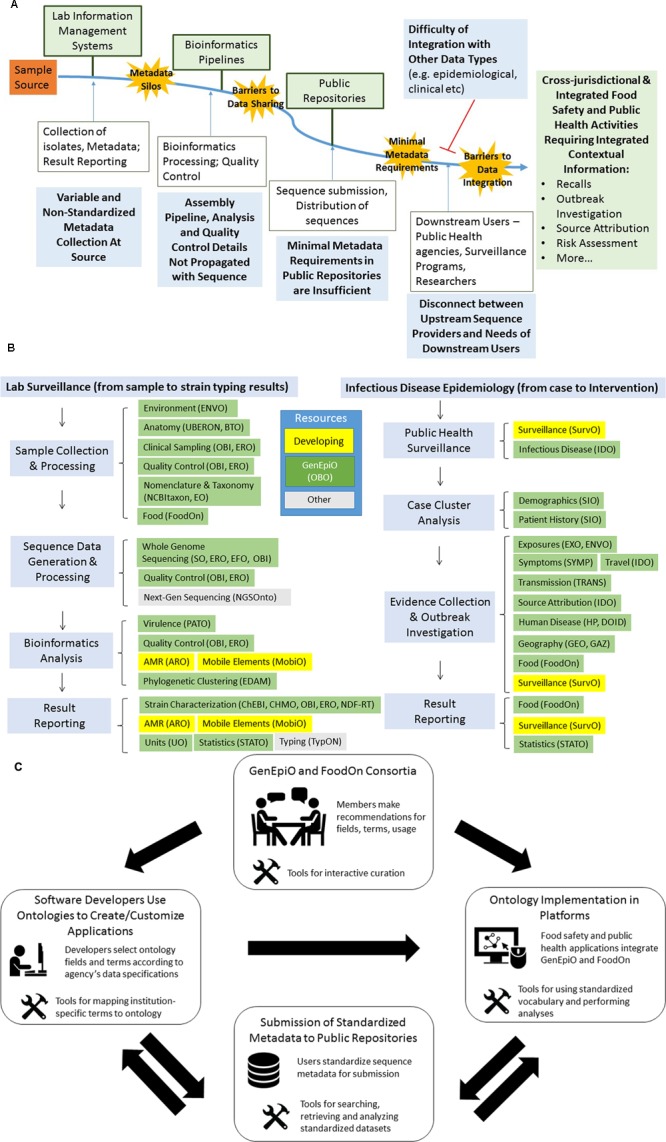
Globalization of food networks increases opportunities for the spread of foodborne pathogens beyond borders and jurisdictions. High resolution whole-genome sequencing (WGS) subtyping of pathogens promises to vastly improve our ability to track and control foodborne disease, but to do so it must be combined with epidemiological, clinical, laboratory and other health care data (called "contextual data") to be meaningfully interpreted for regulatory and health interventions, outbreak investigation, and risk assessment. However, current multi-jurisdictional pathogen surveillance and investigation efforts are complicated by time-consuming data re-entry, curation and integration of contextual information owing to a lack of interoperable standards and inconsistent reporting. A solution to these challenges is the use of 'ontologies' - hierarchies of well-defined and standardized vocabularies interconnected by logical relationships. Terms are specified by universal IDs enabling integration into highly regulated areas and multi-sector sharing (e.g., food and water microbiology with the veterinary sector). Institution-specific terms can be mapped to a given standard at different levels of granularity, maximizing comparability of contextual information according to jurisdictional policies. Fit-for-purpose ontologies provide contextual information with the auditability required for food safety laboratory accreditation. Our research efforts include the development of a Genomic Epidemiology Ontology (GenEpiO), and Food Ontology (FoodOn) that harmonize important laboratory, clinical and epidemiological data fields, as well as existing food resources. These efforts are supported by a global consortium of researchers and stakeholders worldwide. Since foodborne diseases do not respect international borders, uptake of such vocabularies will be crucial for multi-jurisdictional interpretation of WGS results and data sharing.
食品网络的全球化增加了食源性病原体跨越国界和管辖区域传播的机会。对病原体进行高分辨率全基因组测序(WGS)亚型分析有望极大地提高我们追踪和控制食源性疾病的能力,但要做到这一点,必须将其与流行病学、临床、实验室及其他医疗数据(称为“背景数据”)相结合,以便为监管和健康干预、疫情调查及风险评估进行有意义的解读。然而,由于缺乏可互操作的标准和不一致的报告,当前多辖区病原体监测和调查工作因背景信息的数据重新录入、整理和整合耗时而变得复杂。应对这些挑战的一个解决方案是使用“本体”——通过逻辑关系相互连接的定义明确且标准化的词汇层次结构。术语由通用ID指定,能够整合到高度规范的领域并实现多部门共享(例如,食品和水微生物学与兽医部门)。特定机构的术语可以在不同粒度级别映射到给定标准,根据管辖政策最大限度地提高背景信息的可比性。适用的本体为食品安全实验室认可所需的背景信息提供了可审计性。我们的研究工作包括开发基因组流行病学本体(GenEpiO)和食品本体(FoodOn),以协调重要的实验室、临床和流行病学数据领域以及现有食品资源。这些努力得到了全球研究人员和利益相关者联盟的支持。由于食源性疾病不受国界限制,采用此类词汇对于多辖区解读WGS结果及数据共享至关重要。