Lucas Patricia Jane, Patterson Emma, Sacks Gary, Billich Natassja, Evans Charlotte Elizabeth Louise
School for Policy Studies, University of Bristol, Bristol BS8 1TZ, UK.
Department of Public Health Sciences, Karolinska Institutet, SE-171 77 Stockholm, Sweden.
Nutrients. 2017 Jul 11;9(7):736. doi: 10.3390/nu9070736.
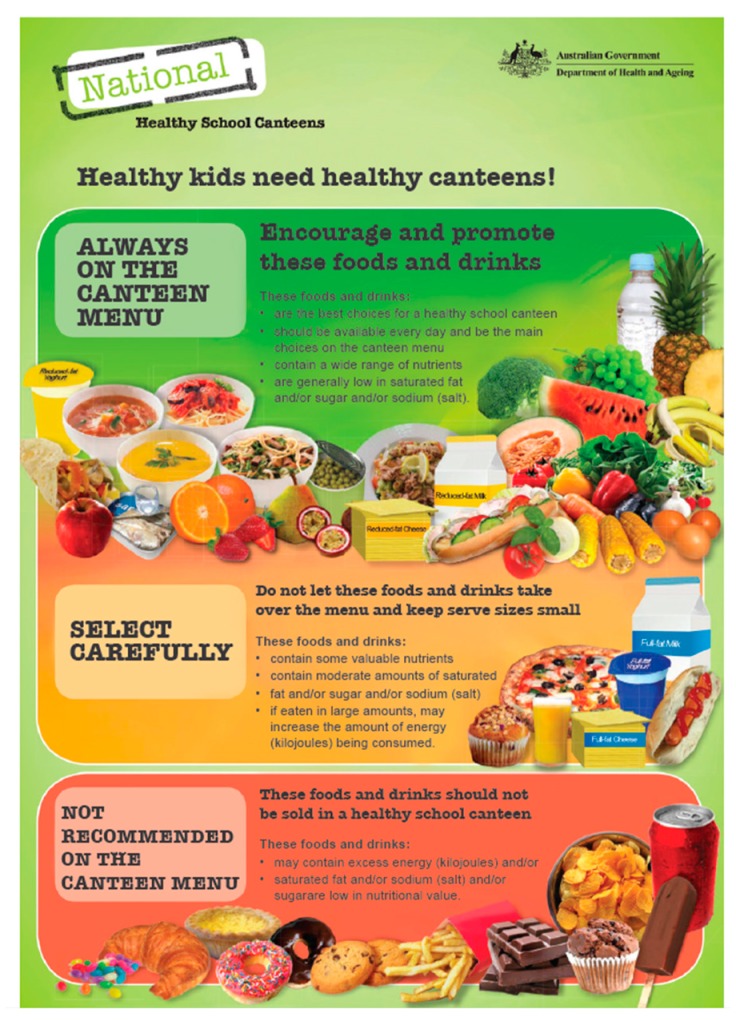
School meals make significant contributions to healthy dietary behaviour, at a time when eating habits and food preferences are being formed. We provide an overview of the approaches to the provision, regulation, and improvement of preschool and primary school meals in the UK, Sweden, and Australia, three countries which vary in their degree of centralisation and regulation of school meals. Sweden has a centralised approach; all children receive free meals, and a pedagogical approach to meals is encouraged. Legislation demands that meals are nutritious. The UK system is varied and decentralised. Meals in most primary schools are regulated by food-based standards, but preschool-specific meal standards only exist in Scotland. The UK uses food groups (starchy foods, fruit and vegetables, proteins and dairy) in a healthy plate approach. Australian States and Territories all employ guidelines for school canteen food, predominantly using a "traffic light" approach outlining recommended and discouraged foods; however, most children bring food from home and are not covered by this guidance. The preschool standards state that food provided should be nutritious. We find that action is often lacking in the preschool years, and suggest that consistent policies, strong incentives for compliance, systematic monitoring, and an acknowledgement of the broader school eating environment (including home provided food) would be beneficial.
在饮食习惯和食物偏好正在形成的时期,学校膳食对健康的饮食行为做出了重大贡献。我们概述了英国、瑞典和澳大利亚在提供、监管和改善学前和小学膳食方面的方法,这三个国家在学校膳食的集中化程度和监管方面存在差异。瑞典采用集中化方式;所有儿童都可获得免费膳食,并且鼓励采用膳食教学法。立法要求膳食营养丰富。英国的体系多样且分散。大多数小学的膳食由基于食物的标准进行监管,但特定于学前教育的膳食标准仅在苏格兰存在。英国在健康餐盘方法中使用食物类别(淀粉类食物、水果和蔬菜、蛋白质和乳制品)。澳大利亚各州和领地都采用学校食堂食物指南,主要使用“红绿灯”方法来列出推荐和不推荐的食物;然而,大多数儿童从家里带食物,不受此指南覆盖。学前教育标准规定提供的食物应营养丰富。我们发现学前教育阶段往往缺乏行动,并建议制定一致的政策、对遵守规定的有力激励、系统监测以及承认更广泛的学校饮食环境(包括家庭提供的食物)将是有益的。