Mallhi Tauqeer Hussain, Khan Amer Hayat, Sarriff Azmi, Adnan Azreen Syazril, Khan Yusra Habib
Discipline of Clinical Pharmacy, School of Pharmaceutical Sciences, Universiti Sains Malaysia, Penang, Malaysia.
Chronic Kidney Disease Resource Centre, School of Medical Sciences, Health Campus, Universiti Sains Malaysia, Kelantan, Malaysia.
BMJ Open. 2017 Jul 10;7(7):e016805. doi: 10.1136/bmjopen-2017-016805.
Dengue imposes substantial economic, societal and personal burden in terms of hospital stay, morbidity and mortality. Early identification of dengue cases with high propensity of increased hospital stay and death could be of value in isolating patients in need of early interventions. The current study was aimed to determine the significant factors associated with dengue-related prolonged hospitalisation and death.
Cross-sectional retrospective study.
Tertiary care teaching hospital.
Patients with confirmed dengue diagnosis were stratified into two categories on the basis of prolonged hospitalisation (≤3 days and >3 days) and mortality (fatal cases and non-fatal cases). Clinico-laboratory characteristics between these categories were compared by using appropriate statistical methods.
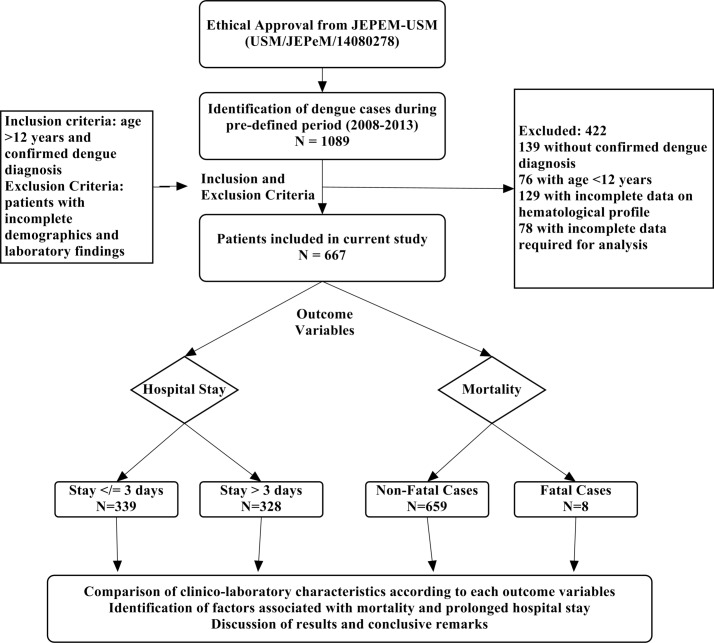
Of 667 patients enrolled, 328 (49.2%) had prolonged hospitalisation. The mean hospital stay was 4.88±2.74 days. Multivariate analysis showed that dengue haemorrhagic fever (OR 2.3), elevated alkaline phosphatase (ALP) (OR 2.3), prolonged prothrombin time (PT) (OR 1.7), activated partial thromboplastin time (aPTT) (OR 1.9) and multiple-organ dysfunctions (OR 2.1) were independently associated with prolonged hospitalisation. Overall case fatality rate was 1.1%. Factors associated with dengue mortality were age >40 years (p=0.004), secondary infection (p=0.040), comorbidities (p<0.05), acute kidney injury (p<0.001), prolonged PT (p=0.022), multiple-organ dysfunctions (p<0.001), haematocrit >20% (p=0.001), rhabdomyolosis (p<0.001) and respiratory failure (p=0.007). Approximately half of the fatal cases in our study had prolonged hospital stay of greater than three days.
The results underscore the high proportion of dengue patients with prolonged hospital stay. Early identification of factors relating to prolonged hospitalisation and death will have obvious advantages in terms of appropriate decisions about treatment and management in high dependency units.
登革热在住院时间、发病率和死亡率方面给经济、社会和个人带来了沉重负担。早期识别出住院时间延长和死亡风险高的登革热病例,对于隔离需要早期干预的患者可能具有重要价值。本研究旨在确定与登革热相关的长期住院和死亡的显著相关因素。
横断面回顾性研究。
三级护理教学医院。
确诊为登革热的患者根据住院时间延长(≤3天和>3天)和死亡率(死亡病例和非死亡病例)分为两类。通过使用适当的统计方法比较这些类别之间的临床实验室特征。
在纳入的667例患者中,328例(49.2%)住院时间延长。平均住院时间为4.88±2.74天。多因素分析显示,登革出血热(比值比2.3)、碱性磷酸酶(ALP)升高(比值比2.3)、凝血酶原时间(PT)延长(比值比1.7)、活化部分凝血活酶时间(aPTT)(比值比1.9)和多器官功能障碍(比值比2.1)与住院时间延长独立相关。总体病死率为1.1%。与登革热死亡相关的因素包括年龄>40岁(p=0.004)、二次感染(p=0.040)、合并症(p<0.05)、急性肾损伤(p<0.001)、PT延长(p=0.022)、多器官功能障碍(p<0.001)、血细胞比容>20%(p=0.001)、横纹肌溶解(p<0.001)和呼吸衰竭(p=0.007)。在我们的研究中,约一半的死亡病例住院时间延长超过三天。
结果强调了住院时间延长的登革热患者比例较高。早期识别与住院时间延长和死亡相关的因素,对于在高依赖病房做出适当的治疗和管理决策具有明显优势。