Mansouri Parisa, Ghadami Maryam, Najafi Seid Saeed, Yektatalab Shahrzad
Department of Medical Surgical Nursing, School of Nursing and Midwifery, Shiraz University of Medical Sciences, Shiraz, Iran.
Community Based Psychiatric Care Research Center, Department of Community Health Nursing, School of Nursing and.
Int J Community Based Nurs Midwifery. 2017 Jul;5(3):256-263.
Cirrhosis is a chronic and progressive disease that causes various complications for patients due to disturbance of the liver's usual function. Self-efficacy refers to an individual's belief in one's ability to perform the necessary behaviors to achieve one's goals. Self-management is also an important criterion for long-term change in behavior. The present study aimed to investigate the effect of self-management training on self-efficacy of patients suffering from liver cirrhosis.
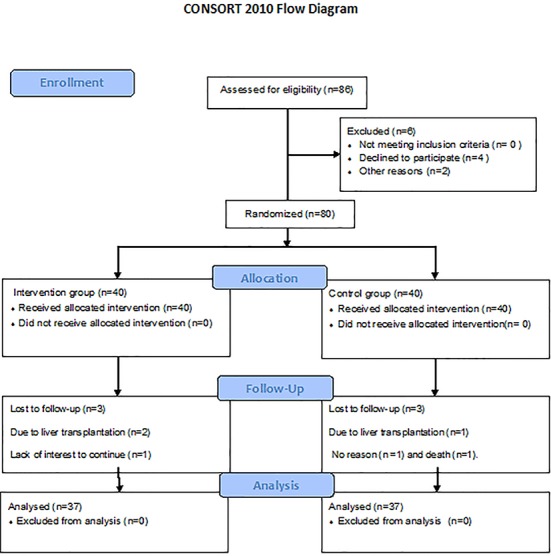
This randomized controlled clinical trial was conducted on 74 patients with liver cirrhosis randomly assigned to an intervention (receiving self-management training) and a control group (routine care) from 2012 to 2013. The data were collected in the transplantation center affiliated to Shiraz University of Medical Sciences. Self-management training was performed in six 90-minute sessions twice a week. Besides, the intervention group was followed up for a month via telephone. Levo self-efficacy questionnaire was filled out by the patients before, immediately after, and one month after the intervention. Then, the data were entered into the SPSS statistical software (v. 16) and analyzed using independent t-test, Chi-square test, and repeated measures ANOVA.
At the beginning of the study, no statistically significant difference was found between the two groups regarding self-efficacy (P=0.18). However, the total score of the questionnaire and those of all its dimensions significantly improved in the intervention group immediately and one month after training self-management skills (P<0.001). The mean score of self-efficacy was 102.24±7.79 and 76.78±9.49 in the intervention and control groups, respectively. On the other hand, no statistically significant difference was observed in the control group's self-efficacy immediately and one month after the intervention (P=0.6).
The results showed that the self-management program resulted in improvement of self-efficacy in the patients with liver cirrhosis. Therefore, this supportive strategy could be useful in patients with chronic illnesses for improvement of care and prevention of complications.
肝硬化是一种慢性进行性疾病,由于肝脏正常功能紊乱,会给患者带来各种并发症。自我效能感是指个体相信自己有能力采取必要行为以实现目标。自我管理也是行为长期改变的一项重要标准。本研究旨在调查自我管理训练对肝硬化患者自我效能感的影响。
本随机对照临床试验于2012年至2013年对74例肝硬化患者进行,这些患者被随机分为干预组(接受自我管理训练)和对照组(常规护理)。数据在设拉子医科大学附属移植中心收集。自我管理训练每周进行两次,每次90分钟,共进行六个疗程。此外,对干预组通过电话随访一个月。患者在干预前、干预后立即以及干预后一个月填写左旋自我效能感问卷。然后,将数据录入SPSS统计软件(版本16),并使用独立t检验、卡方检验和重复测量方差分析进行分析。
研究开始时,两组在自我效能感方面无统计学显著差异(P = 0.18)。然而,干预组在训练自我管理技能后立即和一个月时,问卷总分及其所有维度的得分均显著提高(P < 0.001)。干预组和对照组的自我效能感平均得分分别为102.24±7.79和76.78±9.49。另一方面,干预后立即和一个月时,对照组的自我效能感无统计学显著差异(P = 0.6)。
结果表明,自我管理项目可提高肝硬化患者的自我效能感。因此,这种支持性策略可能对慢性病患者改善护理和预防并发症有用。