
利用卫星衍生环境数据对尼日利亚翁多州阿库雷北区血吸虫病传播风险进行建模。
Modeling the risk of transmission of schistosomiasis in Akure North Local Government Area of Ondo State, Nigeria using satellite derived environmental data.
作者信息
Ajakaye Oluwaremilekun G, Adedeji Oluwatola I, Ajayi Paul O
机构信息
Department of Crop, Soil & Pest Management, Rufus Giwa Polytechnic, Owo, Ondo State, Nigeria.
Department of Strategic Space Applications, National Space Research and Development Agency (NASRDA), Abuja, Nigeria.
出版信息
PLoS Negl Trop Dis. 2017 Jul 12;11(7):e0005733. doi: 10.1371/journal.pntd.0005733. eCollection 2017 Jul.
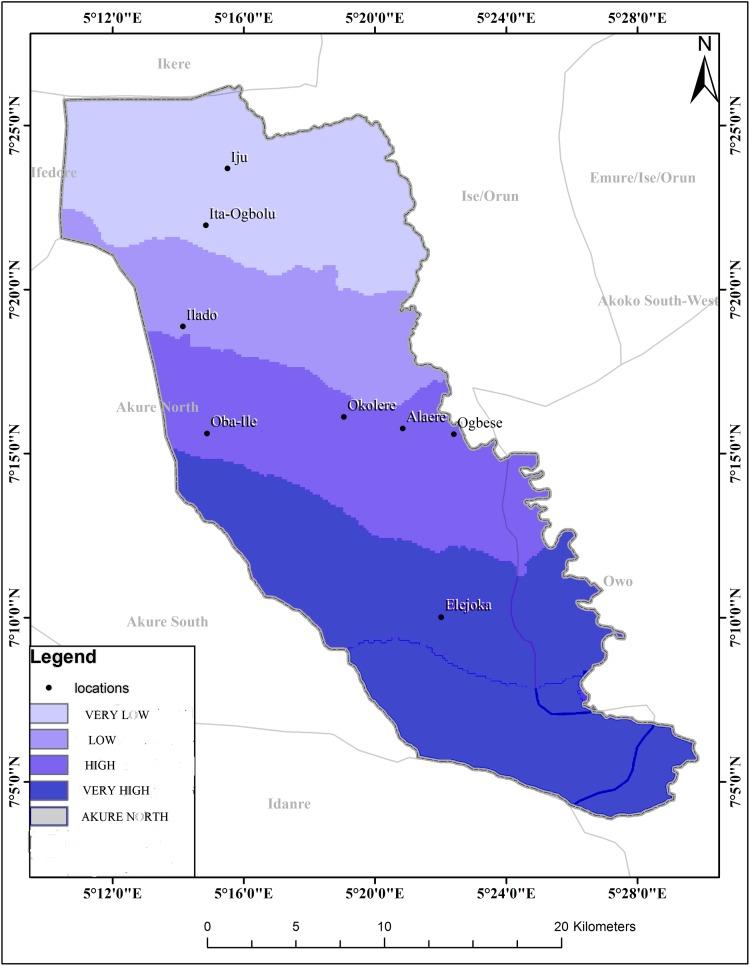
Schistosomiasis is a parasitic disease and its distribution, in space and time, can be influenced by environmental factors such as rivers, elevation, slope, land surface temperature, land use/cover and rainfall. The aim of this study is to identify the areas with suitable conditions for schistosomiasis transmission on the basis of physical and environmental factors derived from satellite imagery and spatial analysis for Akure North Local Government Area (LGA) of Ondo State. Nigeria. This was done through methodology multicriteria evaluation (MCE) using Saaty's analytical hierarchy process (AHP). AHP is a multi-criteria decision method that uses hierarchical structures to represent a problem and makes decisions based on priority scales. In this research AHP was used to obtain the mapping weight or importance of each individual schistosomiasis risk factor. For the purpose of identifying areas of schistosomiasis risk, this study focused on temperature, drainage, elevation, rainfall, slope and land use/land cover as the factors controlling schistosomiasis incidence in the study area. It is by reclassifying and overlaying these factors that areas vulnerable to schistosomiasis were identified. The weighted overlay analysis was done after each factor was given the appropriate weight derived through the analytical hierarchical process. The prevalence of urinary schistosomiasis in the study area was also determined by parasitological analysis of urine samples collected through random sampling. The results showed varying risk of schistosomiasis with a larger portion of the area (82%) falling under the high and very high risk category. The study also showed that one community (Oba Ile) had the lowest risk of schistosomiasis while the risk increased in the four remaining communities (Iju, Igoba, Ita Ogbolu and Ogbese). The predictions made by the model correlated strongly with observations from field study. The high risk zones corresponded to known endemic communities. This study revealed that environmental factors can be used in identifying and predicting the transmission of schistosomiasis as well as effective monitoring of disease risk in newly established rural and agricultural communities.
血吸虫病是一种寄生虫病,其在空间和时间上的分布会受到河流、海拔、坡度、地表温度、土地利用/覆盖以及降雨等环境因素的影响。本研究的目的是基于从卫星图像中获取的物理和环境因素以及空间分析,确定尼日利亚翁多州阿库雷北地方政府辖区适合血吸虫病传播的区域。这是通过使用萨蒂层次分析法(AHP)的多标准评价(MCE)方法来完成的。层次分析法是一种多标准决策方法,它使用层次结构来表示问题,并根据优先级量表做出决策。在本研究中,层次分析法用于获取每个血吸虫病风险因素的制图权重或重要性。为了确定血吸虫病风险区域,本研究重点关注温度、排水、海拔、降雨、坡度以及土地利用/土地覆盖等作为研究区域控制血吸虫病发病率的因素。通过对这些因素进行重新分类和叠加,确定了易感染血吸虫病的区域。在通过层次分析法为每个因素赋予适当权重后,进行了加权叠加分析。还通过对随机采集的尿液样本进行寄生虫学分析,确定了研究区域内泌尿血吸虫病的流行情况。结果显示血吸虫病风险各异,该区域大部分地区(82%)属于高风险和极高风险类别。研究还表明,一个社区(奥巴伊莱)的血吸虫病风险最低,而其余四个社区(伊朱、伊戈巴、伊塔奥博卢和奥格贝塞)的风险则有所增加。模型做出的预测与实地研究的观察结果高度相关。高风险区域与已知的流行社区相对应。本研究表明,环境因素可用于识别和预测血吸虫病的传播以及对新建农村和农业社区的疾病风险进行有效监测。




 Zotero 插件