Timpka Simon, Stuart Jennifer J, Tanz Lauren J, Rimm Eric B, Franks Paul W, Rich-Edwards Janet W
Connors Center for Women's Health and Gender Biology, Brigham and Women's Hospital, Boston, MA, USA.
Harvard Medical School, Boston, MA, USA.
BMJ. 2017 Jul 12;358:j3024. doi: 10.1136/bmj.j3024.
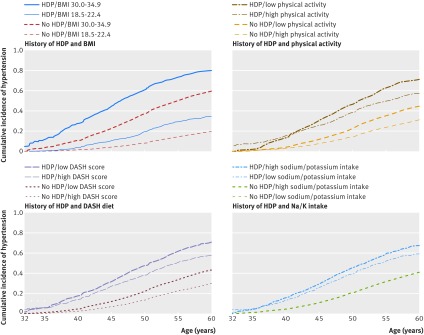
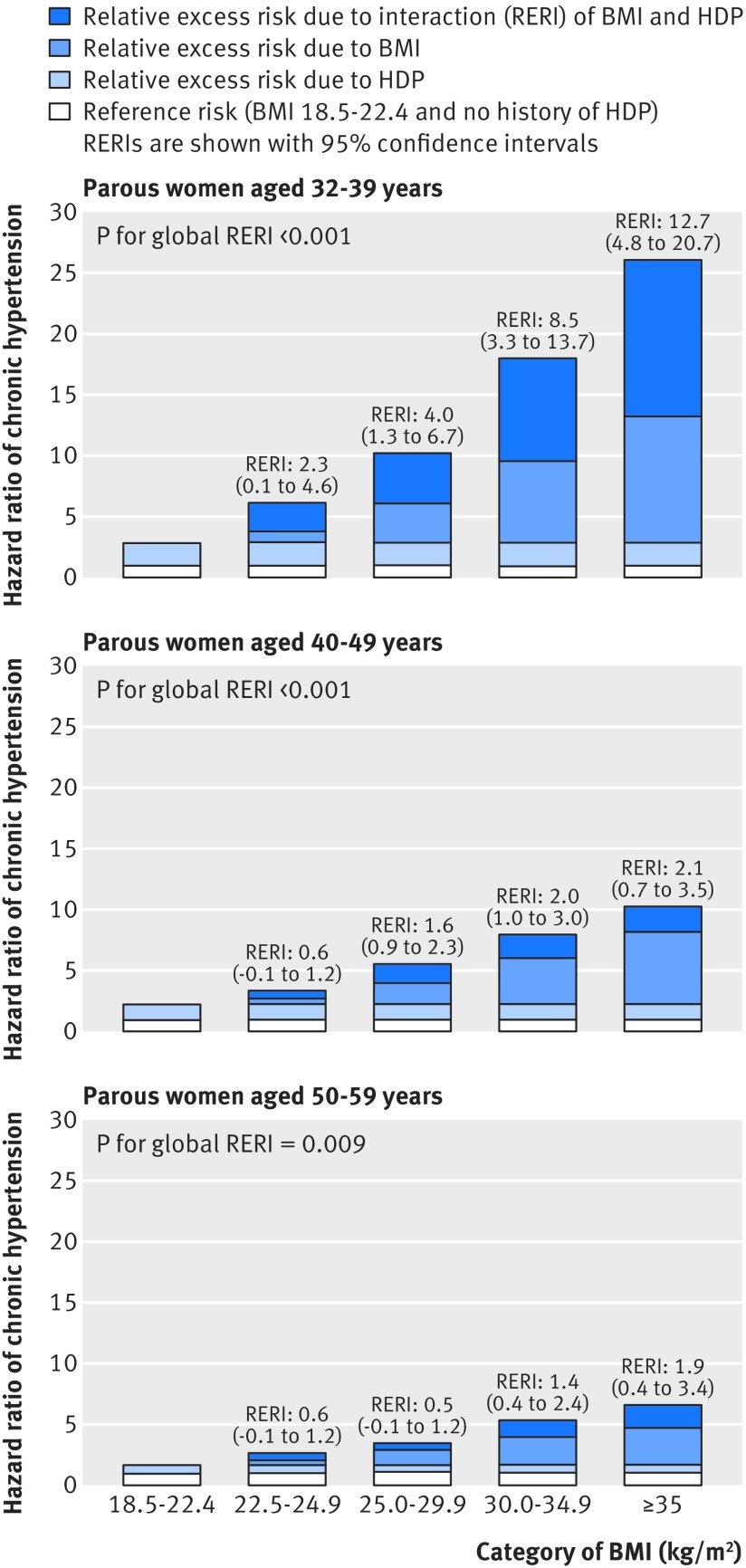
To study the association between lifestyle risk factors and chronic hypertension by history of hypertensive disorders of pregnancy (HDP: gestational hypertension and pre-eclampsia) and investigate the extent to which these risk factors modify the association between HDP and chronic hypertension. Prospective cohort study. Nurses' Health Study II (1991-2013). 54 588 parous women aged 32 to 59 years with data on reproductive history and without previous chronic hypertension, stroke, or myocardial infarction. Chronic hypertension diagnosed by a physician and indicated through nurse participant self report. Multivariable Cox proportional hazards models were used to investigate the development of chronic hypertension contingent on history of HDP and four lifestyle risk factors: post-pregnancy body mass index, physical activity, adherence to the Dietary Approaches to Stop Hypertension (DASH) diet, and dietary sodium/potassium intake. Potential effect modification (interaction) between each lifestyle factor and previous HDP was evaluated with the relative excess risk due to interaction. 10% (n=5520) of women had a history of HDP at baseline. 13 971 cases of chronic hypertension occurred during 689 988 person years of follow-up. Being overweight or obese was the only lifestyle factor consistently associated with higher risk of chronic hypertension. Higher body mass index, in particular, also increased the risk of chronic hypertension associated with history of HDP (relative excess risk due to interaction P<0.01 for all age strata). For example, in women aged 40-49 years with previous HDP and obesity class I (body mass index 30.0-34.9), 25% (95% confidence interval 12% to 37%) of the risk of chronic hypertension was attributable to a potential effect of obesity that was specific to women with previous HDP. There was no clear evidence of effect modification by physical activity, DASH diet, or sodium/potassium intake on the association between HDP and chronic hypertension. This study suggests that the risk of chronic hypertension after HDP might be markedly reduced by adherence to a beneficial lifestyle. Compared with women without a history of HDP, keeping a healthy weight seems to be especially important with such a history.
通过妊娠高血压疾病史(HDP:妊娠期高血压和子痫前期)研究生活方式风险因素与慢性高血压之间的关联,并调查这些风险因素在多大程度上改变了HDP与慢性高血压之间的关联。前瞻性队列研究。护士健康研究II(1991 - 2013年)。54588名年龄在32至59岁之间的经产妇,有生殖史数据且既往无慢性高血压、中风或心肌梗死。由医生诊断并通过护士参与者自我报告指出慢性高血压。多变量Cox比例风险模型用于研究取决于HDP病史和四种生活方式风险因素的慢性高血压的发生情况:产后体重指数、身体活动、遵循终止高血压饮食方法(DASH饮食)以及饮食中钠/钾摄入量。使用交互作用导致的相对超额风险评估每种生活方式因素与既往HDP之间的潜在效应修饰(交互作用)。10%(n = 5520)的女性在基线时有HDP病史。在689988人年的随访期间发生了13971例慢性高血压病例。超重或肥胖是唯一始终与慢性高血压较高风险相关的生活方式因素。特别是较高的体重指数也增加了与HDP病史相关的慢性高血压风险(各年龄层交互作用导致的相对超额风险P < 0.01)。例如,在既往有HDP且为I级肥胖(体重指数30.0 - 34.9)的40 - 49岁女性中,25%(95%置信区间12%至37%)的慢性高血压风险可归因于肥胖对既往有HDP女性的特定潜在影响。没有明确证据表明身体活动、DASH饮食或钠/钾摄入量对HDP与慢性高血压之间的关联有效应修饰作用。这项研究表明,通过坚持有益的生活方式,HDP后慢性高血压的风险可能会显著降低。与无HDP病史的女性相比,有此类病史时保持健康体重似乎尤为重要。