Xiong Liu-Lin, Liu Fei, Lu Bing-Tuan, Zhao Wen-Ling, Dong Xiu-Juan, Liu Jia, Zhang Rong-Ping, Zhang Piao, Wang Ting-Hua
Institute of Neurological Disease and Department of Anesthesiology, Translational Neuroscience Center, West China Hospital, Sichuan UniversityChengdu, China.
Institute of Neuroscience, Animal Zoology Department, Kunming Medical UniversityKunming, China.
Front Cell Neurosci. 2017 Jun 28;11:172. doi: 10.3389/fncel.2017.00172. eCollection 2017.
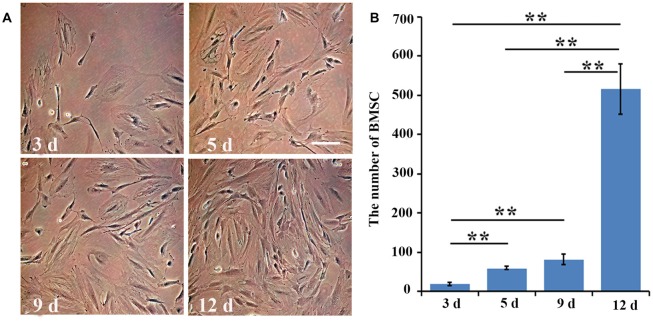
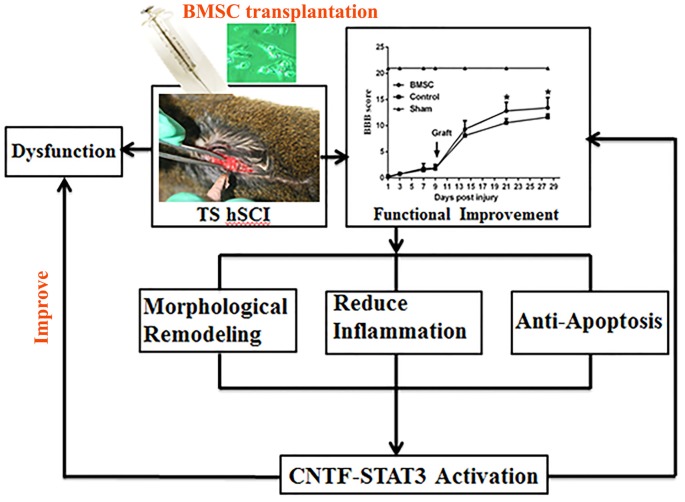
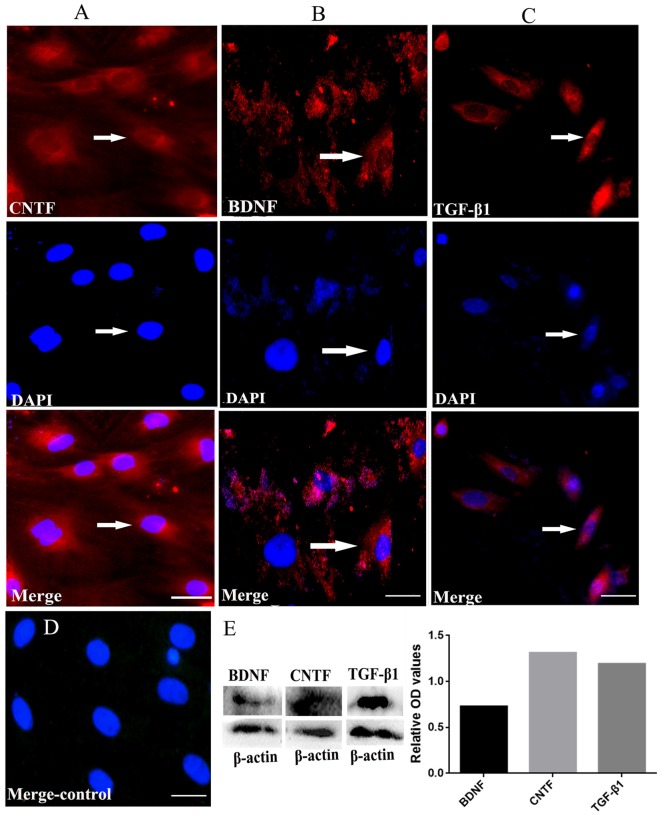
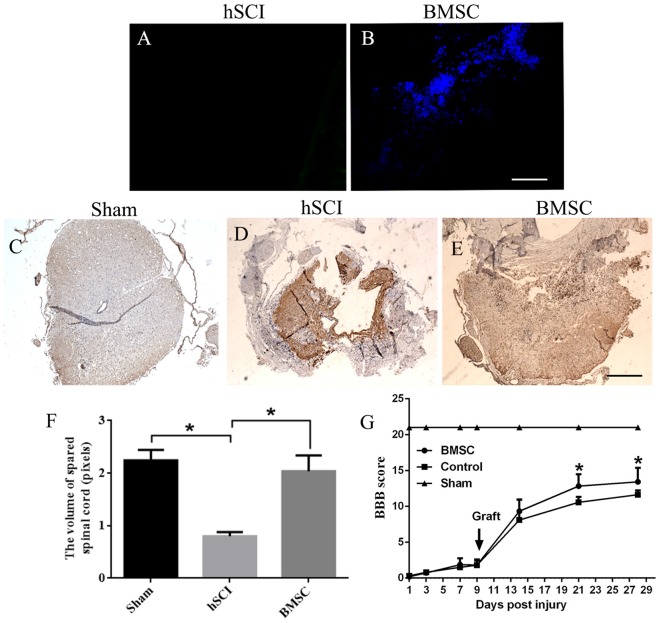
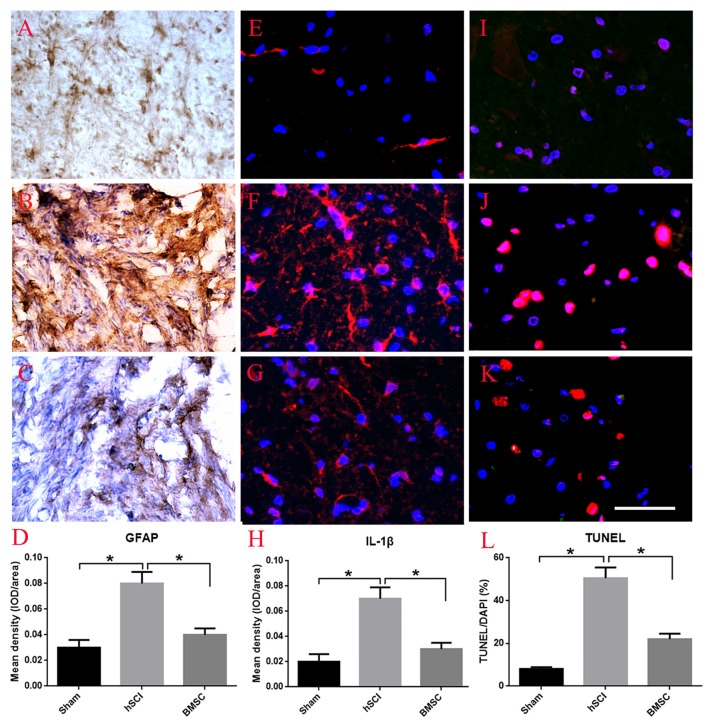
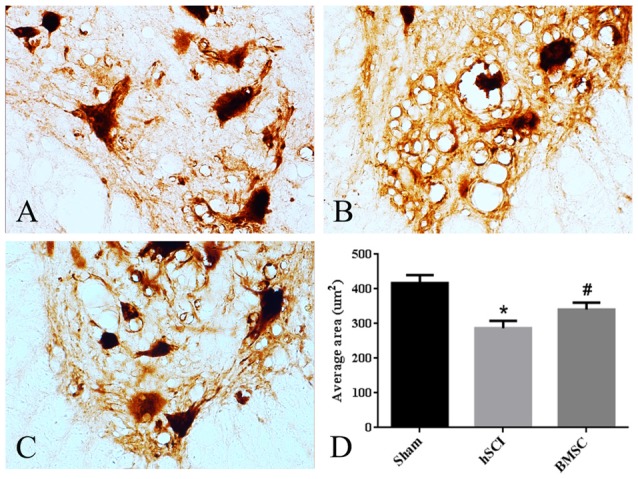
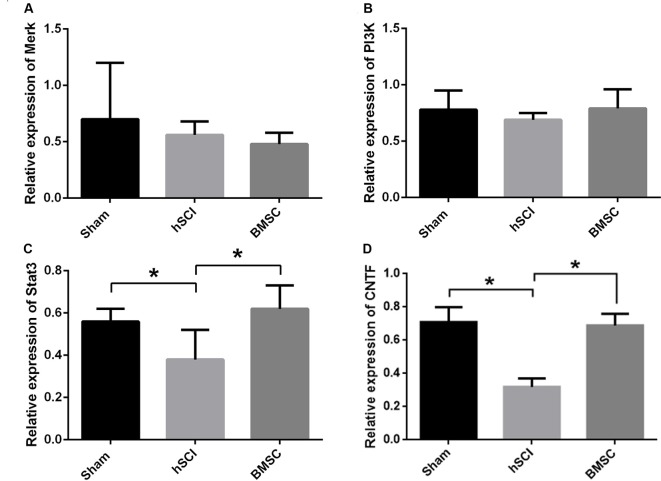
Hemi-sectioned spinal cord injury (hSCI) can lead to spastic paralysis on the injured side, as well as flaccid paralysis on the contralateral side, which can negatively affect a patient's daily life. Stem-cell therapy may offer an effective treatment option for individuals with hSCI. To examine the role of bone marrow mesenchymal stem cells (BMSCs) transplantation on hSCI and explore related mechanisms in the tree shrews, here, we created a model of hSCI by inducing injury at the tenth thoracic vertebra (T10). Hoechst 33342-labeled BMSCs derived from adult tree shrews were isolated, cultured, and implanted into the spinal cord around the injury site at 9 days after injury. The isolated BMSCs were able to survive, proliferate and release a variety of neurotrophic factors (NTFs) both and . At 28 days after injury, compared with the sham group, the hSCI group displayed scar formation and dramatic elevations in the mean interleukin 1 beta (IL-1β) density and cell apoptosis level, whereas the expression of signal transducer and activator of transcription 3 () and ciliary neurotrophic factor () mRNA was reduced. Following BMSC transplantation, motoneurons extent of shrinkage were reduced and the animals' Basso, Beattie, and Bresnahan (BBB) locomotion scale scores were significantly higher at 21 and 28 days after injury when compared with the injured group. Moreover, the hSCI-induced elevations in scar formation, IL-1β, and cell apoptosis were reduced by BMSC transplantation to levels that were close to those of the sham group. Corresponding elevations in the expression of and mRNA were observed in the hSCI + BMSCs group, and the levels were not significantly different from those observed in the sham group. Together, our results support that grafted BMSCs can significantly improve locomotor function in tree shrews subjected to hSCI and that this improvement is associated with the upregulation of and signaling.
半横断脊髓损伤(hSCI)可导致损伤侧痉挛性瘫痪以及对侧弛缓性瘫痪,这会对患者的日常生活产生负面影响。干细胞疗法可能为hSCI患者提供一种有效的治疗选择。为了研究骨髓间充质干细胞(BMSCs)移植对hSCI的作用并探索树鼩中的相关机制,在此,我们通过在第十胸椎(T10)诱导损伤创建了hSCI模型。分离、培养成年树鼩来源的经Hoechst 33342标记的BMSCs,并在损伤后9天植入损伤部位周围的脊髓。分离出的BMSCs在体内和体外都能够存活、增殖并释放多种神经营养因子(NTFs)。损伤后28天,与假手术组相比,hSCI组出现瘢痕形成,平均白细胞介素1β(IL-1β)密度和细胞凋亡水平显著升高,而信号转导和转录激活因子3(STAT3)和睫状神经营养因子(CNTF)mRNA的表达降低。BMSCs移植后,运动神经元的萎缩程度降低,与损伤组相比,动物在损伤后21天和28天的Basso、Beattie和Bresnahan(BBB)运动量表评分显著更高。此外,BMSCs移植将hSCI诱导的瘢痕形成、IL-1β和细胞凋亡的升高降低至接近假手术组的水平。在hSCI + BMSCs组中观察到STAT3和CNTF mRNA表达相应升高,且水平与假手术组观察到的无显著差异。总之,我们的结果支持移植的BMSCs可显著改善hSCI树鼩的运动功能,且这种改善与STAT3和CNTF信号上调有关。