Bredtmann Christina M, Krücken Jürgen, Murugaiyan Jayaseelan, Kuzmina Tetiana, von Samson-Himmelstjerna Georg
Department of Veterinary Medicine, Institute for Parasitology and Tropical Veterinary Medicine, Freie Universität BerlinBerlin, Germany.
Department of Veterinary Medicine, Institute for Animal Hygiene and Environmental Health, Freie Universität BerlinBerlin, Germany.
Front Cell Infect Microbiol. 2017 Jun 28;7:283. doi: 10.3389/fcimb.2017.00283. eCollection 2017.
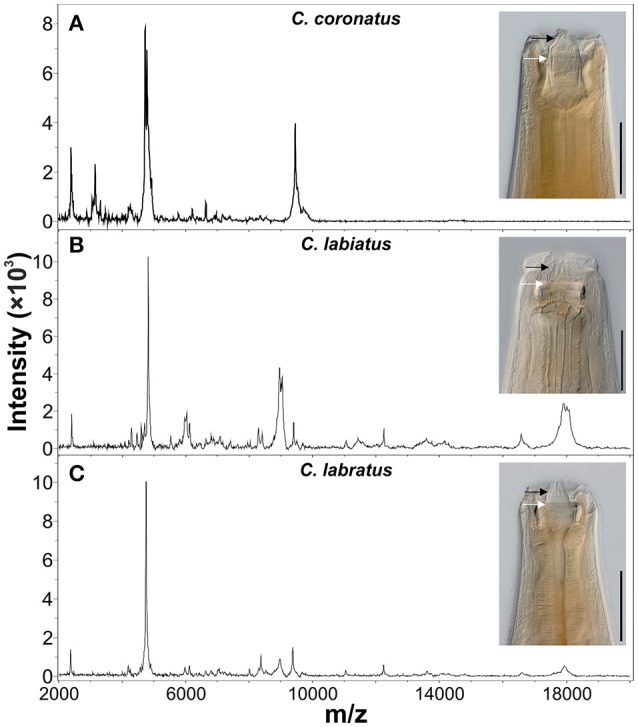
Human and animal health is globally affected by a variety of parasitic helminths. The impact of co-infections and development of anthelmintic resistance requires improved diagnostic tools, especially for parasitic nematodes e.g., to identify resistant species or attribute pathological effects to individual species or particular species combinations. In horses, co-infection with cyathostomins is rather a rule than an exception with typically 5 to 15 species (out of more than 40 described) per individual host. In cyathostomins, reliable morphological species differentiation is currently limited to adults and requires highly specialized expertize while precise morphological identification of eggs and early stage larvae is impossible. The situation is further complicated by a questionable validity of some cyathostomins while others might actually represent cryptic species complexes. Several molecular methods using different target sequences were established to overcome these limitations. For adult worms, PCR followed by sequencing of mitochondrial genes or external or internal ribosomal RNA spacers is suitable to genetically confirm morphological identifications. The most commonly used method to differentiate eggs or larvae is the reverse-line-blot hybridization assay. However, both methods suffer from the fact that target sequences are not available for many species or even that GenBank® entries are unreliable regarding the cyathostomin species. Recent advances in proteomic tools for identification of metazoans including insects and nematodes of the genus will be evaluated for suitability to diagnose cyathostomins. Future research should focus on the comparative analysis of morphological, molecular and proteomic data from the same cyathostomin specimen to optimize tools for species-specific identification.
人类和动物的健康在全球范围内受到多种寄生性蠕虫的影响。共感染和抗蠕虫药耐药性的发展所带来的影响,需要改进诊断工具,尤其是针对寄生线虫,例如识别耐药物种或将病理效应归因于单个物种或特定物种组合。在马匹中,与杯环线虫共感染相当常见,通常每个宿主个体有5至15种(在已描述的40多种中)。对于杯环线虫,目前可靠的形态学物种区分仅限于成虫,需要高度专业化的专业知识,而对虫卵和早期幼虫进行精确的形态学鉴定则是不可能的。由于一些杯环线虫的有效性存疑,而其他一些可能实际上代表隐性物种复合体,情况进一步复杂化。已经建立了几种使用不同靶序列的分子方法来克服这些限制。对于成虫,通过线粒体基因或外部或内部核糖体RNA间隔区测序的PCR适合从基因上确认形态学鉴定。区分虫卵或幼虫最常用的方法是反向线印迹杂交分析。然而,这两种方法都存在这样的问题:许多物种没有可用的靶序列,甚至GenBank®条目中关于杯环线虫物种的信息不可靠。将评估蛋白质组学工具在鉴定后生动物(包括昆虫和该属线虫)方面的最新进展,以确定其对诊断杯环线虫的适用性。未来的研究应侧重于对来自同一杯环线虫标本的形态学、分子和蛋白质组学数据进行比较分析,以优化物种特异性鉴定工具。