Kryuchkov Mikhail, Lehmann Jannis, Schaab Jakob, Fiebig Manfred, Katanaev Vladimir L
Department of Pharmacology and Toxicology, University of Lausanne, Rue du Bugnon 27, 1011, Lausanne, Switzerland.
Department of Materials, ETH Zurich, Vladimir-Prelog-Weg 4, 8093, Zurich, Switzerland.
J Nanobiotechnology. 2017 Jul 14;15(1):52. doi: 10.1186/s12951-017-0287-0.
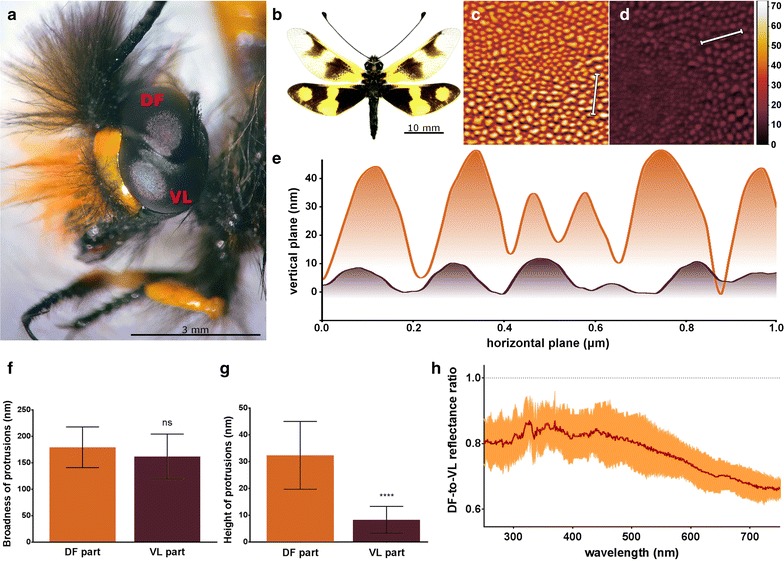
Moth-eye nanostructures, discovered to coat corneae of certain nocturnal insects, have inspired numerous technological applications to reduce light reflectance from solar cells, light-emitting diodes, and optical detectors. Technological developments require such nanocoatings to possess broadband antireflective properties, transcending the visual light spectrum, in which animals typically operate. Here we describe the corneal nanostructures of the visual organ exclusive in UV sensation of the hunting insect Libelloides macaronius and report their supreme anti-light-reflectance capacity.
蛾眼纳米结构是在某些夜行昆虫的角膜上发现的,它启发了许多技术应用,以减少太阳能电池、发光二极管和光学探测器的光反射。技术发展要求这种纳米涂层具有宽带抗反射特性,超越动物通常运作的可见光光谱范围。在这里,我们描述了捕食性昆虫黄斑宽腹蜻独特的紫外线感光视觉器官的角膜纳米结构,并报告了它们卓越的抗光反射能力。