Laranjo Liliana, Lau Annie Y S, Martin Paige, Tong Huong Ly, Coiera Enrico
Macquarie University, Australian Institute of Health Innovation-Centre for Health Informatics, Sydney, Australia.
BMJ Open. 2017 Jul 12;7(7):e016665. doi: 10.1136/bmjopen-2017-016665.
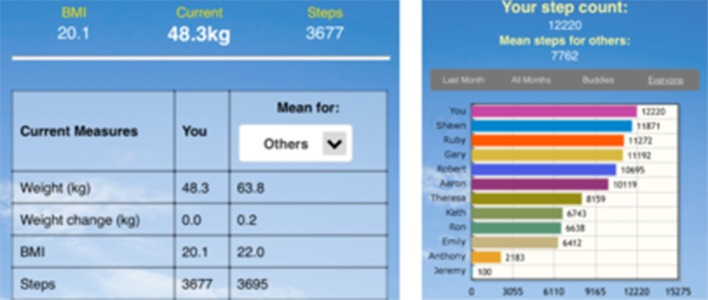
Obesity and physical inactivity are major societal challenges and significant contributors to the global burden of disease and healthcare costs. Information and communication technologies are increasingly being used in interventions to promote behaviour change in diet and physical activity. In particular, social networking platforms seem promising for the delivery of weight control interventions.We intend to pilot test an intervention involving the use of a social networking mobile application and tracking devices ( and scale) to promote the social comparison of weight and physical activity, in order to evaluate whether mechanisms of social influence lead to changes in those outcomes over the course of the study.
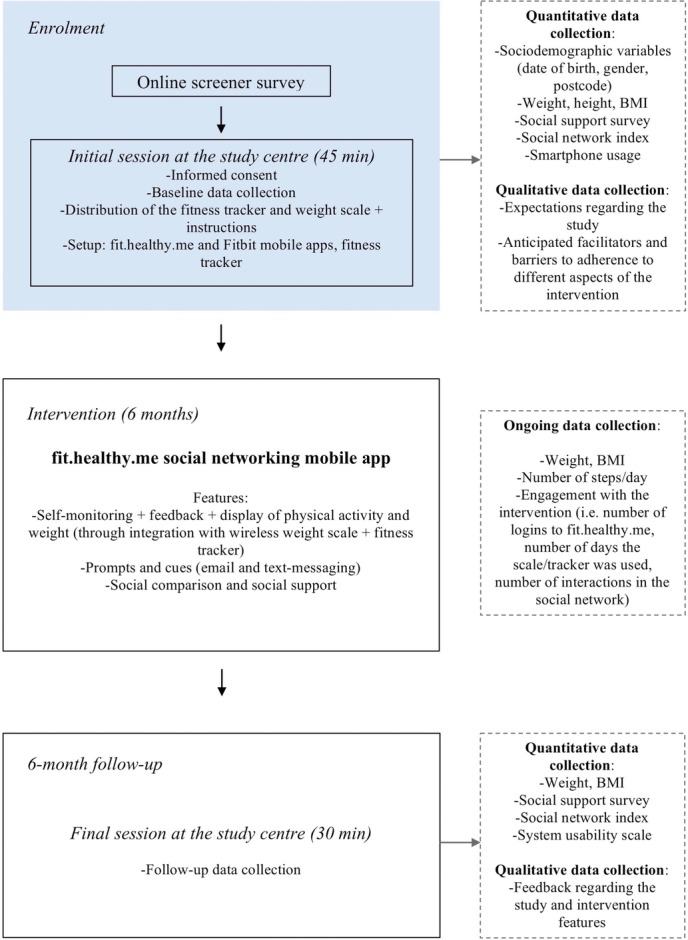
Mixed-methods study involving semi-structured interviews and a pre-post quasi-experimental pilot with one arm, where healthy participants in different body mass index (BMI) categories, aged between 19 and 35 years old, will be subjected to a social networking intervention over a 6-month period. The primary outcome is the average difference in weight before and after the intervention. Secondary outcomes include BMI, number of steps per day, engagement with the intervention, social support and system usability. Semi-structured interviews will assess participants' expectations and perceptions regarding the intervention.
Ethics approval was granted by Macquarie University's Human Research Ethics Committee for Medical Sciences on 3 November 2016 (ethics reference number 5201600716).The social network will be moderated by a researcher with clinical expertise, who will monitor and respond to concerns raised by participants. Monitoring will involve daily observation of measures collected by the fitness tracker and the wireless scale, as well as continuous supervision of forum interactions and posts. Additionally, a protocol is in place to monitor for participant misbehaviour and direct participants-in-need to appropriate sources of help.
肥胖和缺乏身体活动是主要的社会挑战,也是全球疾病负担和医疗成本的重要促成因素。信息和通信技术越来越多地用于促进饮食和身体活动行为改变的干预措施中。特别是,社交网络平台似乎有望用于提供体重控制干预措施。我们打算对一项干预措施进行试点测试,该措施涉及使用社交网络移动应用程序和追踪设备(以及体重秤)来促进体重和身体活动的社会比较,以便评估社会影响机制是否会在研究过程中导致这些结果发生变化。
采用混合方法研究,包括半结构化访谈和单组前后准实验性试点研究,19至35岁、不同体重指数(BMI)类别的健康参与者将在6个月内接受社交网络干预。主要结局是干预前后体重的平均差异。次要结局包括BMI、每日步数、对干预的参与度、社会支持和系统可用性。半结构化访谈将评估参与者对干预措施的期望和看法。
2016年11月3日,麦考瑞大学医学科学人类研究伦理委员会批准了伦理许可(伦理参考编号5201600716)。社交网络将由具有临床专业知识的研究人员进行管理,该研究人员将监测并回应参与者提出的问题。监测将包括每日观察健身追踪器和无线体重秤收集的测量数据,以及对论坛互动和帖子的持续监督。此外,还制定了一项协议,以监测参与者的不当行为,并将有需要的参与者引导至适当的帮助来源。