Aadland Katrine N, Ommundsen Yngvar, Aadland Eivind, Brønnick Kolbjørn S, Lervåg Arne, Resaland Geir K, Moe Vegard F
Faculty of Teacher Education and Sport, Western Norway University of Applied SciencesBergen, Norway.
Department of Coaching and Psychology, Norwegian School of Sport SciencesOslo, Norway.
Front Psychol. 2017 Jun 29;8:1088. doi: 10.3389/fpsyg.2017.01088. eCollection 2017.
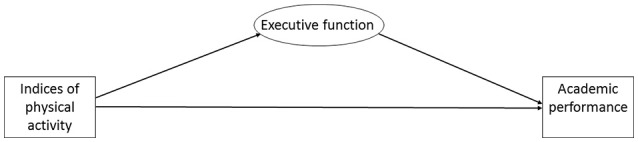
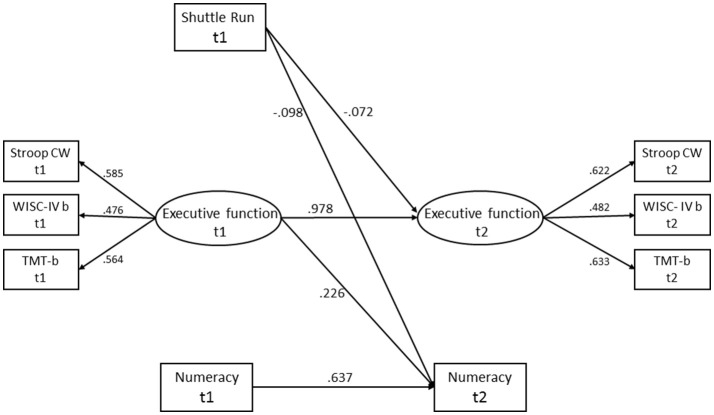
Changes in cognitive function induced by physical activity have been proposed as a mechanism for the link between physical activity and academic performance. The aim of this study was to investigate if executive function mediated the prospective relations between indices of physical activity and academic performance in a sample of 10-year-old Norwegian children. The study included 1,129 children participating in the Active Smarter Kids (ASK) trial, followed over 7 months. Structural equation modeling (SEM) with a latent variable of executive function (measuring inhibition, working memory, and cognitive flexibility) was used in the analyses. Predictors were objectively measured physical activity, time spent sedentary, aerobic fitness, and motor skills. Outcomes were performance on national tests of numeracy, reading, and English (as a second language). Generally, indices of physical activity did not predict executive function and academic performance. A modest mediation effect of executive function was observed for the relation between motor skills and academic performance. Clinicaltrials.gov registry, trial registration number: NCT02132494.
体育活动引起的认知功能变化已被提出作为体育活动与学业成绩之间联系的一种机制。本研究的目的是调查在10岁挪威儿童样本中,执行功能是否介导了体育活动指标与学业成绩之间的前瞻性关系。该研究包括1129名参与“积极更聪明儿童”(ASK)试验的儿童,随访7个月。分析中使用了具有执行功能潜在变量(测量抑制、工作记忆和认知灵活性)的结构方程模型(SEM)。预测因素包括客观测量的体育活动、久坐时间、有氧适能和运动技能。结果是全国算术、阅读和英语(作为第二语言)测试的成绩。一般来说,体育活动指标不能预测执行功能和学业成绩。观察到执行功能对运动技能与学业成绩之间的关系有适度的中介作用。Clinicaltrials.gov注册库,试验注册号:NCT02132494。