Physiotherapy Program, Faculty of Health Sciences and Medicine, Bond University, Gold Coast, QLD 4229, Australia.
School of Community Health, Charles Sturt University, Thurgoona, NSW 2640, Australia.
BMC Pediatr. 2020 Feb 14;20(1):69. doi: 10.1186/s12887-020-1967-8.
A key priority for learning during the early years of school is for children to develop skills in numeracy and literacy. Consequently, less time may be allocated in the curriculum to foster other important developmental areas, including the ongoing motor skill development of school children, which has been positively linked to academic performance. In order to promote holistic approaches to teaching and learning in the early years of school, it is necessary to further delineate the nature of associations between motor skills and foundation academic skills. The aim of this study was to examine associations between fine and gross motor proficiency and academic performance in mathematics and reading in Year 1 children.
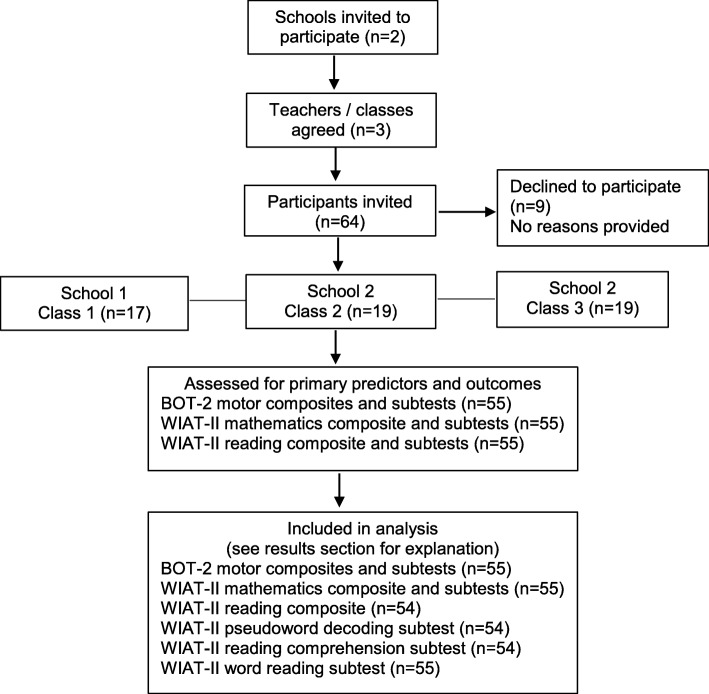
A cross-sectional study was conducted with Year 1 children from two primary schools in New South Wales, Australia (N = 55; 25 boys, 30 girls; mean age 6.77 ± 0.40 years). The Bruininks-Oseretsky Test of Motor Proficiency (2nd Edition) and the Wechsler Individual Achievement Test II (Australian Edition) were used to assess motor proficiency and academic performance in mathematics and reading, respectively. Associations between the components of motor proficiency and academic outcomes were examined using Pearson's and Spearman's correlation analyses. Hierarchical multiple linear regression analyses were conducted to determine how much variance in mathematics and reading composite scores could be explained by motor proficiency after controlling for age.
A significant moderate positive association was found between total motor composite and mathematics composite scores (r = .466, p < .001). Fine manual control composite scores were significantly associated with both mathematics (r = .572, p < .001) and reading (r = .476, p = .001) composite scores. After controlling for age, fine motor integration was the only component of motor proficiency that explained significant variance in mathematics and reading composite scores.
The results of the study revealed that Year 1 children's overall motor proficiency was significantly related to their mathematical ability. Children's fine motor integration skills were also predictive of mathematics and reading ability. These study findings may interest both early childhood educators and paediatric health professionals.
在学校的早年阶段,学习的一个关键重点是让儿童发展计算和读写能力方面的技能。因此,课程中可能会分配较少的时间来培养其他重要的发展领域,包括在校儿童正在进行的运动技能发展,而运动技能发展与学业成绩呈正相关。为了在学校的早年阶段进一步推广教学的整体方法,有必要更详细地描述运动技能与基础学术技能之间的关联。本研究的目的是检验一年级儿童精细运动和粗大运动能力与数学和阅读成绩之间的关联。
对澳大利亚新南威尔士州的两所小学的一年级儿童(N=55;男 25 名,女 30 名;平均年龄 6.77±0.40 岁)进行了横断面研究。采用 Bruininks-Oseretsky 运动能力测试(第 2 版)和 Wechsler 个体成就测试 II(澳大利亚版)分别评估运动能力和数学与阅读方面的学业成绩。使用 Pearson 和 Spearman 相关分析检验运动能力各成分与学业结果之间的关联。进行分层多元线性回归分析,以确定在控制年龄后,运动能力可以解释多少数学和阅读综合成绩的差异。
总运动综合成绩与数学综合成绩之间存在显著的中度正相关(r=0.466,p<0.001)。精细运动控制综合成绩与数学(r=0.572,p<0.001)和阅读(r=0.476,p=0.001)综合成绩均显著相关。在控制年龄后,精细运动整合是运动能力中唯一可以解释数学和阅读综合成绩差异的成分。
研究结果表明,一年级儿童的整体运动能力与他们的数学能力显著相关。儿童的精细运动整合技能也可以预测数学和阅读能力。这些研究结果可能引起幼儿教育工作者和儿科保健专业人员的兴趣。