Division of Immunology, Transplantation and Infectious Diseases, IRCCS (Istituto di Ricerca e Cura a carattere Scientifico) San Raffaele Scientific Institute, 20132 Milan, Italy.
Vita-Salute San Raffaele University, 20132 Milan, Italy.
Sci Adv. 2017 Jul 12;3(7):e1700492. doi: 10.1126/sciadv.1700492. eCollection 2017 Jul.
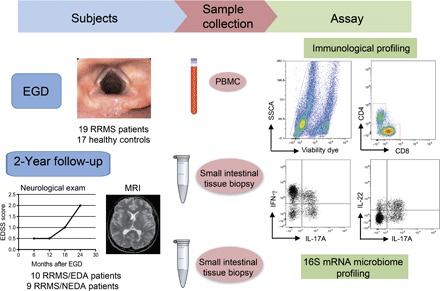
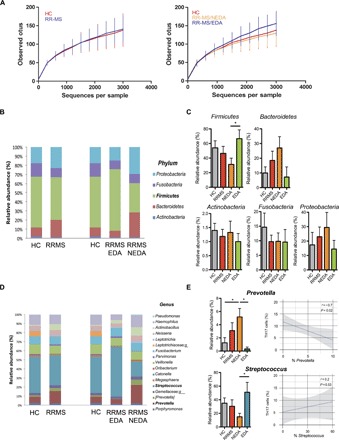
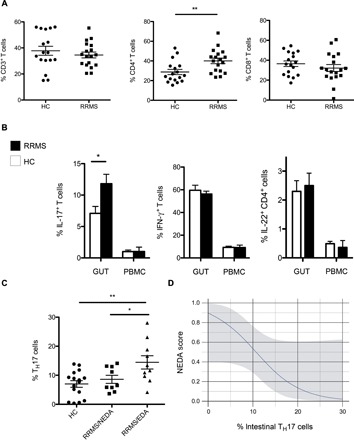
T helper 17 (T17) cells are key players in multiple sclerosis (MS), and studies in animal models demonstrated that effector T17 cells that trigger brain autoimmunity originate in the intestine. We validate in humans the crucial role of the intestinal environment in promoting T17 cell expansion in MS patients. We found that increased frequency of T17 cells correlates with high disease activity and with specific alterations of the gut mucosa-associated microbiota in MS patients. By using 16 ribosomal RNA sequencing, we analyzed the microbiota isolated from small intestinal tissues and found that MS patients with high disease activity and increased intestinal T17 cell frequency showed a higher Firmicutes/Bacteroidetes ratio, increased relative abundance of , and decreased strains compared to healthy controls and MS patients with no disease activity. We demonstrated that the intestinal T17 cell frequency is inversely related to the relative abundance of strains in the human small intestine. Our data demonstrate that brain autoimmunity is associated with specific microbiota modifications and excessive T17 cell expansion in the human intestine.
辅助性 T 细胞 17(T17)细胞是多发性硬化症(MS)中的关键角色,动物模型研究表明,引发大脑自身免疫的效应性 T17 细胞起源于肠道。我们在人类中验证了肠道环境在促进 MS 患者 T17 细胞扩增中的关键作用。我们发现 T17 细胞频率的增加与疾病的高活性以及 MS 患者肠道黏膜相关微生物群的特定改变相关。通过使用 16S 核糖体 RNA 测序,我们分析了从小肠组织中分离出的微生物群,发现与健康对照组和无疾病活动的 MS 患者相比,疾病活动度高且肠道 T17 细胞频率增加的 MS 患者具有更高的厚壁菌门/拟杆菌门比值、相对丰度增加的 和减少的 菌株。我们证明了肠道 T17 细胞频率与人类小肠中 菌株的相对丰度呈负相关。我们的数据表明,大脑自身免疫与特定的微生物群改变以及人类肠道中过度的 T17 细胞扩增有关。