Lin Tzu-Ken, Wang Wei-Kai, Huang Shih-Yung, Tasi Chi-Tsung, Wuu Dong-Sing
Department of Materials Science and Engineering, National Chung Hsing University, Taichung 40227, Taiwan.
Department of Materials Science and Engineering, Da-Yeh University, Changhua 51591, Taiwan.
Nanomaterials (Basel). 2017 Jul 14;7(7):183. doi: 10.3390/nano7070183.
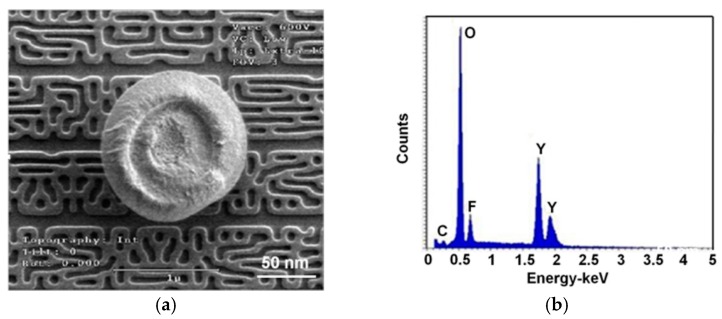
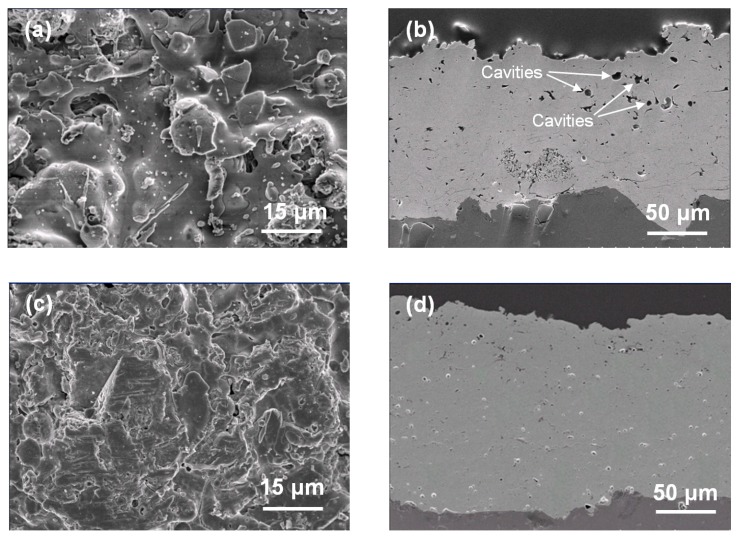
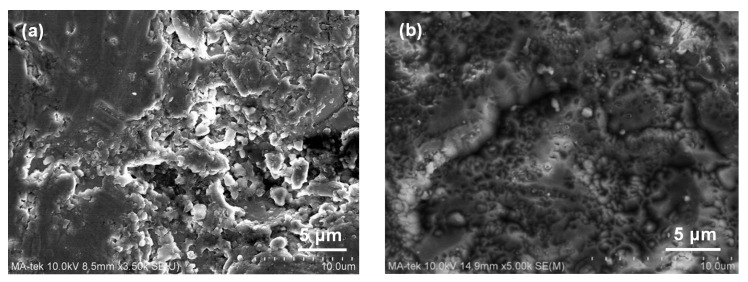
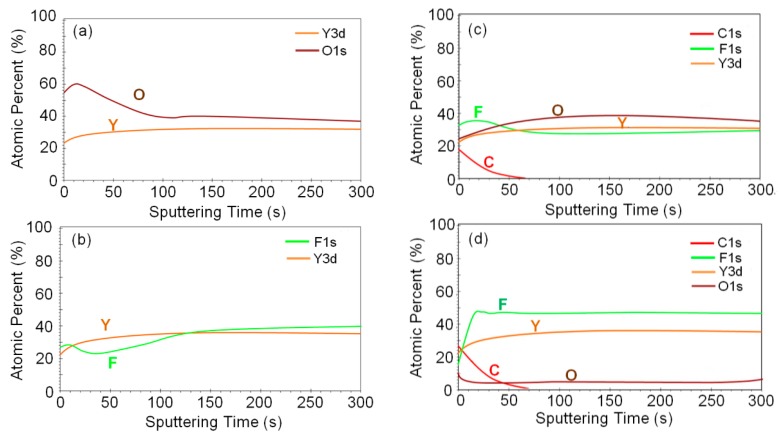
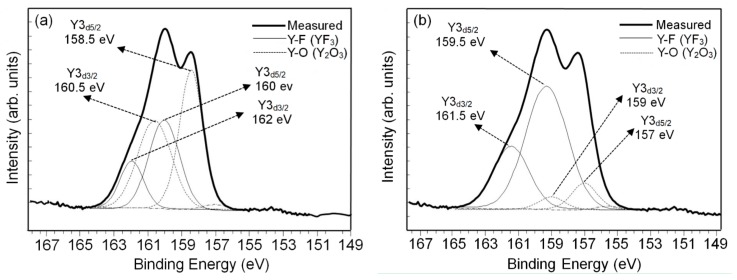
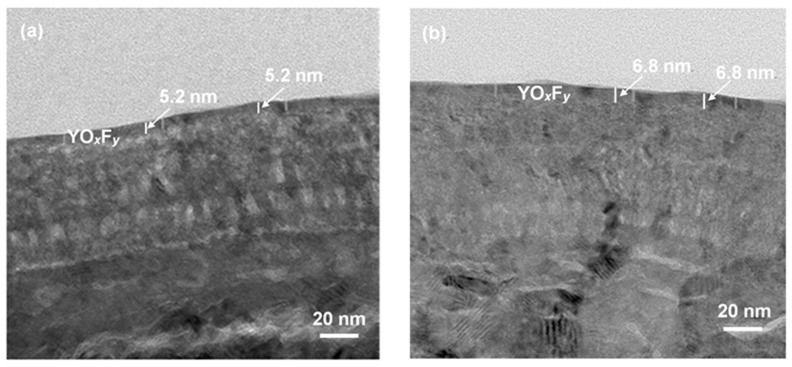
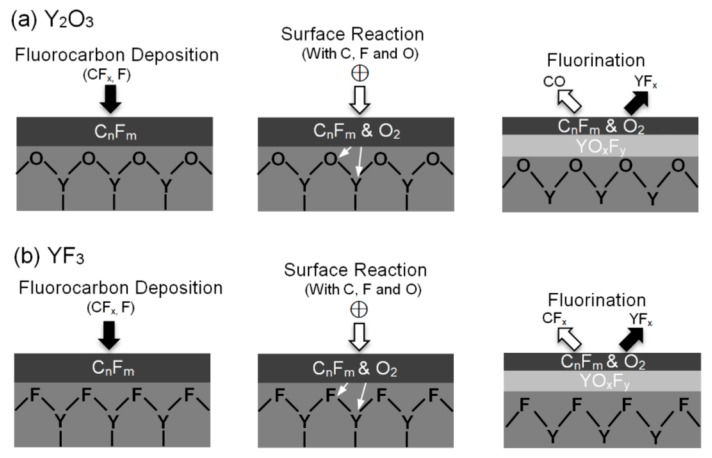
Yttrium fluoride (YF₃) and yttrium oxide (Y₂O₃) protective coatings prepared using an atmospheric plasma spraying technique were used to investigate the relationship between surface erosion behaviors and their nanoparticle generation under high-density plasma (10-10 cm) etching. As examined by transmission electron microscopy, the Y₂O₃ and YF₃ coatings become oxyfluorinated after exposure to the plasma, wherein the yttrium oxyfluoride film formation was observed on the surface with a thickness of 5.2 and 6.8 nm, respectively. The difference in the oxyfluorination of Y₂O₃ and YF₃ coatings could be attributed to Y-F and Y-O bonding energies. X-ray photoelectron spectroscopy analyses revealed that a strongly fluorinated bonding (Y-F bond) was obtained on the etched surface of the YF₃ coating. Scanning electron microscopy and energy dispersive X-ray diffraction analysis revealed that the nanoparticles on the 12-inch wafer are composed of etchant gases and Y₂O₃. These results indicate that the YF₃ coating is a more erosion-resistant material, resulting in fewer contamination particles compared with the Y₂O₃ coating.
采用大气等离子喷涂技术制备的氟化钇(YF₃)和氧化钇(Y₂O₃)防护涂层,用于研究在高密度等离子体(10⁻¹⁰厘米)蚀刻下表面侵蚀行为与其纳米颗粒生成之间的关系。通过透射电子显微镜检查发现,Y₂O₃和YF₃涂层在暴露于等离子体后会发生氧氟化,其中在表面观察到形成了厚度分别为5.2纳米和6.8纳米的氟氧化钇薄膜。Y₂O₃和YF₃涂层氧氟化的差异可归因于Y-F和Y-O键能。X射线光电子能谱分析表明,在YF₃涂层的蚀刻表面获得了强氟化键(Y-F键)。扫描电子显微镜和能量色散X射线衍射分析表明,12英寸晶圆上的纳米颗粒由蚀刻气体和Y₂O₃组成。这些结果表明,与Y₂O₃涂层相比,YF₃涂层是一种更耐腐蚀的材料,产生的污染颗粒更少。