Virant David, Turkowyd Bartosz, Balinovic Alexander, Endesfelder Ulrike
Department of Systems and Synthetic Microbiology, Max Planck Institute for Terrestrial Microbiology & LOEWE Center for Synthetic Microbiology (SYNMIKRO), Karl-von-Frisch-Str. 16, 35043 Marburg, Germany.
Int J Mol Sci. 2017 Jul 14;18(7):1524. doi: 10.3390/ijms18071524.
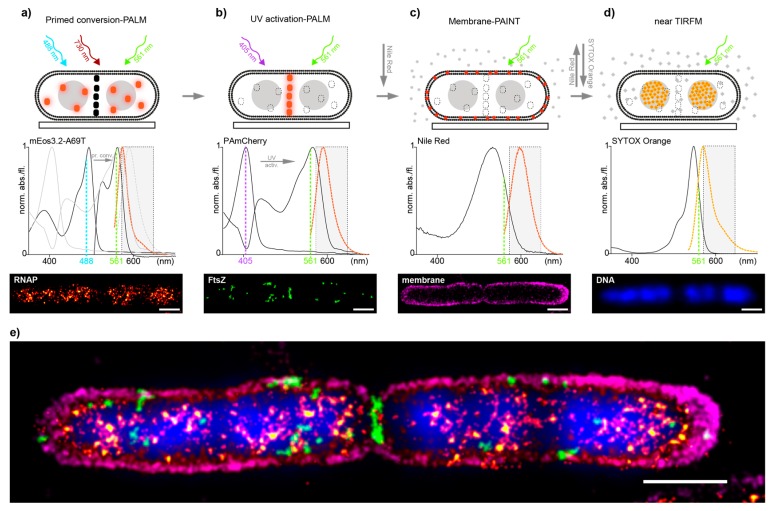
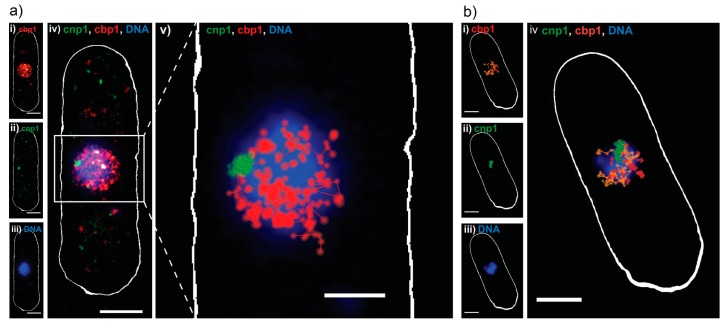
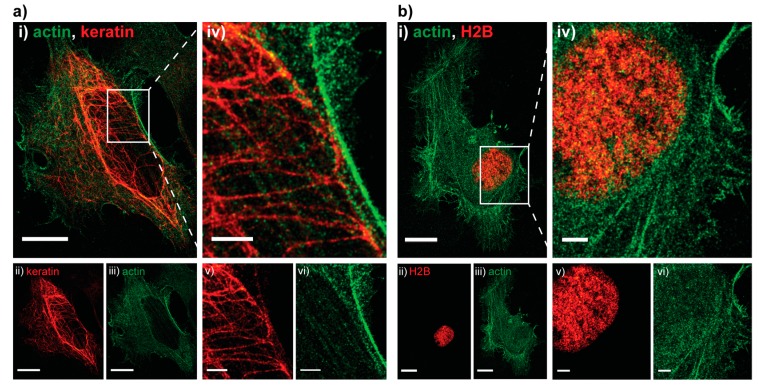
Super-resolution fluorescence microscopy plays a major role in revealing the organization and dynamics of living cells. Nevertheless, single-molecule localization microscopy imaging of multiple targets is still limited by the availability of suitable fluorophore combinations. Here, we introduce a novel imaging strategy which combines primed photoconversion (PC) and UV-photoactivation for imaging different molecular species tagged by suitable fluorescent protein combinations. In this approach, the fluorescent proteins can be specifically photoactivated/-converted by different light wavelengths using PC and UV-activation modes but emit fluorescence in the same spectral emission channel. We demonstrate that this aberration-free, live-cell compatible imaging method can be applied to various targets in bacteria, yeast and mammalian cells and can be advantageously combined with correlative imaging schemes.
超分辨率荧光显微镜在揭示活细胞的组织和动态方面发挥着重要作用。然而,多个目标的单分子定位显微镜成像仍然受到合适荧光团组合可用性的限制。在这里,我们介绍了一种新颖的成像策略,该策略结合了引发光转换(PC)和紫外光激活,用于对由合适荧光蛋白组合标记的不同分子种类进行成像。在这种方法中,荧光蛋白可以使用PC和紫外激活模式通过不同的光波长进行特异性光激活/光转换,但在相同的光谱发射通道中发射荧光。我们证明,这种无像差、与活细胞兼容的成像方法可以应用于细菌、酵母和哺乳动物细胞中的各种目标,并且可以有利地与相关成像方案相结合。