• 文献检索
  • 文档翻译
  • 深度研究
  • 学术资讯
  • Suppr Zotero 插件Zotero 插件
  • 邀请有礼
  • 套餐&价格
  • 历史记录
应用&插件
Suppr Zotero 插件Zotero 插件浏览器插件Mac 客户端Windows 客户端微信小程序
定价
高级版会员购买积分包购买API积分包
服务
文献检索文档翻译深度研究API 文档MCP 服务
关于我们
关于 Suppr公司介绍联系我们用户协议隐私条款
关注我们

Suppr 超能文献

核心技术专利:CN118964589B侵权必究
粤ICP备2023148730 号-1Suppr @ 2026

文献检索

告别复杂PubMed语法,用中文像聊天一样搜索,搜遍4000万医学文献。AI智能推荐,让科研检索更轻松。

立即免费搜索

文件翻译

保留排版,准确专业,支持PDF/Word/PPT等文件格式,支持 12+语言互译。

免费翻译文档

深度研究

AI帮你快速写综述,25分钟生成高质量综述,智能提取关键信息,辅助科研写作。

立即免费体验

非金属对金属髋关节置换术患者因金属碎屑不良反应进行翻修手术后的结果:对英格兰和威尔士国家关节注册中心185例翻修病例的分析

Outcomes following revision surgery performed for adverse reactions to metal debris in non-metal-on-metal hip arthroplasty patients: Analysis of 185 revisions from the National Joint Registry for England and Wales.

作者信息

Matharu G S, Judge A, Murray D W, Pandit H G

机构信息

Nuffield Department of Orthopaedics, Rheumatology and Musculoskeletal Sciences, University of Oxford, Nuffield Orthopaedic Centre, Oxford OX3 7LD, UK

Nuffield Department of Orthopaedics, Rheumatology and Musculoskeletal Sciences; University of Oxford, Nuffield Orthopaedic Centre, Oxford OX3 7LD, and MRC Lifecourse Epidemiology Unit, Southampton General Hospital, University of Southampton, Southampton SO16 6YD, UK.

出版信息

Bone Joint Res. 2017 Jul;6(7):405-413. doi: 10.1302/2046-3758.67.BJR-2017-0017.R2.

DOI:10.1302/2046-3758.67.BJR-2017-0017.R2
PMID:28710154
原文链接:https://pmc.ncbi.nlm.nih.gov/articles/PMC5539305/
Abstract

OBJECTIVES

Few studies have assessed outcomes following non-metal-on-metal hip arthroplasty (non-MoMHA) revision surgery performed for adverse reactions to metal debris (ARMD). We assessed outcomes following non-MoMHA revision surgery performed for ARMD, and identified predictors of re-revision.

METHODS

We performed a retrospective observational study using data from the National Joint Registry for England and Wales. All non-MoMHAs undergoing revision surgery for ARMD between 2008 and 2014 were included (185 hips in 185 patients). Outcome measures following ARMD revision were intra-operative complications, mortality and re-revision surgery. Predictors of re-revision were identified using Cox regression.

RESULTS

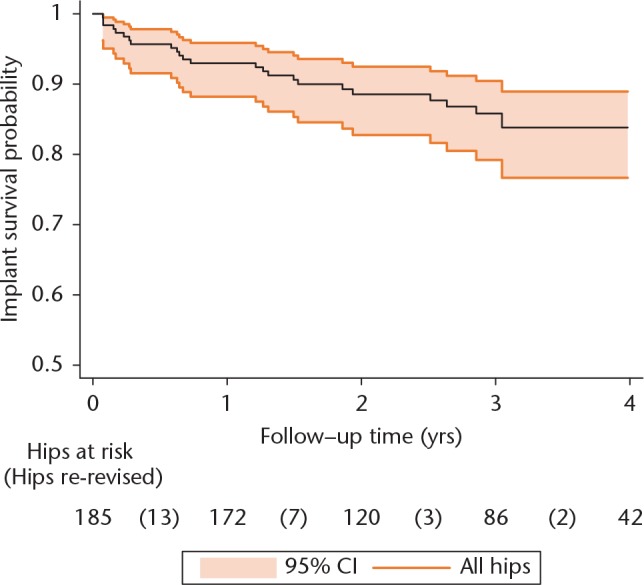
Intra-operative complications occurred in 6.0% (n = 11) of the 185 cases. The cumulative four-year patient survival rate was 98.2% (95% CI 92.9 to 99.5). Re-revision surgery was performed in 13.5% (n = 25) of hips at a mean time of 1.2 years (0.1 to 3.1 years) following ARMD revision. Infection (32%; n = 8), dislocation/subluxation (24%; n = 6), and aseptic loosening (24%; n = 6) were the most common re-revision indications. The cumulative four-year implant survival rate was 83.8% (95% CI 76.7 to 88.9). Multivariable analysis identified three predictors of re-revision: multiple revision indications (hazard ratio (HR) = 2.78; 95% CI 1.03 to 7.49; p = 0.043); selective component revisions (HR = 5.76; 95% CI 1.28 to 25.9; p = 0.022); and ceramic-on-polyethylene revision bearings (HR = 3.08; 95% CI 1.01 to 9.36; p = 0.047).

CONCLUSIONS

Non-MoMHAs revised for ARMD have a high short-term risk of re-revision, with important predictors of future re-revision including selective component revision, multiple revision indications, and ceramic-on-polyethylene revision bearings. Our findings may help counsel patients about the risks of ARMD revision, and guide reconstructive decisions. Future studies attempting to validate the predictors identified should also assess the effects of implant design (metallurgy and modularity), given that this was an important study limitation potentially influencing the reported prognostic factors. G. S. Matharu, A. Judge, D. W. Murray, H. G. Pandit. Outcomes following revision surgery performed for adverse reactions to metal debris in non-metal-on-metal hip arthroplasty patients: Analysis of 185 revisions from the National Joint Registry for England and Wales. 2017;6:405-413. DOI: 10.1302/2046-3758.67.BJR-2017-0017.R2.

摘要

目的

很少有研究评估因金属碎屑不良反应(ARMD)而行非金属对金属髋关节置换术(non-MoMHA)翻修手术后的结果。我们评估了因ARMD而行non-MoMHA翻修手术的结果,并确定了再次翻修的预测因素。

方法

我们使用来自英格兰和威尔士国家关节注册中心的数据进行了一项回顾性观察研究。纳入2008年至2014年间因ARMD接受翻修手术的所有non-MoMHA(185例患者的185髋)。ARMD翻修后的结果指标包括术中并发症、死亡率和再次翻修手术。使用Cox回归确定再次翻修的预测因素。

结果

185例病例中有6.0%(n = 11)发生术中并发症。四年累积患者生存率为98.2%(95%CI 92.9至99.5)。在ARMD翻修后平均1.2年(0.1至3.1年),13.5%(n = 25)的髋关节进行了再次翻修手术。感染(32%;n = 8)、脱位/半脱位(24%;n = 6)和无菌性松动(24%;n = 6)是最常见的再次翻修指征。四年累积植入物生存率为83.8%(95%CI 76.7至88.9)。多变量分析确定了再次翻修的三个预测因素:多个翻修指征(风险比(HR)= 2.78;95%CI 1.03至7.49;p = 0.043);选择性部件翻修(HR = 5.76;95%CI 1.28至25.9;p = 0.022);以及陶瓷对聚乙烯翻修轴承(HR = 3.08;95%CI 1.01至9.36;p = 0.047)。

结论

因ARMD而行翻修的non-MoMHA具有较高的短期再次翻修风险,未来再次翻修的重要预测因素包括选择性部件翻修、多个翻修指征和陶瓷对聚乙烯翻修轴承。我们的研究结果可能有助于向患者咨询ARMD翻修的风险,并指导重建决策。鉴于这是一个可能影响所报告预后因素的重要研究局限性,未来试图验证所确定预测因素的研究还应评估植入物设计(冶金和模块化)的影响。G. S. Matharu、A. Judge、D. W. Murray、H. G. Pandit。非金属对金属髋关节置换术患者因金属碎屑不良反应行翻修手术后的结果:对英格兰和威尔士国家关节注册中心185例翻修病例的分析。2017;6:405 - 413。DOI:10.1302/2046 - 3758.67.BJR - 2017 - 0017.R2。
https://cdn.ncbi.nlm.nih.gov/pmc/blobs/b4a7/5539305/0a3fe4d82585/bonejointres-06-405-g001.jpg

相似文献

1
Outcomes following revision surgery performed for adverse reactions to metal debris in non-metal-on-metal hip arthroplasty patients: Analysis of 185 revisions from the National Joint Registry for England and Wales.非金属对金属髋关节置换术患者因金属碎屑不良反应进行翻修手术后的结果:对英格兰和威尔士国家关节注册中心185例翻修病例的分析
Bone Joint Res. 2017 Jul;6(7):405-413. doi: 10.1302/2046-3758.67.BJR-2017-0017.R2.
2
Which factors influence the rate of failure following metal-on-metal hip arthroplasty revision surgery performed for adverse reactions to metal debris? an analysis from the National Joint Registry for England and Wales.对于金属碎片不良反应进行金属对金属髋关节置换翻修手术时,哪些因素会影响失败率?来自英格兰和威尔士国家关节注册中心的分析。
Bone Joint J. 2017 Aug;99-B(8):1020-1027. doi: 10.1302/0301-620X.99B8.BJJ-2016-0889.R1.
3
Adverse reactions to metal debris occur with all types of hip replacement not just metal-on-metal hips: a retrospective observational study of 3340 revisions for adverse reactions to metal debris from the National Joint Registry for England, Wales, Northern Ireland and the Isle of Man.金属碎片的不良反应发生在所有类型的髋关节置换手术中,而不仅仅是金属对金属的髋关节:这是一项对来自英格兰、威尔士、北爱尔兰和马恩岛国家关节注册中心的3340例因金属碎片不良反应进行翻修手术的回顾性观察研究。
BMC Musculoskelet Disord. 2016 Dec 13;17(1):495. doi: 10.1186/s12891-016-1329-8.
4
Outcomes After Metal-on-metal Hip Revision Surgery Depend on the Reason for Failure: A Propensity Score-matched Study.金属对金属髋关节翻修手术后的结果取决于失败原因:一项倾向评分匹配研究。
Clin Orthop Relat Res. 2018 Feb;476(2):245-258. doi: 10.1007/s11999.0000000000000029.
5
No Threshold Exists for Recommending Revision Surgery in Metal-on-Metal Hip Arthroplasty Patients With Adverse Reactions to Metal Debris: A Retrospective Cohort Study of 346 Revisions.金属对金属髋关节置换术后金属屑不良反应患者中不存在推荐翻修手术的阈值:346 例翻修的回顾性队列研究。
J Arthroplasty. 2019 Jul;34(7):1483-1491. doi: 10.1016/j.arth.2019.03.022. Epub 2019 Mar 13.
6
What Is the Risk of THA Revision for ARMD in Patients with Non-metal-on-metal Bearings? A Study from the Australian National Joint Replacement Registry.非金属对金属假体的 ARMD 患者行全髋关节翻修术的风险如何?来自澳大利亚国家关节置换登记处的一项研究。
Clin Orthop Relat Res. 2020 Jun;478(6):1244-1253. doi: 10.1097/CORR.0000000000001277.
7
Predictors of time to revision and clinical outcomes following revision of metal-on-metal hip replacements for adverse reaction to metal debris.金属对金属髋关节置换因金属碎屑不良反应翻修后的翻修时间及临床结果的预测因素
Bone Joint J. 2014 Dec;96-B(12):1600-9. doi: 10.1302/0301-620X.96B12.33473.
8
Revision surgery of metal-on-metal hip arthroplasties for adverse reactions to metal debris.金属对金属髋关节置换术后翻修术治疗金属颗粒不良反应
Acta Orthop. 2018 Jun;89(3):278-288. doi: 10.1080/17453674.2018.1440455. Epub 2018 Mar 1.
9
Has the threshold for revision surgery for adverse reactions to metal debris changed in metal-on-metal hip arthroplasty patients? A cohort study of 239 patients using an adapted risk-stratification algorithm.金属对金属髋关节置换术后金属颗粒不良反应行翻修手术的阈值是否发生了变化?采用改良风险分层算法对 239 例患者进行的队列研究
Acta Orthop. 2019 Dec;90(6):530-536. doi: 10.1080/17453674.2019.1659661. Epub 2019 Sep 9.
10
Trabecular Metal Versus Non-Trabecular Metal Acetabular Components and the Risk of Re-Revision Following Revision Total Hip Arthroplasty: A Propensity Score-Matched Study from the National Joint Registry for England and Wales.网眼金属与非网眼金属髋臼部件在翻修全髋关节置换术后再次翻修风险方面的比较:来自英国国家关节注册处的一项倾向评分匹配研究。
J Bone Joint Surg Am. 2018 Jul 5;100(13):1132-1140. doi: 10.2106/JBJS.17.00718.

引用本文的文献

1
Trunnionosis in Metal-on-Polyethylene Total Hip Arthroplasty With Periprosthetic Infection: A Case Report.金属对聚乙烯全髋关节置换术中假体周围感染并发耳轴病:一例报告
Cureus. 2023 Nov 25;15(11):e49401. doi: 10.7759/cureus.49401. eCollection 2023 Nov.
2
Synchrotron-based characterization of arthroprosthetic CoCrMo particles in human bone marrow.基于同步加速器的人骨髓内关节置换用 CoCrMo 颗粒的表征。
J Mater Sci Mater Med. 2022 Jun 13;33(6):54. doi: 10.1007/s10856-022-06675-2.
3
Complications and re-revisions after revisions of 528 metal-on-metal hips because of adverse reaction to metal debris.

本文引用的文献

1
Which factors influence the rate of failure following metal-on-metal hip arthroplasty revision surgery performed for adverse reactions to metal debris? an analysis from the National Joint Registry for England and Wales.对于金属碎片不良反应进行金属对金属髋关节置换翻修手术时,哪些因素会影响失败率?来自英格兰和威尔士国家关节注册中心的分析。
Bone Joint J. 2017 Aug;99-B(8):1020-1027. doi: 10.1302/0301-620X.99B8.BJJ-2016-0889.R1.
2
"Top-Out" Removal of Well-Fixed Dual-Taper Femoral Stems: Surgical Technique and Radiographic Risk Factors.固定良好的双锥度股骨柄“封顶”取出术:手术技术及影像学风险因素
J Arthroplasty. 2016 Dec;31(12):2843-2849. doi: 10.1016/j.arth.2016.05.046. Epub 2016 Jun 17.
3
528 例因金属颗粒不良反应行金属对金属髋关节翻修术后的并发症和再次翻修。
Acta Orthop. 2020 Aug;91(4):365-371. doi: 10.1080/17453674.2020.1748351. Epub 2020 Apr 14.
4
No Threshold Exists for Recommending Revision Surgery in Metal-on-Metal Hip Arthroplasty Patients With Adverse Reactions to Metal Debris: A Retrospective Cohort Study of 346 Revisions.金属对金属髋关节置换术后金属屑不良反应患者中不存在推荐翻修手术的阈值:346 例翻修的回顾性队列研究。
J Arthroplasty. 2019 Jul;34(7):1483-1491. doi: 10.1016/j.arth.2019.03.022. Epub 2019 Mar 13.
5
Comparison of the stability of three fixation techniques between porous metal acetabular components and augments.多孔金属髋臼组件与增强物之间三种固定技术的稳定性比较。
Bone Joint Res. 2018 May 5;7(4):282-288. doi: 10.1302/2046-3758.74.BJR-2017-0198.R1. eCollection 2018 Apr.
Porous tantalum uncemented acetabular components in revision total hip arthroplasty: a minimum ten-year clinical, radiological and quality of life outcome study.
翻修全髋关节置换术中的多孔钽非骨水泥髋臼组件:一项至少十年的临床、放射学及生活质量结局研究
Bone Joint J. 2016 Jun;98-B(6):767-71. doi: 10.1302/0301-620X.98B6.37183.
4
Epidemiology of periprosthetic femoral fractures in 5417 revision total hip arthroplasties: a 40-year experience.5417例翻修全髋关节置换术中假体周围股骨骨折的流行病学:40年经验
Bone Joint J. 2016 Apr;98-B(4):468-74. doi: 10.1302/0301-620X.98B4.37203.
5
Early Outcomes of Revision Surgery for Taper Corrosion of Dual Taper Total Hip Arthroplasty in 187 Patients.187例双锥度全髋关节置换术锥形腐蚀翻修手术的早期结果
J Arthroplasty. 2016 Jul;31(7):1549-54. doi: 10.1016/j.arth.2016.01.015. Epub 2016 Jan 21.
6
Revision for taper corrosion at the neck-body junction following total hip arthroplasty: pearls and pitfalls.全髋关节置换术后股骨柄-髋臼杯连接处锥形腐蚀的翻修:经验与教训
Curr Rev Musculoskelet Med. 2016 Mar;9(1):75-83. doi: 10.1007/s12178-016-9322-2.
7
Comprehensive Analysis of a Recalled Modular Total Hip System and Recommendations for Management.召回的模块化全髋关节系统的综合分析及处理建议。
J Bone Joint Surg Am. 2016 Jan 6;98(1):40-7. doi: 10.2106/JBJS.N.01121.
8
Are all metal-on-metal hip revision operations contributing to the National Joint Registry implant survival curves? : a study comparing the London Implant Retrieval Centre and National Joint Registry datasets.所有金属对金属髋关节翻修手术都对国家关节注册中心的植入物存活曲线有贡献吗?:一项比较伦敦植入物取出中心和国家关节注册中心数据集的研究。
Bone Joint J. 2016 Jan;98-B(1):33-9. doi: 10.1302/0301-620X.98B1.36431.
9
Diagnosis and Management of Adverse Local Tissue Reactions Secondary to Corrosion at the Head-Neck Junction in Patients With Metal on Polyethylene Bearings.金属对聚乙烯轴承患者头颈交界处腐蚀继发局部组织不良反应的诊断与处理
J Arthroplasty. 2016 Jan;31(1):264-8. doi: 10.1016/j.arth.2015.07.039. Epub 2015 Aug 1.
10
Adverse local tissue reactions in metal-on-polyethylene total hip arthroplasty due to trunnion corrosion: the risk of misdiagnosis.金属对聚乙烯全髋关节置换术中因柄部腐蚀导致的局部组织不良反应:误诊风险
Bone Joint J. 2015 Aug;97-B(8):1024-30. doi: 10.1302/0301-620X.97B8.34682.