Department of Medical Physiology, Division of Heart and Lungs, University Medical Center Utrecht, Yalelaan 50, 3584 CM, Utrecht, The Netherlands.
Center for Molecular Medicine, Department of Medical Genetics, University Medical Center Utrecht, Utrecht, The Netherlands.
J Biomed Sci. 2017 Jul 15;24(1):44. doi: 10.1186/s12929-017-0352-x.
The inward rectifier potassium current I contributes to a stable resting membrane potential and phase 3 repolarization of the cardiac action potential. KCNJ2 gain-of-function mutations V93I and D172N associate with increased I, short QT syndrome type 3 and congenital atrial fibrillation. Pentamidine-Analogue 6 (PA-6) is an efficient (IC = 14 nM with inside-out patch clamp methodology) and specific I inhibitor that interacts with the cytoplasmic pore region of the K2.1 ion channel, encoded by KCNJ2. At 10 μM, PA-6 increases wild-type (WT) K2.1 expression in HEK293T cells upon chronic treatment. We hypothesized that PA-6 will interact with and inhibit V93I and D172N K2.1 channels, whereas impact on channel expression at the plasma membrane requires higher concentrations.
Molecular modelling was performed with the human K2.1 closed state homology model using FlexX. WT and mutant K2.1 channels were expressed in HEK293 cells. Patch-clamp single cell electrophysiology measurements were performed in the whole cell and inside-out mode of the patch clamp method. K2.1 expression level and localization were determined by western blot analysis and immunofluorescence microscopy, respectively.
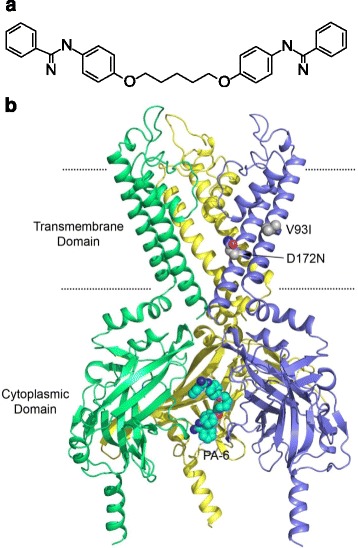
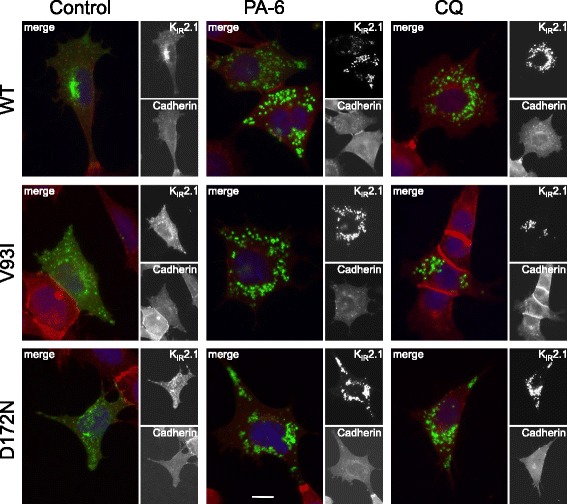
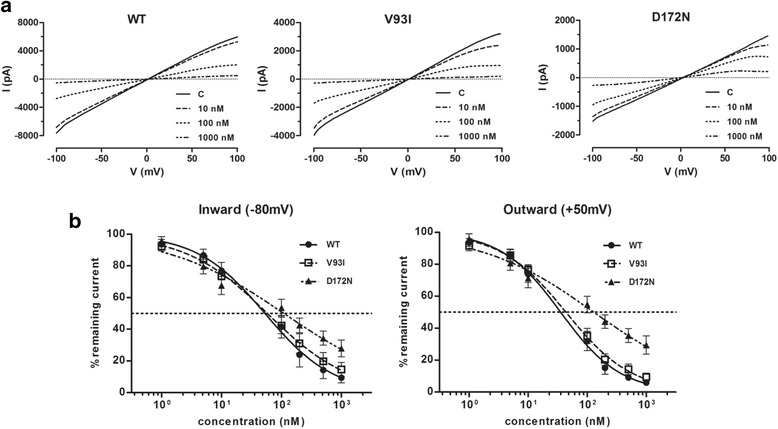
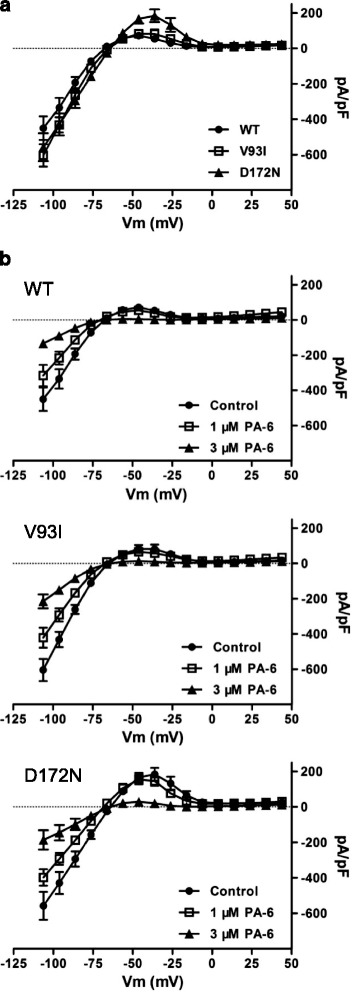
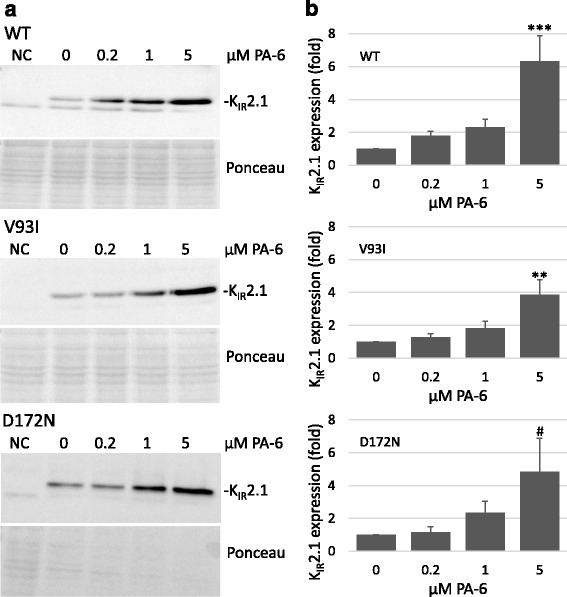
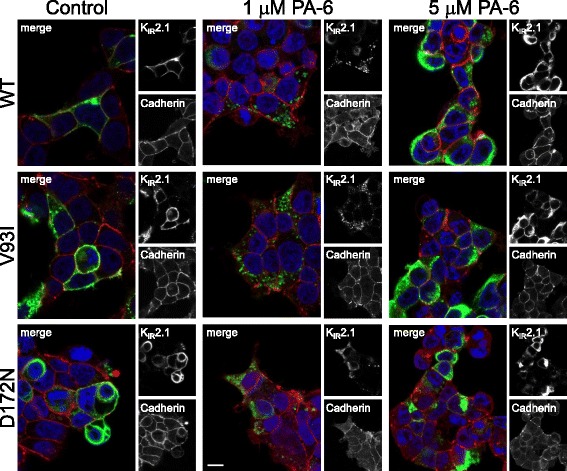
PA-6 docking in the V93I/D172N double mutant homology model of K2.1 demonstrated that mutations and drug-binding site are >30 Å apart. PA-6 inhibited WT and V93I outward currents with similar potency (IC = 35.5 and 43.6 nM at +50 mV for WT and V93I), whereas D172N currents were less sensitive (IC = 128.9 nM at +50 mV) using inside-out patch-clamp electrophysiology. In whole cell mode, 1 μM of PA-6 inhibited outward I at -50 mV by 28 ± 36%, 18 ± 20% and 10 ± 6%, for WT, V93I and D172N channels respectively. Western blot analysis demonstrated that PA-6 (5 μM, 24 h) increased K2.1 expression levels of WT (6.3 ± 1.5 fold), and V93I (3.9 ± 0.9) and D172N (4.8 ± 2.0) mutants. Immunofluorescent microscopy demonstrated dose-dependent intracellular K2.1 accumulation following chronic PA-6 application (24 h, 1 and 5 μM).
内向整流钾电流 I 有助于稳定心肌动作电位的静息膜电位和 3 相复极化。KCNJ2 功能获得性突变 V93I 和 D172N 与 I 的增加、3 型短 QT 综合征和先天性心房颤动有关。戊二脒类似物 6(PA-6)是一种有效的(用膜片钳内面向外技术测定的 IC = 14 nM)和特异性 I 抑制剂,与 K2.1 离子通道的细胞质孔区相互作用,该通道由 KCNJ2 编码。在 10 μM 时,PA-6 可增加慢性治疗后野生型(WT)K2.1 在 HEK293T 细胞中的表达。我们假设 PA-6 将与 V93I 和 D172N K2.1 通道相互作用并抑制它们,而在质膜上的通道表达需要更高的浓度。
使用 FlexX 对人 K2.1 关闭状态同源模型进行分子建模。在 HEK293 细胞中表达 WT 和突变 K2.1 通道。在全细胞和膜片钳内面向外模式下进行膜片钳单细胞电生理测量。通过 Western blot 分析和免疫荧光显微镜分别确定 K2.1 的表达水平和定位。
PA-6 在 K2.1 的 V93I/D172N 双突变同源模型中的对接表明,突变和药物结合位点相距 >30 Å。PA-6 以相似的效力抑制 WT 和 V93I 外向电流(WT 和 V93I 在 +50 mV 时的 IC = 35.5 和 43.6 nM),而 D172N 电流的敏感性较低(在 +50 mV 时的 IC = 128.9 nM)使用膜片钳内面向外电生理学。在全细胞模式下,1 μM 的 PA-6 在 -50 mV 时抑制 WT、V93I 和 D172N 通道的外向 I 分别为 28 ± 36%、18 ± 20%和 10 ± 6%。Western blot 分析表明,PA-6(5 μM,24 小时)使 WT(6.3 ± 1.5 倍)、V93I(3.9 ± 0.9)和 D172N(4.8 ± 2.0)突变体的 K2.1 表达水平增加。免疫荧光显微镜显示,慢性 PA-6 应用后(24 小时,1 和 5 μM),细胞内 K2.1 积累呈剂量依赖性。
1)K2.1 离子通道中的 KCNJ2 功能获得性突变 V93I 和 D172N 并不损害 PA-6 介导的 I 抑制,2)PA-6 可增加 K2.1 蛋白表达并诱导细胞内 K2.1 积累,3)PA-6 是治疗先天性 SQT3 和 AF 的进一步临床前评估的有力候选药物。