Orygen, The National Centre of Excellence in Youth Mental Health, The University of Melbourne, Parkville, Victoria, Australia.
Centre for Youth Mental Health, The University of Melbourne, Parkville, Victoria, Australia.
Early Interv Psychiatry. 2018 Jun;12(3):292-306. doi: 10.1111/eip.12459. Epub 2017 Jul 18.
Previous research indicates that preventive intervention is likely to benefit patients "at risk" of psychosis, in terms of functional improvement, symptom reduction and delay or prevention of onset of threshold psychotic disorder. The primary aim of the current study is to test outcomes of ultra high risk (UHR) patients, primarily functional outcome, in response to a sequential intervention strategy consisting of support and problem solving (SPS), cognitive-behavioural case management and antidepressant medication. A secondary aim is to test biological and psychological variables that moderate and mediate response to this sequential treatment strategy.
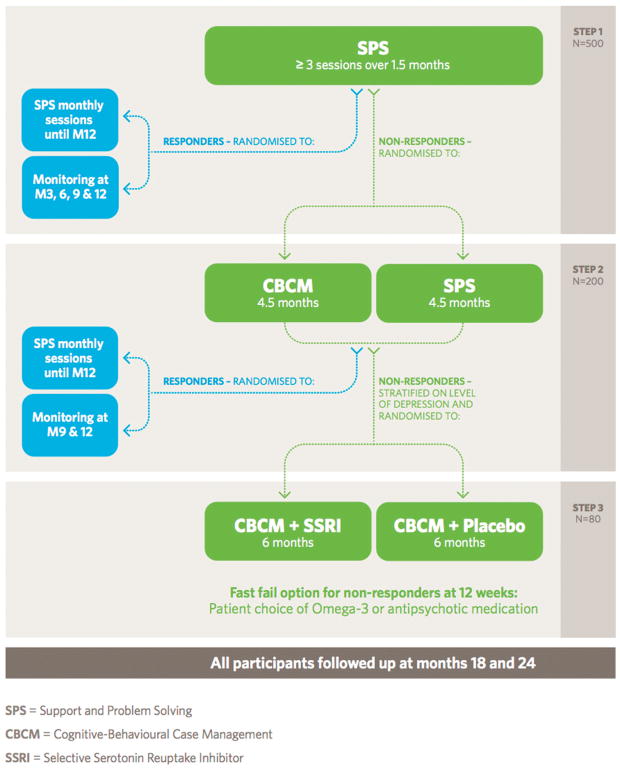
This is a sequential multiple assignment randomised trial (SMART) consisting of three steps: Step 1: SPS (1.5 months); Step 2: SPS vs Cognitive Behavioural Case Management (4.5 months); Step 3: Cognitive Behavioural Case Management + Antidepressant Medication vs Cognitive Behavioural Case Management + Placebo (6 months). The intervention is of 12 months duration in total and participants will be followed up at 18 months and 24 months post baseline.
This paper reports on the rationale and protocol of the Staged Treatment in Early Psychosis (STEP) study. With a large sample of 500 UHR participants this study will investigate the most effective type and sequence of treatments for improving functioning and reducing the risk of developing psychotic disorder in this clinical population.
先前的研究表明,预防干预可能有益于处于精神病前期的“高危”患者,这体现在功能改善、症状减轻、以及发病阈值性精神病障碍的延迟或预防上。本研究的主要目的是检验超高危(UHR)患者的预后,主要是功能预后,他们接受的是包括支持和问题解决(SPS)、认知行为管理和抗抑郁药物在内的序贯干预策略。次要目的是检验生物和心理变量对这种序贯治疗策略的调节和中介作用。
这是一项由三个步骤组成的序贯多重分配随机试验(SMART):步骤 1:SPS(1.5 个月);步骤 2:SPS 与认知行为管理(4.5 个月);步骤 3:认知行为管理+抗抑郁药与认知行为管理+安慰剂(6 个月)。干预总共持续 12 个月,参与者将在基线后 18 个月和 24 个月进行随访。
本文报告了早期精神病分期治疗(STEP)研究的基本原理和方案。该研究纳入了 500 名 UHR 参与者的大样本,将调查改善功能和降低该临床人群出现精神病障碍风险的最有效治疗类型和顺序。