Chen Xiao-Qing, Zhou Chun-Xue, Elsheikha Hany M, He Shuai, Hu Gui-Xue, Zhu Xing-Quan
Department of Veterinary Medicine, College of Animal Science and Technology, Jilin Agricultural University, Changchun, Jilin Province, 130118, People's Republic of China.
State Key Laboratory of Veterinary Etiological Biology, Key Laboratory of Veterinary Parasitology of Gansu Province, Lanzhou Veterinary Research Institute, Chinese Academy of Agricultural Sciences, Lanzhou, Gansu Province, 730046, People's Republic of China.
Parasit Vectors. 2017 Jul 18;10(1):339. doi: 10.1186/s13071-017-2282-6.
Toxoplasma gondii, a common opportunistic protozoan, is a leading cause of illness and mortality among immunosuppressed individuals and during congenital infections. Current therapeutic strategies for toxoplasmosis are not fully effective at curtailing disease progression in these cases. Given the parasite ability to influence host immunity and metabolism, understanding of the metabolic alterations in the host's immune organs during T. gondii infection may enhance the understanding of the molecular mechanisms that define the pathophysiology of T. gondii infection.
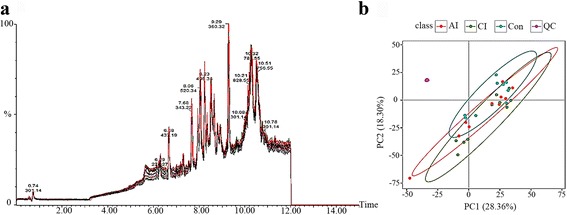
We investigated the global metabolic changes in the spleen of BALB/c mice at early and late stage of infection with T. gondii using LC-MS/MS-based metabolomics. Multivariate data analysis methods, principal components analysis (PCA) and partial least squares discriminant analysis (PLS-DA), were used to identify metabolites that are influenced by T. gondii infection.
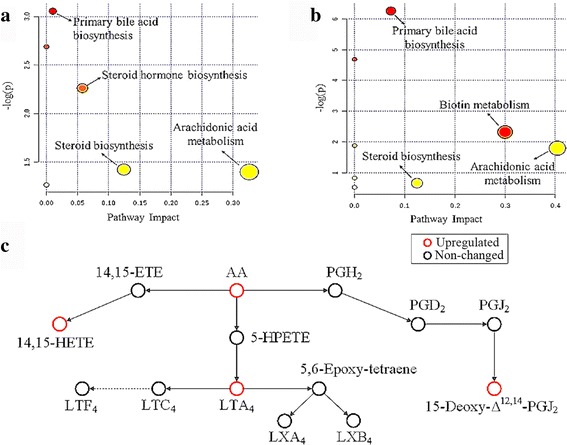
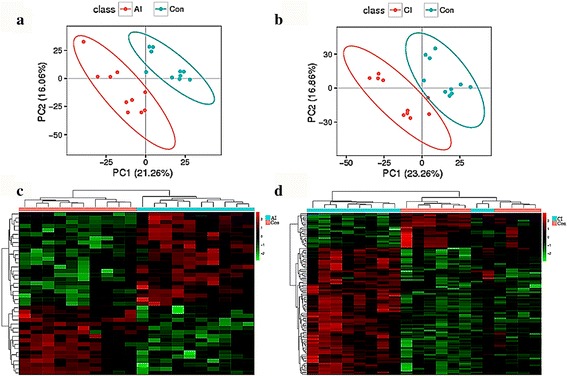
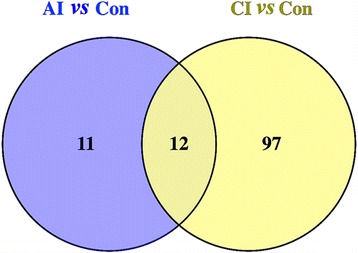
Multivariate analyses clearly separated the metabolites of spleen of infected and control mice. A total of 132 differential metabolites were identified, 23 metabolites from acutely infected versus control mice and 109 metabolites from chronically infected versus control mice. Lipids, hormones, lactones, acids, peptides, antibiotics, alkaloids and natural toxins were the most influenced chemical groups. There were 12 shared differential metabolites between acutely infected versus control mice and chronically infected versus control mice, of which 4,4-Dimethyl-5alpha-cholesta-8,14,24-trien-3beta-ol was significantly upregulated and ubiquinone-8 was significantly downregulated. Major perturbed metabolic pathways included primary bile acid biosynthesis, steroid hormone biosynthesis, biotin metabolism, and steroid biosynthesis, with arachidonic acid metabolism being the most significantly impacted pathway. These metabolic changes suggest a multifactorial nature of the immunometabolic responses of mouse spleen to T. gondii infection.
This study demonstrated that T. gondii infection can cause significant metabolomic alterations in the spleen of infected mice. These findings provide new insights into the molecular mechanisms that underpin the pathogenesis of T. gondii infection.
刚地弓形虫是一种常见的机会性原生动物,是免疫抑制个体发病和死亡以及先天性感染的主要原因。目前针对弓形虫病的治疗策略在遏制这些情况下的疾病进展方面并不完全有效。鉴于该寄生虫具有影响宿主免疫和代谢的能力,了解刚地弓形虫感染期间宿主免疫器官中的代谢改变可能会加深对界定刚地弓形虫感染病理生理学的分子机制的理解。
我们使用基于液相色谱-串联质谱的代谢组学方法,研究了BALB/c小鼠在感染刚地弓形虫早期和晚期脾脏中的整体代谢变化。采用多变量数据分析方法,即主成分分析(PCA)和偏最小二乘判别分析(PLS-DA),来识别受刚地弓形虫感染影响的代谢物。
多变量分析清楚地分离了感染小鼠和对照小鼠脾脏的代谢物。共鉴定出132种差异代谢物,急性感染小鼠与对照小鼠相比有23种代谢物,慢性感染小鼠与对照小鼠相比有109种代谢物。脂质、激素、内酯、酸、肽、抗生素、生物碱和天然毒素是受影响最大的化学类别。急性感染小鼠与对照小鼠以及慢性感染小鼠与对照小鼠之间有12种共同的差异代谢物,其中4,4-二甲基-5α-胆甾-8,14,24-三烯-3β-醇显著上调,泛醌-8显著下调。主要受干扰的代谢途径包括初级胆汁酸生物合成、类固醇激素生物合成、生物素代谢和类固醇生物合成,花生四烯酸代谢是受影响最显著的途径。这些代谢变化表明小鼠脾脏对刚地弓形虫感染的免疫代谢反应具有多因素性质。
本研究表明,刚地弓形虫感染可导致感染小鼠脾脏发生显著的代谢组学改变。这些发现为刚地弓形虫感染发病机制的分子机制提供了新的见解。