Knell Gregory, Gabriel Kelley Pettee, Businelle Michael S, Shuval Kerem, Wetter David W, Kendzor Darla E
Michael and Susan Dell Center for Healthy Living, Department of Health Promotion and Behavioral Sciences, University of Texas Health Science Center (UTHealth) at Houston, Houston, TX, United States.
Michael and Susan Dell Center for Healthy Living, Department of Epidemiology, Human Genetics & Environmental Sciences, University of Texas Health Science Center (UTHealth) at Houston, Austin, TX, United States.
J Med Internet Res. 2017 Jul 18;19(7):e253. doi: 10.2196/jmir.7602.
Ecological momentary assessment (EMA) may elicit physical activity (PA) estimates that are less prone to bias than traditional self-report measures while providing context.
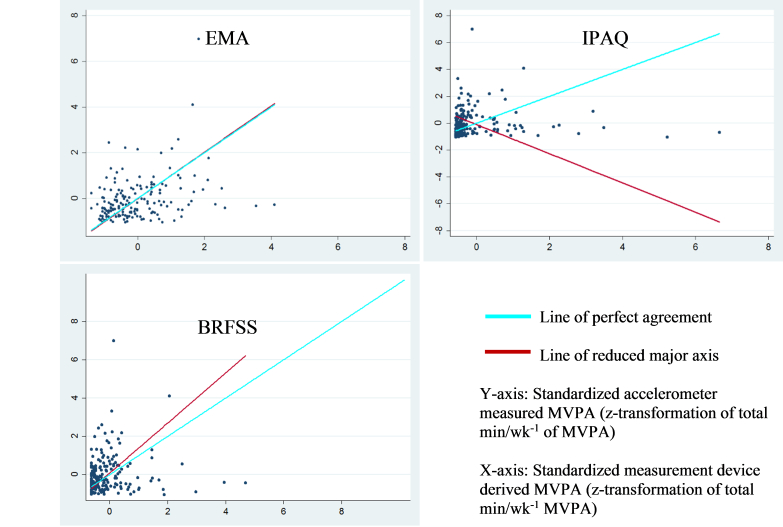
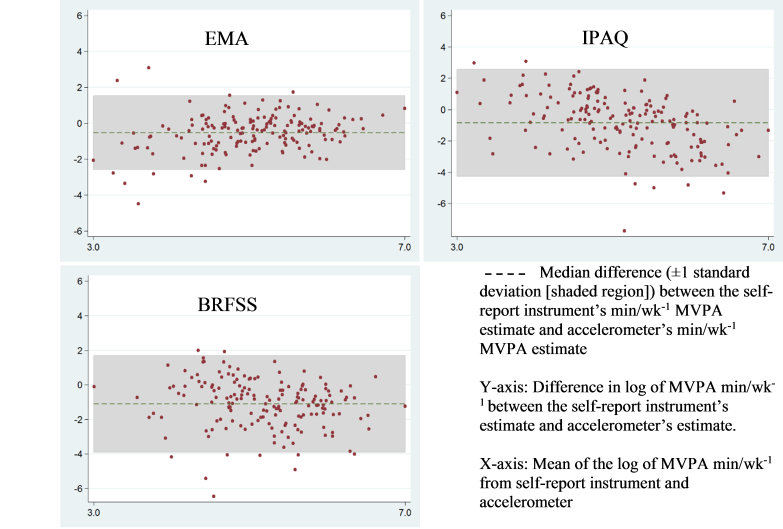
The objective of this study was to examine the convergent validity of EMA-assessed PA compared with accelerometry.
The participants self-reported their PA using International Physical Activity Questionnaire (IPAQ) and Behavioral Risk Factor Surveillance System (BRFSS) and wore an accelerometer while completing daily EMAs (delivered through the mobile phone) for 7 days. Weekly summary estimates included sedentary time and moderate-, vigorous-, and moderate-to vigorous-intensity physical activity (MVPA). Spearman coefficients and Lin's concordance correlation coefficients (LCC) examined the linear association and agreement for EMA and the questionnaires as compared with accelerometry.
Participants were aged 43.3 (SD 13.1) years, 51.7% (123/238) were African American, 74.8% (178/238) were overweight or obese, and 63.0% (150/238) were low income. The linear associations of EMA and traditional self-reports with accelerometer estimates were statistically significant (P<.05) for sedentary time (EMA: ρ=.16), moderate-intensity PA (EMA: ρ=.29; BRFSS: ρ=.17; IPAQ: ρ=.24), and MVPA (EMA: ρ=.31; BRFSS: ρ=.17; IPAQ: ρ=.20). Only EMA estimates of PA were statistically significant compared with accelerometer for agreement.
The mobile EMA showed better correlation and agreement to accelerometer estimates than traditional self-report methods. These findings suggest that mobile EMA may be a practical alternative to accelerometers to assess PA in free-living settings.
生态瞬时评估(EMA)可能得出比传统自我报告测量方法偏差更小的身体活动(PA)估计值,同时还能提供背景信息。
本研究的目的是检验与加速度计相比,EMA评估的PA的收敛效度。
参与者使用国际身体活动问卷(IPAQ)和行为危险因素监测系统(BRFSS)自我报告其PA,并在连续7天完成每日EMA(通过手机发送)时佩戴加速度计。每周汇总估计值包括久坐时间以及中等强度、高强度和中等至高强度身体活动(MVPA)。Spearman系数和Lin一致性相关系数(LCC)检验了EMA和问卷与加速度计相比的线性关联和一致性。
参与者年龄为43.3(标准差13.1)岁,51.7%(123/238)为非裔美国人,74.8%(178/238)超重或肥胖,63.0%(150/238)为低收入人群。对于久坐时间(EMA:ρ = 0.16)、中等强度PA(EMA:ρ = 0.29;BRFSS:ρ = 0.17;IPAQ:ρ = 0.24)和MVPA(EMA:ρ = 0.31;BRFSS:ρ = 0.17;IPAQ:ρ = 0.20),EMA和传统自我报告与加速度计估计值的线性关联具有统计学意义(P < 0.05)。与加速度计相比,仅PA的EMA估计值在一致性方面具有统计学意义。
移动EMA与加速度计估计值的相关性和一致性优于传统自我报告方法。这些发现表明,在自由生活环境中评估PA时,移动EMA可能是加速度计的一种实用替代方法。