Lau Christine Sm, Siracuse Brianna L, Chamberlain Ronald S
Department of Surgery, Saint Barnabas Medical Center, Livingston, NJ, USA.
Saint George's University School of Medicine, Grenada, West Indies.
Int J Chron Obstruct Pulmon Dis. 2017 Jun 29;12:1891-1902. doi: 10.2147/COPD.S136768. eCollection 2017.
COPD affects over 13 million Americans, and accounts for over half a million hospitalizations annually. The Hospital Readmission Reduction Program, established by the Affordable Care Act requires the Centers for Medicare and Medicaid Services to reduce payments to hospitals with excess readmissions for COPD as of 2015. This study sought to develop a predictive readmission scale to identify COPD patients at higher readmission risk.
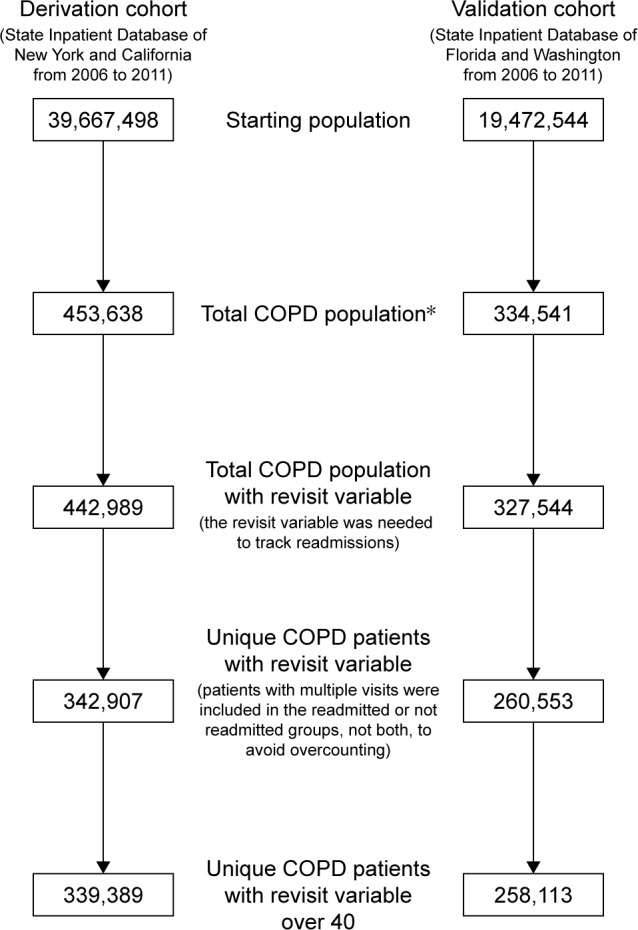
Demographic and clinical data on 339,389 patients from New York and California (derivation cohort) and 258,113 patients from Washington and Florida (validation cohort) were abstracted from the State Inpatient Database (2006-2011), and the Readmission After COPD Exacerbation (RACE) Scale was developed to predict 30-day readmission risk.
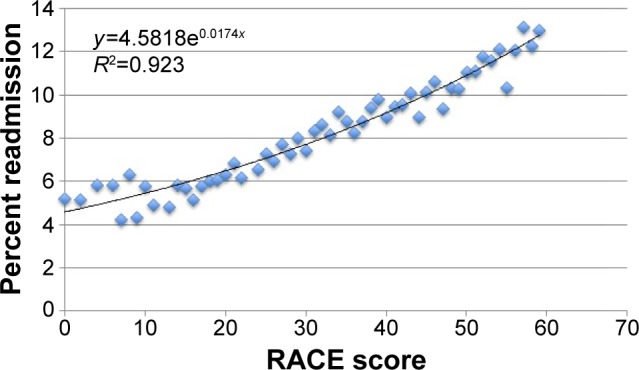
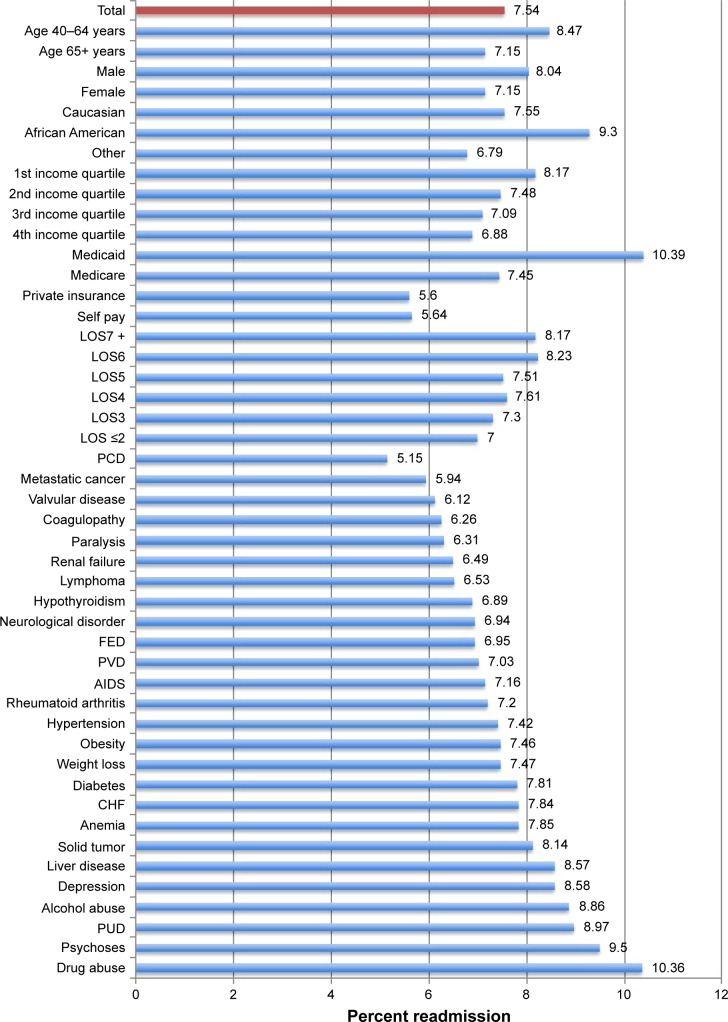
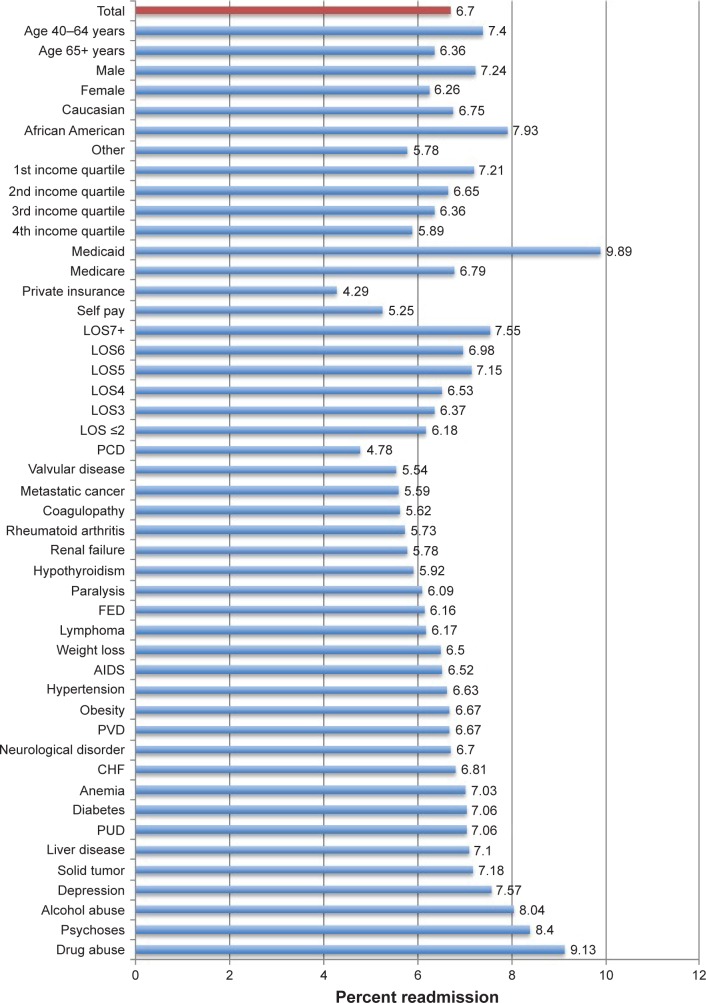
Thirty-day COPD readmission rates were 7.54% for the derivation cohort and 6.70% for the validation cohort. Factors including age 40-65 years (odds ratio [OR] 1.17; 95% CI, 1.12-1.21), male gender (OR 1.16; 95% CI, 1.13-1.19), African American (OR 1.11; 95% CI, 1.06-1.16), 1st income quartile (OR 1.10; 95% CI, 1.06-1.15), 2nd income quartile (OR 1.06; 95% CI, 1.02-1.10), Medicaid insured (OR 1.83; 95% CI, 1.73-1.93), Medicare insured (OR 1.45; 95% CI, 1.38-1.52), anemia (OR 1.05; 95% CI, 1.02-1.09), congestive heart failure (OR 1.06; 95% CI, 1.02-1.09), depression (OR 1.18; 95% CI, 1.14-1.23), drug abuse (OR 1.17; 95% CI, 1.09-1.25), and psychoses (OR 1.19; 95% CI, 1.13-1.25) were independently associated with increased readmission rates, <0.01. When the devised RACE scale was applied to both cohorts together, it explained 92.3% of readmission variability.
The RACE Scale reliably predicts an individual patient's 30-day COPD readmission risk based on specific factors present at initial admission. By identifying these patients at high risk of readmission with the RACE Scale, patient-specific readmission-reduction strategies can be implemented to improve patient care as well as reduce readmissions and health care expenditures.
慢性阻塞性肺疾病(COPD)影响着超过1300万美国人,每年导致超过50万人住院治疗。《平价医疗法案》设立的医院再入院减少计划要求医疗保险和医疗补助服务中心自2015年起减少对COPD再入院率过高的医院的支付。本研究旨在开发一种预测再入院的量表,以识别再入院风险较高的COPD患者。
从州住院数据库(2006 - 2011年)中提取了来自纽约和加利福尼亚的339389名患者(推导队列)以及来自华盛顿和佛罗里达的258113名患者(验证队列)的人口统计学和临床数据,并开发了慢性阻塞性肺疾病急性加重后再入院(RACE)量表来预测30天再入院风险。
推导队列的30天COPD再入院率为7.54%,验证队列为6.70%。包括40 - 65岁(比值比[OR] 1.17;95%置信区间[CI],1.12 - 1.21)、男性(OR 1.16;95% CI,1.13 - 1.19)、非裔美国人(OR 1.11;95% CI,1.06 - 1.16)、第一收入四分位数(OR 1.10;95% CI,1.06 - 1.15)、第二收入四分位数(OR 1.06;95% CI,1.02 - 1.10)、医疗补助参保者(OR 1.83;95% CI,1.73 - 1.93)、医疗保险参保者(OR 1.45;95% CI,1.38 - 1.52)、贫血(OR 1.05;95% CI,1.02 - 1.09)、充血性心力衰竭(OR 1.06;95% CI,1.02 - 1.09)、抑郁症(OR 1.18;95% CI,1.14 - 1.23)、药物滥用(OR 1.17;95% CI,1.09 - 1.25)和精神病(OR 1.19;95% CI,1.13 - 1.25)等因素与再入院率增加独立相关,P < 0.01。当将设计的RACE量表应用于两个队列时,它解释了92.3%的再入院变异性。
RACE量表基于初次入院时存在的特定因素可靠地预测个体患者30天COPD再入院风险。通过使用RACE量表识别这些再入院高风险患者,可以实施针对患者的再入院减少策略,以改善患者护理,同时减少再入院率和医疗保健支出。