Burlacu Alexandru, Siriopol Dimitrie, Nistor Ionut, Voroneanu Luminita, Nedelciuc Igor, Statescu Cristian, Covic Adrian
Department of Interventional Cardiology, Cardiovascular Diseases Institute, Iasi, Romania.
Department of Nephrology, University of Medicine 'Gr. T. Popa', Iasi, Romania.
Arch Med Sci. 2017 Jun;13(4):837-844. doi: 10.5114/aoms.2016.60374. Epub 2016 Jun 6.
In ST-elevation myocardial infarction (STEMI) patients, multisite artery disease represents a serious issue influencing evolution, outcomes and prognosis. We evaluated for the first time the power of the Myocardial Infarction SYNTAX Score (MI SS) and Clinical SYNTAX Score (MI CSS) as predictors for renal artery stenosis (RAS) in STEMI. We also stratified the study population according to the two scores, and identified the variables correlated with the higher score.
We used data from the REN-ACS study, which included 181 consecutive patients prospectively investigated for presence of RAS (through renal angiography), arterial stiffness (carotid-femoral pulse wave velocity, cf-PWV) and hydration status (bioimpedance). MI SS and CSS were computed.
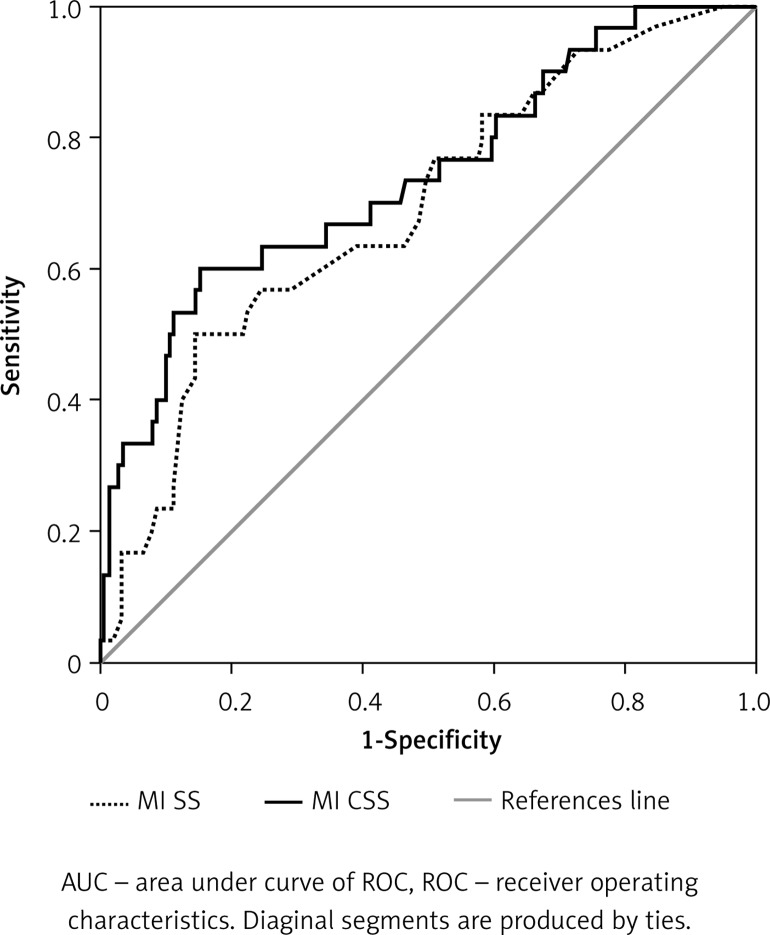
Multivariate regressions indicated that the independent variables correlated with MI SS were left ventricular ejection fraction < 40%, significant RAS (> 50%, defined as RAS+), history of heart failure, and multivascular coronary disease (CAD, < 0.03 for each), while those correlated with MI CSS were RAS+, cf-PWV, history of CAD, multivascular CAD, cholesterol, and total body water ( < 0.02 for each). In order to evaluate the ability to predict RAS+ we generated receiver operating characteristics and areas under curves, and the Youden index for MI SS and CSS.
Both scores correlated with extensive atherosclerotic disease and presence of RAS+. A lower CSS proved to be a good predictor for exclusion of RAS+, with high specificity (85%) and negative predictive value (92%), and fair sensitivity (60%). We aim to further pursue this line of research and design a better predictor for RAS, with the inclusion of a novel biomarker in order to increase sensitivity.
在ST段抬高型心肌梗死(STEMI)患者中,多部位动脉疾病是影响病情发展、结局和预后的严重问题。我们首次评估了心肌梗死SYNTAX评分(MI SS)和临床SYNTAX评分(MI CSS)作为STEMI患者肾动脉狭窄(RAS)预测指标的效能。我们还根据这两个评分对研究人群进行分层,并确定与较高评分相关的变量。
我们使用了REN-ACS研究的数据,该研究前瞻性地纳入了181例连续患者,对其进行RAS(通过肾血管造影)、动脉僵硬度(颈股脉搏波速度,cf-PWV)和水化状态(生物电阻抗)的检查。计算MI SS和CSS。
多因素回归分析表明,与MI SS相关的独立变量为左心室射血分数<40%、显著RAS(>50%,定义为RAS+)、心力衰竭病史和多支血管冠状动脉疾病(CAD,每项<0.03),而与MI CSS相关的独立变量为RAS+、cf-PWV、CAD病史、多支血管CAD、胆固醇和全身水含量(每项<0.02)。为了评估预测RAS+的能力,我们绘制了受试者工作特征曲线和曲线下面积,并计算了MI SS和CSS的约登指数。
两个评分均与广泛的动脉粥样硬化疾病和RAS+的存在相关。较低的CSS被证明是排除RAS+的良好预测指标,具有高特异性(85%)和阴性预测值(92%),以及中等敏感性(60%)。我们旨在进一步开展这方面的研究,并设计出更好的RAS预测指标,纳入一种新型生物标志物以提高敏感性。