Gállego Suárez Cecilia, Singer Benjamin H, Gebremariam Achamyeleh, Lee Joyce M, Singer Kanakadurga
Department of Pediatrics and Communicable Diseases, Division of Pediatric Endocrinology and Metabolism, University of Michigan Medical School, Ann Arbor, Michigan, United States of America.
Department of Internal Medicine, Division of Pulmonary and Critical Care Medicine, University of Michigan Medical School, Ann Arbor, Michigan, United States of America.
PLoS One. 2017 Jul 19;12(7):e0181587. doi: 10.1371/journal.pone.0181587. eCollection 2017.
In adults, obesity has been associated with several health outcomes including increased bone density. Our objective was to evaluate the association between percent body fat and fat mass with bone mineral density (BMD) in a nationally representative population of children and adolescents.
A total of 8,348 participants 8-18 years of age from the National Health and Nutrition Examination Survey (NHANES) 1999-2006 had whole body DXA scans performed. We conducted linear regressions to examine the relationship between percent body fat and fat mass with outcome variables of total body, pelvic and lumbar spine areal BMD (aBMD), controlling for lean body mass and assessing for gender and race/ethnicity interactions.
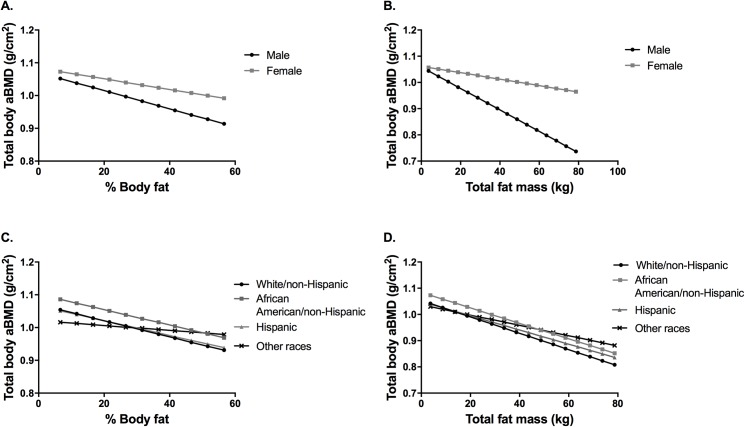
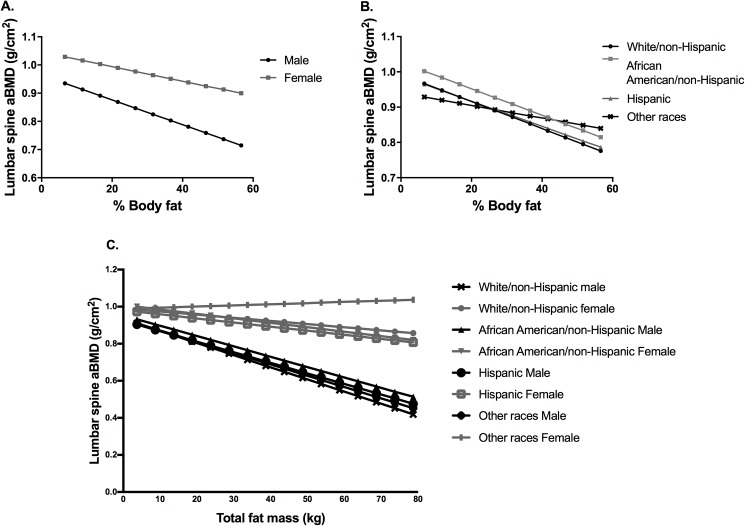
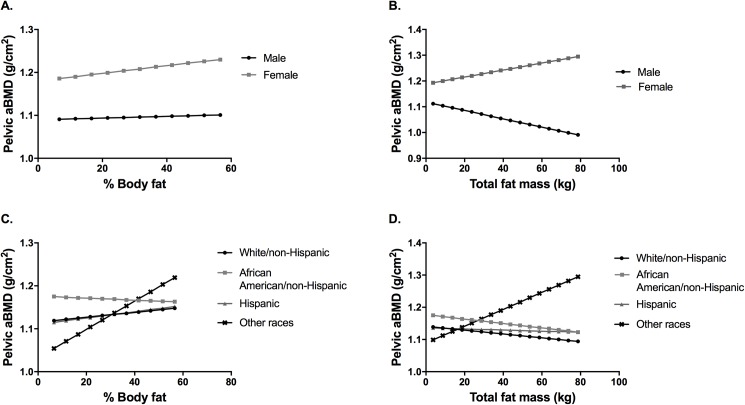
We found evidence of gender and race/ethnicity interactions with percent body fat and total fat mass for the different BMD areas. Generally, there were decreases in total body aBMD (p<0.001) and lumbar spine aBMD (p<0.001) with increasing percent body fat and total fat mass, with less consistent patterns for pelvic aBMD.
Our findings of regional differences in the relationship of adiposity to aBMD in children and adolescents with significant interactions by gender and race/ethnicity emphasizes the need for further investigations to understand the impact of adiposity on bone health outcomes.
在成年人中,肥胖与多种健康结果相关,包括骨密度增加。我们的目的是在全国代表性的儿童和青少年人群中评估体脂百分比和脂肪量与骨矿物质密度(BMD)之间的关联。
对1999 - 2006年国家健康与营养检查调查(NHANES)中8348名8至18岁的参与者进行了全身双能X线吸收测定(DXA)扫描。我们进行了线性回归分析,以检验体脂百分比和脂肪量与全身、骨盆和腰椎面积骨密度(aBMD)等结果变量之间的关系,同时控制瘦体重,并评估性别和种族/族裔的相互作用。
我们发现不同骨密度区域在体脂百分比和总脂肪量方面存在性别和种族/族裔的相互作用。一般来说,随着体脂百分比和总脂肪量的增加,全身aBMD(p<0.001)和腰椎aBMD(p<0.001)下降,而骨盆aBMD的变化模式不太一致。
我们关于儿童和青少年肥胖与aBMD关系存在区域差异且有显著性别和种族/族裔相互作用的研究结果强调,需要进一步开展调查以了解肥胖对骨骼健康结果的影响。