Department of Medical Oncology, Liaoning Cancer Hospital and Institute, Cancer Hospital of China Medical University, Shenyang, Liaoning, 110042, People's Republic of China.
Department of Medical Oncology, The First Hospital of China Medical University, Shenyang, Liaoning, 110001, People's Republic of China.
BMC Cancer. 2017 Jul 19;17(1):492. doi: 10.1186/s12885-017-3457-4.
Although the efficacy of tamoxifen (TAM) for breast cancer has been attributed to inducing cell cycle arrest and apoptosis by inhibiting estrogen receptor (ER) signaling, recent evidence indicates that TAM also possesses ER-independent antitumor activity through an unclear mechanism. The present study investigated the anti-tumor mechanism of TAM on mesenchymal triple-negative breast cancer (TNBC).
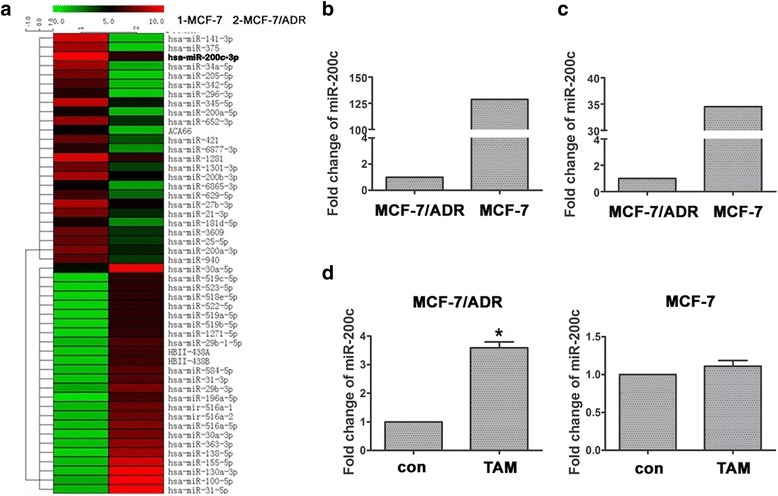
The inhibitory effect of TAM on tumor migration and metastasis was analyzed by transwell chamber in vitro and by murine xenograft model in vivo. The promoter sequence of miR-200c was predicted by an online CpG island predictor. Relative expression of miR-200c was measured by quantitative real-time PCR.
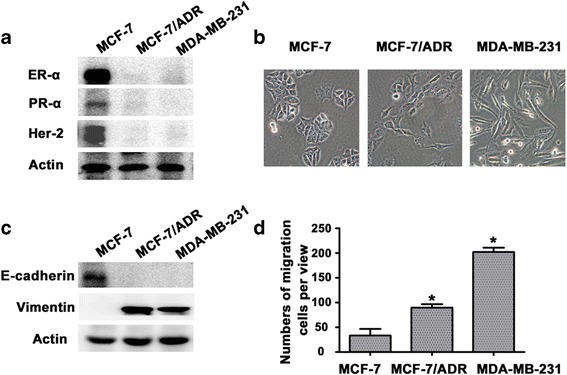
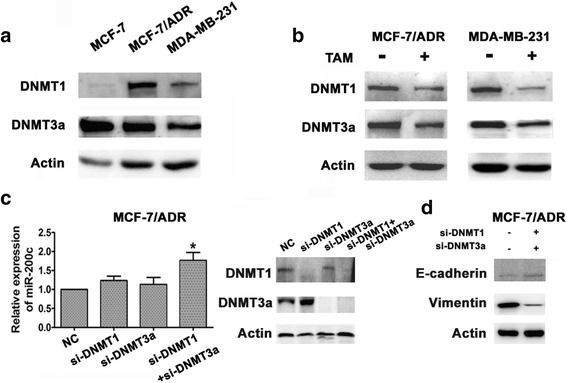
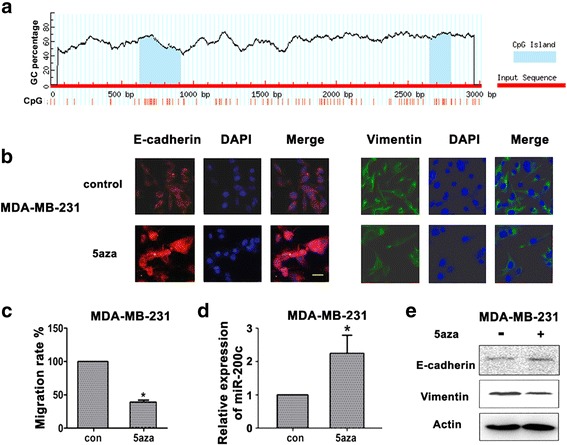
After treatment with TAM, mesenchymal TNBC cells (MCF-7/ADR and MDA-MB-231) morphologically changed from mesenchymal to epithelial types. Meanwhile, cell migration ability was also significantly decreased in ER-positive breast cancer cells after exposure to TAM. Consistent with these in-vitro results, TAM significantly suppressed lung metastasis rate of mesenchymal TNBC cells in murine xenograft tumors. miRNA array analysis of two types of breast cancer cells showed that miR-200c expression was inhibited in mesenchymal TNBC cells, but increased after TAM treatment due to demethylation of miR-200c promoters.
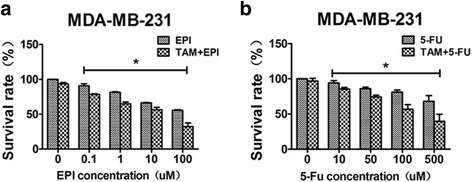
Our results indicate that TAM inhibits cell migration and enhances chemosensitivity of mesenchymal TNBC cells by reversing their EMT-like property; and that this EMT-reversal effect results from upregulation of miR-200c through demethylating its promoter. To our knowledge, this is the first explanation of a non-ER-related mechanism for the effect of TAM on mesenchymal TNBC cells.
尽管他莫昔芬(TAM)通过抑制雌激素受体(ER)信号诱导细胞周期停滞和细胞凋亡,从而对乳腺癌产生疗效,但最近的证据表明,TAM 还通过一种尚不清楚的机制具有非 ER 依赖性抗肿瘤活性。本研究探讨了 TAM 对间充质三阴性乳腺癌(TNBC)的抗肿瘤机制。
通过体外 Transwell 室和体内小鼠异种移植模型分析 TAM 对肿瘤迁移和转移的抑制作用。miR-200c 的启动子序列通过在线 CpG 岛预测器进行预测。定量实时 PCR 测量 miR-200c 的相对表达。
TAM 处理后,间充质 TNBC 细胞(MCF-7/ADR 和 MDA-MB-231)形态从间充质型转变为上皮型。同时,ER 阳性乳腺癌细胞暴露于 TAM 后迁移能力也显著降低。与这些体外结果一致,TAM 显著抑制了间充质 TNBC 细胞在小鼠异种移植肿瘤中的肺转移率。两种乳腺癌细胞的 miRNA 芯片分析显示,miR-200c 在间充质 TNBC 细胞中受到抑制,但由于 miR-200c 启动子的去甲基化,TAM 处理后表达增加。
我们的结果表明,TAM 通过逆转 EMT 样特性抑制间充质 TNBC 细胞的迁移并增强其化学敏感性;并且这种 EMT 逆转效应是通过去甲基化其启动子而上调 miR-200c 引起的。据我们所知,这是 TAM 对间充质 TNBC 细胞的非 ER 相关作用机制的首次解释。