Guo Jimin, Canaff Lucie, Rajadurai Charles Vincent, Fils-Aimé Nadège, Tian Jun, Dai Meiou, Korah Juliana, Villatoro Manuel, Park Morag, Ali Suhad, Lebrun Jean-Jacques
Division of Medical Oncology, Department of Medicine, McGill University Health Center, H7 Royal Victoria Hospital, 687 Pine Avenue West, Montreal, Quebec, H3A 1A1, Canada.
Rosalind and Morris Goodman Cancer Center, 1160 Pine Avenue West, Montreal, Quebec, H3A 1A3, Canada.
Breast Cancer Res. 2014 Dec 13;16(6):476. doi: 10.1186/s13058-014-0476-9.
This study helps to define the implications of breast cancer anti-estrogen resistance 3 (BCAR3) in breast cancer and extends the current understanding of its molecular mechanism of action. BCAR3 has been shown to promote cell proliferation, migration and attachment to extracellular matrix components. However, in a cohort of metastatic breast cancer patients who received tamoxifen treatment, high BCAR3 mRNA levels were associated with favorable progression-free survival outcome. These results suggest that, besides its established roles, BCAR3 may have additional mechanisms of action that regulate breast cancer aggressive phenotype. In this study, we investigated whether BCAR3 is a novel antagonist of the canonical transforming growth factor β (TGFβ) pathway, which induces potent migration and invasion responses in breast cancer cells.
We surveyed functional genomics databases for correlations between BCAR3 expression and disease outcomes of breast cancer patients. We also studied how BCAR3 could regulate the TGFβ/Smad signaling axis using Western blot analysis, coimmunoprecipitation and luciferase assays. In addition, we examined whether BCAR3 could modulate TGFβ-induced cell migration and invasion by using an automated imaging system and a confocal microscopy imaging-based matrix degradation assay, respectively.
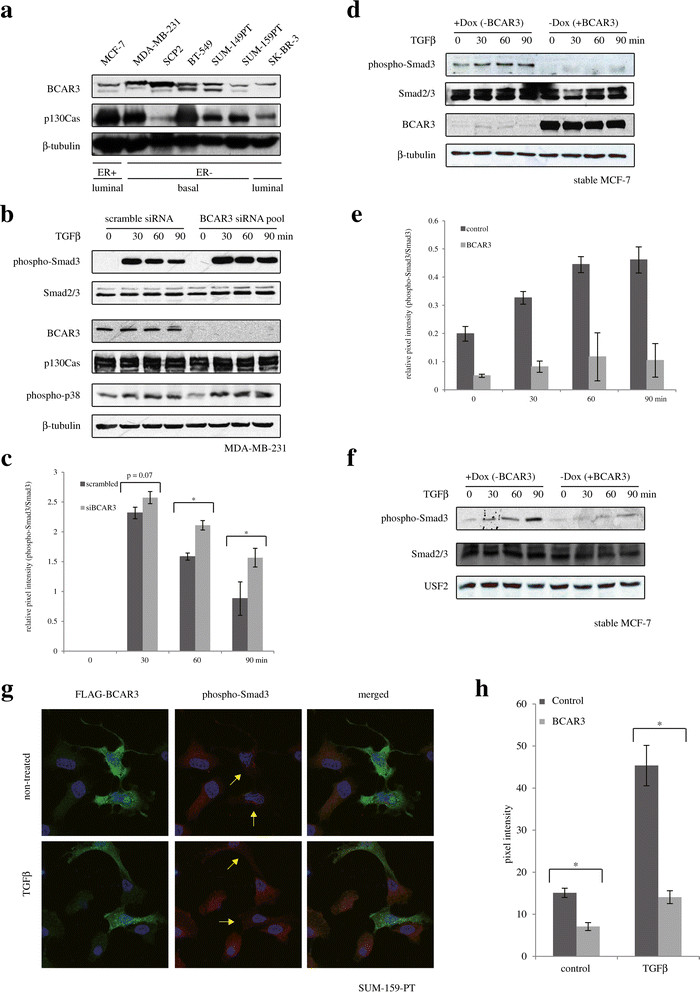
Relatively low levels of BCAR3 expression in primary breast tumors correlate with poor distant metastasis-free survival and relapse-free survival outcomes. We also found a strong correlation between the loss of heterozygosity at BCAR3 gene alleles and lymph node invasion in human breast cancer, further suggesting a role for BCAR3 in preventing disease progression. In addition, we found BCAR3 to inhibit Smad activation, Smad-mediated gene transcription, Smad-dependent cell migration and matrix digestion in breast cancer cells. Furthermore, we found BCAR3 to be downregulated by TGFβ through proteasome degradation, thus defining a novel positive feedback loop mechanism downstream of the TGFβ/Smad signaling pathway.
BCAR3 is considered to be associated with aggressive breast cancer phenotypes. However, our results indicate that BCAR3 acts as a putative suppressor of breast cancer progression by inhibiting the prometastatic TGFβ/Smad signaling pathway in invasive breast tumors. These data provide new insights into BCAR3's molecular mechanism of action and highlight BCAR3 as a novel TGFβ/Smad antagonist in breast cancer.
本研究有助于明确乳腺癌抗雌激素耐药3(BCAR3)在乳腺癌中的作用,并拓展了目前对其分子作用机制的认识。已有研究表明,BCAR3可促进细胞增殖、迁移以及与细胞外基质成分的附着。然而,在一组接受他莫昔芬治疗的转移性乳腺癌患者中,BCAR3 mRNA高水平与较好的无进展生存结果相关。这些结果提示,除了其已明确的作用外,BCAR3可能还具有调节乳腺癌侵袭性表型的其他作用机制。在本研究中,我们调查了BCAR3是否是经典转化生长因子β(TGFβ)信号通路的新型拮抗剂,该信号通路可诱导乳腺癌细胞产生强烈的迁移和侵袭反应。
我们在功能基因组学数据库中调查了BCAR3表达与乳腺癌患者疾病预后之间的相关性。我们还通过蛋白质印迹分析、免疫共沉淀和荧光素酶测定研究了BCAR3如何调节TGFβ/Smad信号轴。此外,我们分别使用自动成像系统和基于共聚焦显微镜成像的基质降解试验,研究了BCAR3是否能调节TGFβ诱导的细胞迁移和侵袭。
原发性乳腺肿瘤中BCAR3表达水平相对较低与远处无转移生存和无复发生存结果较差相关。我们还发现,BCAR3基因等位基因杂合性缺失与人乳腺癌中的淋巴结侵袭之间存在强烈相关性,进一步表明BCAR3在预防疾病进展中发挥作用。此外,我们发现BCAR3可抑制乳腺癌细胞中的Smad激活、Smad介导的基因转录、Smad依赖性细胞迁移和基质消化。此外,我们发现TGFβ可通过蛋白酶体降解使BCAR3下调,从而在TGFβ/Smad信号通路下游定义了一种新型正反馈环机制。
BCAR3被认为与侵袭性乳腺癌表型相关。然而,我们的结果表明,BCAR3通过抑制侵袭性乳腺肿瘤中促进转移的TGFβ/Smad信号通路,作为乳腺癌进展的假定抑制因子发挥作用。这些数据为BCAR3的分子作用机制提供了新的见解,并突出了BCAR3作为乳腺癌中新型TGFβ/Smad拮抗剂的作用。