Hofmeester Tim R, Jansen Patrick A, Wijnen Hendrikus J, Coipan Elena C, Fonville Manoj, Prins Herbert H T, Sprong Hein, van Wieren Sipke E
Resource Ecology Group, Wageningen University and Research, Droevendaalsesteeg 3a, 6708 PB Wageningen, The Netherlands
Resource Ecology Group, Wageningen University and Research, Droevendaalsesteeg 3a, 6708 PB Wageningen, The Netherlands.
Proc Biol Sci. 2017 Jul 26;284(1859). doi: 10.1098/rspb.2017.0453.
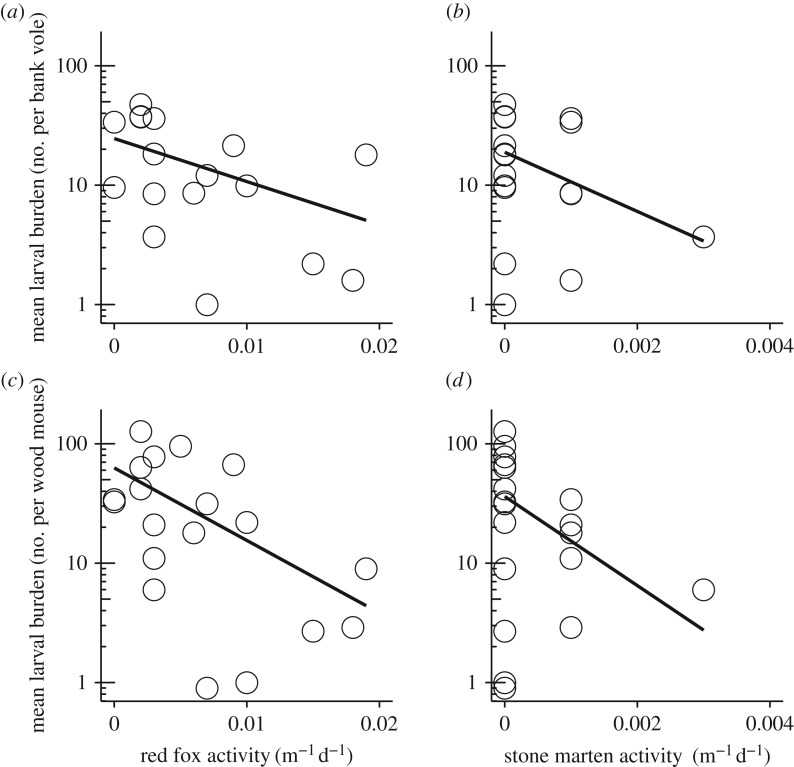
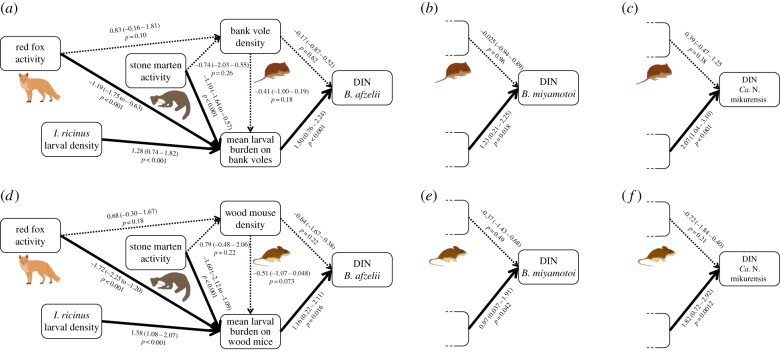
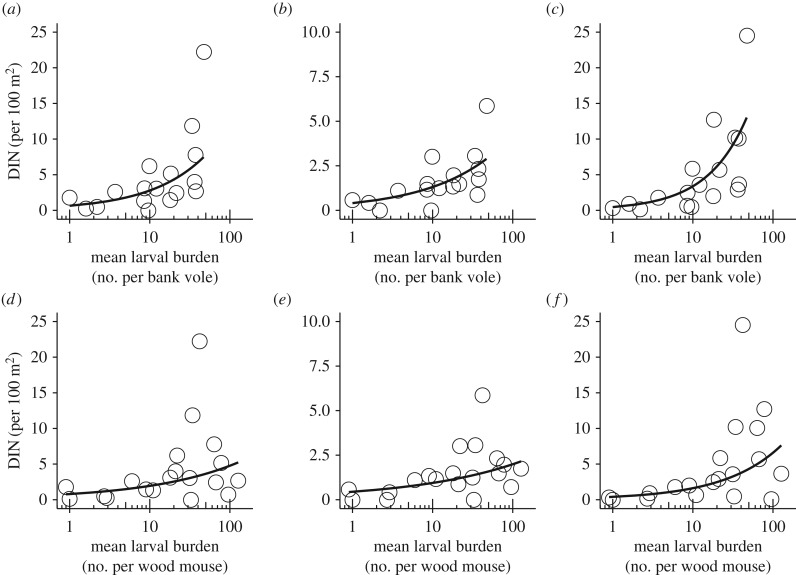
Predators and competitors of vertebrates can in theory reduce the density of infected nymphs (DIN)-an often-used measure of tick-borne disease risk-by lowering the density of reservoir-competent hosts and/or the tick burden on reservoir-competent hosts. We investigated this possible indirect effect of predators by comparing data from 20 forest plots across the Netherlands that varied in predator abundance. In each plot, we measured the density of questing nymphs (DON), DIN for three pathogens, rodent density, the tick burden on rodents and the activity of mammalian predators. We analysed whether rodent density and tick burden on rodents were correlated with predator activity, and how rodent density and tick burden predicted DON and DIN for the three pathogens. We found that larval burden on two rodent species decreased with activity of two predator species, while DON and DIN for all three pathogens increased with larval burden on rodents, as predicted. Path analyses supported an indirect negative correlation of activity of both predator species with DON and DIN. Our results suggest that predators can indeed lower the number of ticks feeding on reservoir-competent hosts, which implies that changes in predator abundance may have cascading effects on tick-borne disease risk.
脊椎动物的捕食者和竞争者理论上可以通过降低宿主的密度和/或宿主身上蜱虫的数量,来降低受感染若虫的密度(DIN),这是衡量蜱传疾病风险的常用指标。我们通过比较荷兰20个森林地块的数据来研究捕食者的这种可能的间接影响,这些地块的捕食者丰度各不相同。在每个地块中,我们测量了寻觅若虫的密度(DON)、三种病原体的DIN、啮齿动物的密度、啮齿动物身上的蜱虫数量以及哺乳动物捕食者的活动情况。我们分析了啮齿动物的密度和啮齿动物身上的蜱虫数量是否与捕食者的活动相关,以及啮齿动物的密度和蜱虫数量如何预测三种病原体的DON和DIN。我们发现,两种啮齿动物物种身上的幼虫数量随着两种捕食者物种的活动而减少,而正如预测的那样,所有三种病原体的DON和DIN都随着啮齿动物身上的幼虫数量而增加。路径分析支持了两种捕食者物种的活动与DON和DIN之间的间接负相关。我们的结果表明,捕食者确实可以减少在宿主身上取食的蜱虫数量,这意味着捕食者丰度的变化可能对蜱传疾病风险产生连锁反应。