Guangdong Provincial Key Laboratory of Protein Function and Regulation in Agricultural Organisms, College of Life Sciences, South China Agricultural University, Guangzhou, Guangdong, 510642, P.R. China.
Key Laboratory of Zoonosis of Ministry of Agriculture, South China Agricultural University, Guangzhou, Guangdong, 510642, P.R. China.
Sci Rep. 2017 Jul 19;7(1):5889. doi: 10.1038/s41598-017-06199-8.
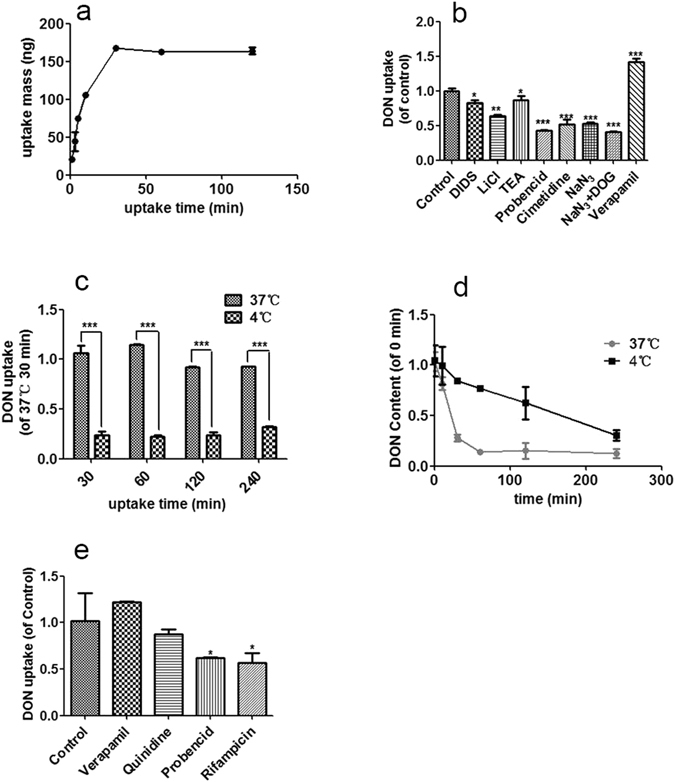
Deoxynivalenol (DON) is one of the most abundant mycotoxins and exerts many adverse effects on humans and animals. To date, the transporting mechanism of DON in mammalian cells remains unclear. In this study, the parallel artificial membrane permeability assay (PAMPA), Transwell models and metabolic inhibitors were used to determine the possible transporting mechanisms of DON in Caco-2, MDCK and HepG2 cells. PAMPA and Transwell models showed reduced passive transport and increased intestinal absorption, indicating a carrier-mediated transporting mechanism. Furthermore, higher unidirectional transport of DON was observed in the basolateral-to-apical direction than in the apical-to-basolateral direction, indicating the existence of efflux proteins. Interestingly, DON was accumulated in the nucleus, and no DON was detected in mitochondria, indicating that the nucleus may be the main target organelle of DON. Moreover, the use of various transporter inhibitors in different cells shows that organic anion transporters, organic cation transporters, and organic anion-transporting polypeptides participate in DON uptake, and P-glycoprotein is the major efflux protein. Importantly, DON uptake is strongly inhibited by metabolic inhibitors and is highly dependent on temperature. In summary, carrier-mediated and energy-dependent uptake and efflux mechanisms for DON in mammalian cells are reported, aiding in improving our understanding of its toxicological mechanisms.
脱氧雪腐镰刀菌烯醇(DON)是最丰富的霉菌毒素之一,对人类和动物有许多不良影响。迄今为止,DON 在哺乳动物细胞中的转运机制仍不清楚。在这项研究中,我们使用平行人工膜渗透率测定(PAMPA)、Transwell 模型和代谢抑制剂来确定 DON 在 Caco-2、MDCK 和 HepG2 细胞中的可能转运机制。PAMPA 和 Transwell 模型表明 DON 的被动转运减少,肠道吸收增加,表明存在载体介导的转运机制。此外,DON 在基底外侧到顶端的单向转运高于顶端到基底外侧的单向转运,表明存在外排蛋白。有趣的是,DON 在细胞核中积累,而在线粒体中未检测到 DON,表明细胞核可能是 DON 的主要靶细胞器。此外,在不同细胞中使用各种转运体抑制剂表明,有机阴离子转运体、有机阳离子转运体和有机阴离子转运多肽参与 DON 的摄取,而 P-糖蛋白是主要的外排蛋白。重要的是,DON 的摄取强烈地被代谢抑制剂抑制,并且高度依赖于温度。总之,报告了 DON 在哺乳动物细胞中通过载体介导和能量依赖的摄取和外排机制,有助于提高我们对其毒理学机制的理解。