Badu Eric, Opoku Maxwell P, Appiah Seth C Y
Department of Community Health, Center for Disability and Rehabilitation Studies, Kwame Nkrumah University of Science and Technology (KNUST), Ghana.
Department of Sociology and Social Work, Kwame Nkrumah University of Science and Technology (KNUST), Ghana.
Afr J Disabil. 2016 Aug 16;5(1):181. doi: 10.4102/ajod.v5i1.181. eCollection 2016.
Awareness of disability issues has gained considerable interest by advocacy groups in recent years. However, it is uncertain whether attitudes and perceptions of all service providers and society have adjusted accordingly towards the health care of people with disabilities. This study sought to examine the attitudes of health providers from the perspective of people with disabilities in the Kumasi Metropolis.
A cross-sectional study using semi-structured questionnaires was conducted with people with disabilities (with physical, hearing and visual impairments,) in the Kumasi Metropolis. The study used a multi-stage sampling involving cluster and simple random sampling to select 255 respondents split amongst the following five clusters of communities; Oforikrom, Subin, Asewase, Tafo and Asokwa. Data were analysed using STATA 14 and presented in descriptive and inferential statistics.
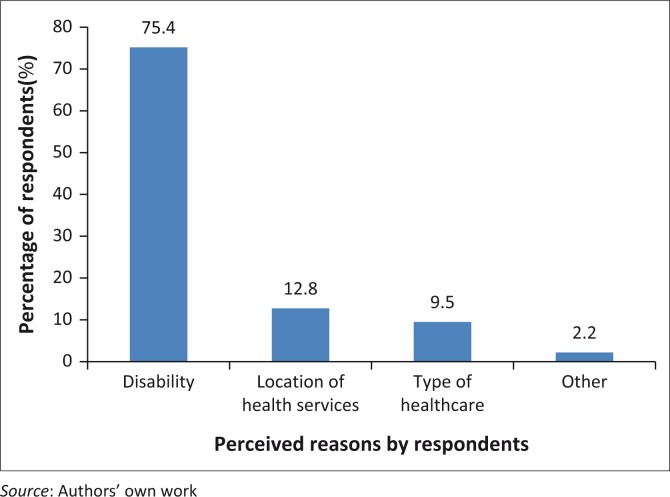
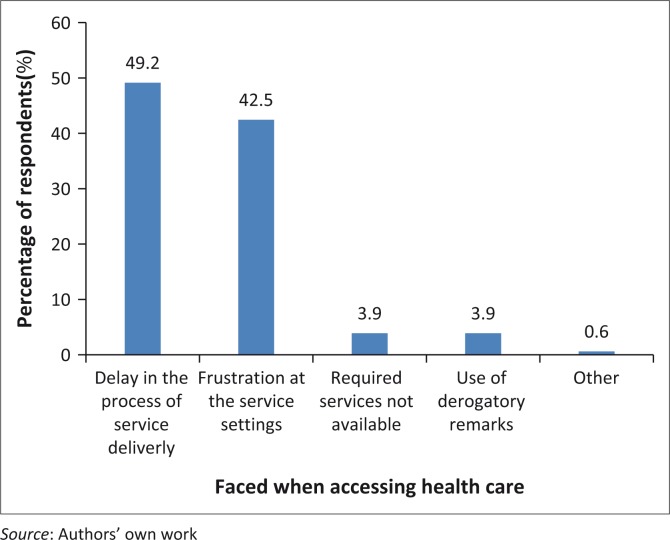
The study found that 71% of the respondents faced some form of discrimination including the use of derogatory remarks, frustration and unavailable required services on the basis of their disability, the type of services they need and the location. Women were 3.89 times more likely to face discrimination; Adjusted odds ratio (AOR) = 3.89 (95% confidence interval [CI]; 1.41, 10.76), and visually impaired was more likely to be discriminated at the facility compared with physical disability; AOR = 5.05 (95% CI; 1.44, 17.65). However, respondents with some educational qualification and those who stayed with their family members were less likely to face discrimination; AOR = 0.08 (95% CI; 0.01, 0.39).
The study recommends the provision of in-service training for service providers to update their knowledge on disability issues and improve access to services for people with disabilities.
近年来,残疾问题受到了倡导团体的广泛关注。然而,所有服务提供者和社会对残疾人医疗保健的态度和认知是否相应地有所调整尚不确定。本研究旨在从库马西都会区残疾人的角度审视医疗服务提供者的态度。
在库马西都会区,对患有身体、听力和视力障碍的残疾人进行了一项使用半结构化问卷的横断面研究。该研究采用多阶段抽样,包括整群抽样和简单随机抽样,从以下五个社区集群中选取了255名受访者;奥福里克罗姆、苏宾、阿塞瓦塞、塔福和阿索夸。使用STATA 14对数据进行分析,并以描述性和推断性统计呈现。
研究发现,71%的受访者面临某种形式的歧视,包括基于他们的残疾、所需服务类型和地点而遭受贬损性言论、挫折感以及无法获得所需服务。女性面临歧视的可能性高出3.89倍;调整后的优势比(AOR)= 3.89(95%置信区间[CI];1.41,10.76),与身体残疾相比,视力障碍者在医疗机构更易受到歧视;AOR = 5.05(95% CI;1.44,17.65)。然而,具有一定教育程度的受访者以及与家人同住的受访者面临歧视的可能性较小;AOR = 0.08(95% CI;0.01,0.39)。
该研究建议为服务提供者提供在职培训,以更新他们关于残疾问题的知识,并改善残疾人获得服务的机会。