Gisder Sebastian, Schüler Vivian, Horchler Lennart L, Groth Detlef, Genersch Elke
Department of Molecular Microbiology and Bee Diseases, Institute for Bee ResearchHohen Neuendorf, Germany.
Institute of Biochemistry and Biology, University of PotsdamPotsdam-Golm, Germany.
Front Cell Infect Microbiol. 2017 Jul 6;7:301. doi: 10.3389/fcimb.2017.00301. eCollection 2017.
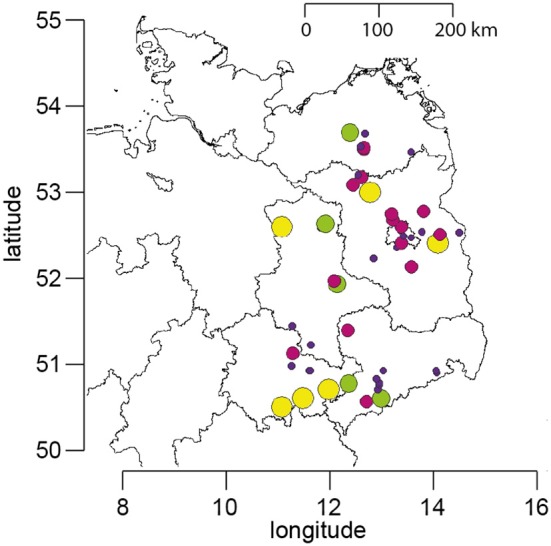
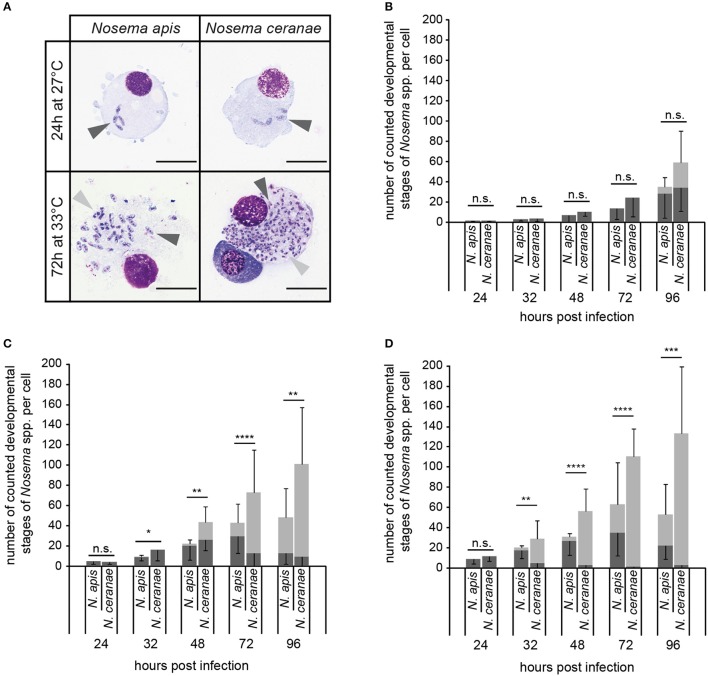
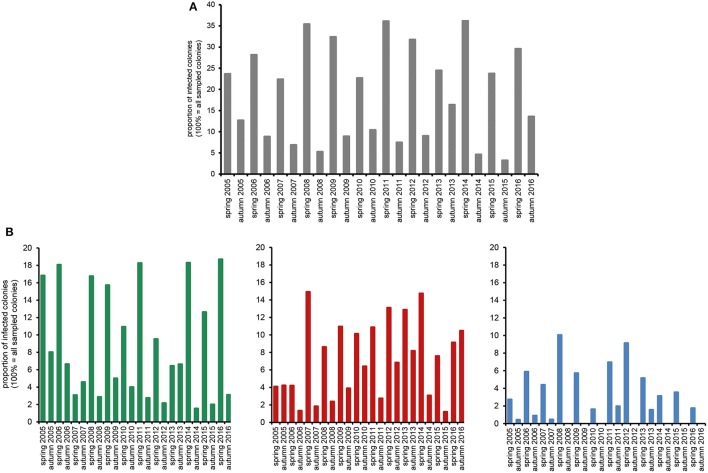
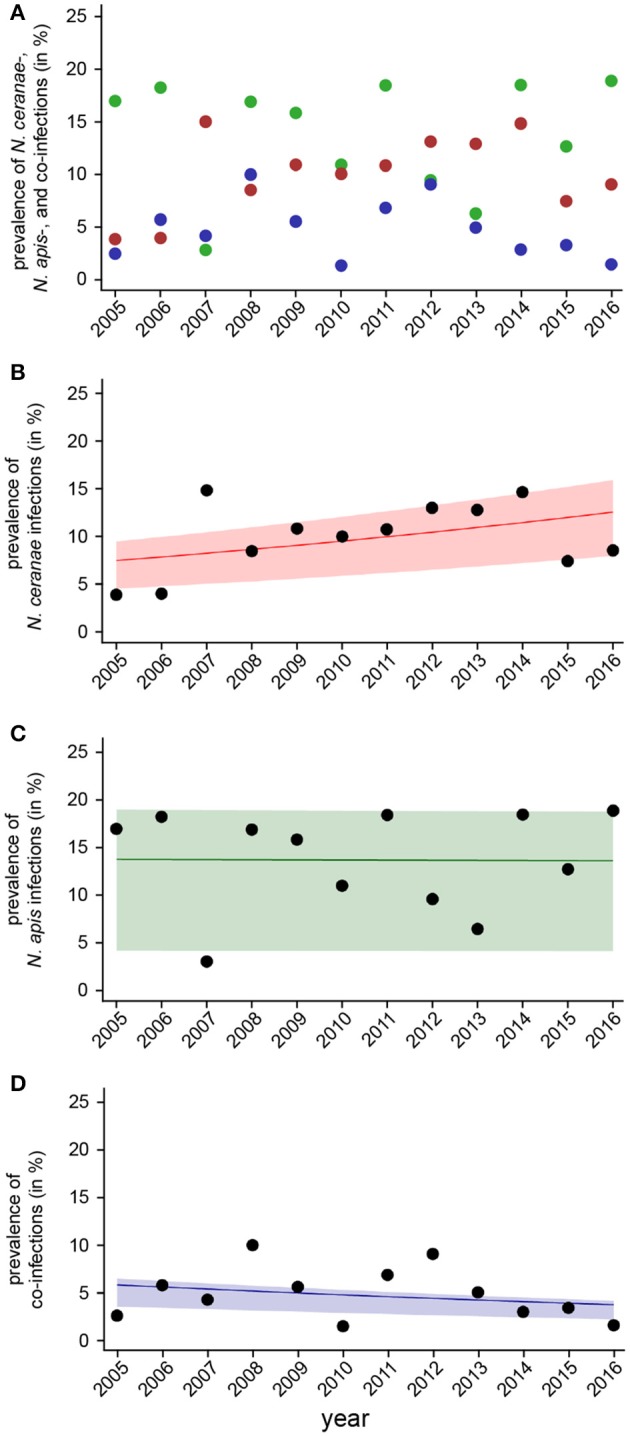
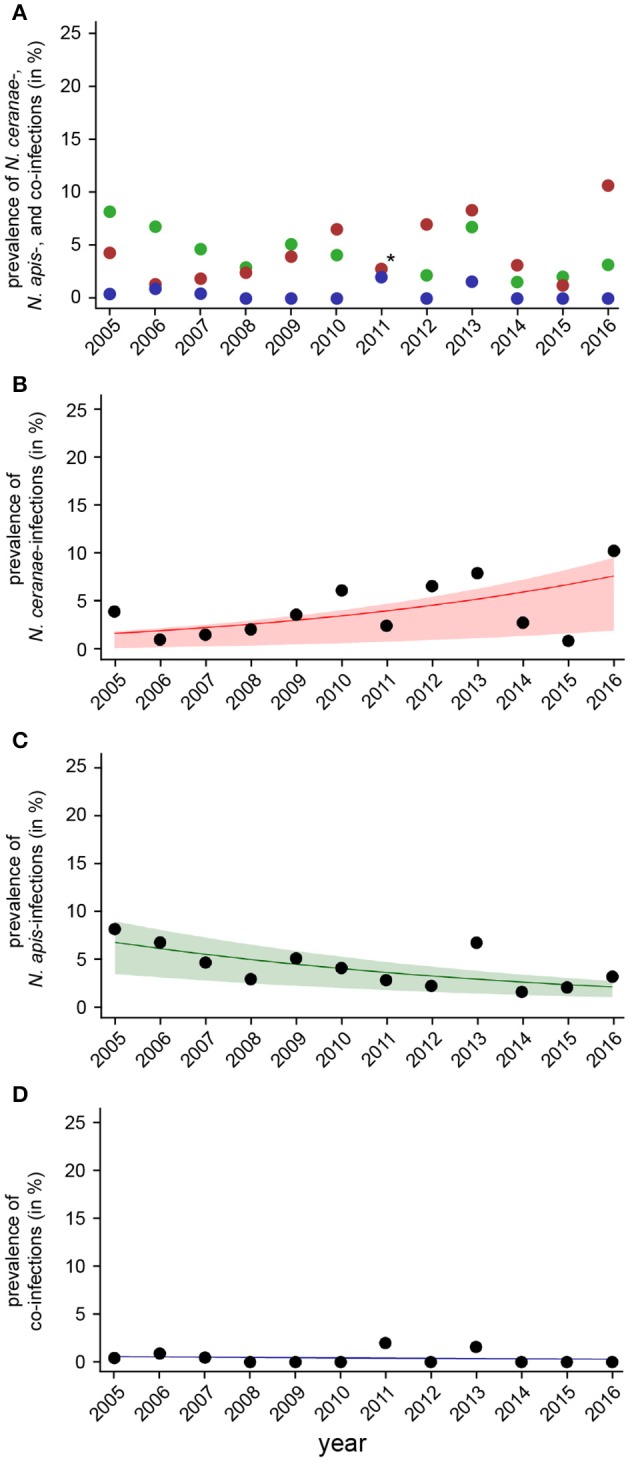
The Western honey bee () is widely used as commercial pollinator in worldwide agriculture and, therefore, plays an important role in global food security. Among the parasites and pathogens threatening health and survival of honey bees are two species of microsporidia, and is considered an emerging pathogen of the Western honey bee. Reports on the spread of suggested that this presumably highly virulent species is replacing its more benign congener in the global population. We here present a 12 year longitudinal cohort study on the prevalence of and in Northeast Germany. Between 2005 and 2016, a cohort of about 230 honey bee colonies originating from 23 apiaries was sampled twice a year (spring and autumn) resulting in a total of 5,600 bee samples which were subjected to microscopic and molecular analysis for determining the presence of infections with or/and . Throughout the entire study period, both - and -infections could be diagnosed within the cohort. Logistic regression analysis of the prevalence data demonstrated a significant increase of -infections over the last 12 years, both in autumn (reflecting the development during the summer) and in spring (reflecting the development over winter) samples. Cell culture experiments confirmed that has a higher proliferative potential than at 27° and 33°C potentially explaining the increase in prevalence during summer. In autumn, characterized by generally low infection prevalence, this increase was accompanied by a significant decrease in -infection prevalence. In contrast, in spring, the season with a higher prevalence of infection, no significant decrease of infections despite a significant increase in infections could be observed. Therefore, our data do not support a general advantage of over and an overall replacement of by in the studied honey bee population.
西方蜜蜂(Apis mellifera)在全球农业中被广泛用作商业授粉昆虫,因此在全球粮食安全中发挥着重要作用。威胁蜜蜂健康和生存的寄生虫和病原体中,有两种微孢子虫,其中蜜蜂微孢子虫(Nosema ceranae)被认为是西方蜜蜂的一种新兴病原体。关于蜜蜂微孢子虫传播的报告表明,这种可能具有高致病性的物种正在全球蜜蜂种群中取代其致病性较低的同类物种东方蜜蜂微孢子虫(Nosema apis)。我们在此展示了一项针对德国东北部蜜蜂微孢子虫和东方蜜蜂微孢子虫流行情况的为期12年的纵向队列研究。在2005年至2016年期间,对来自23个养蜂场的约230群蜜蜂每年进行两次采样(春季和秋季),共获得5600份蜜蜂样本,对其进行显微镜和分子分析以确定是否感染蜜蜂微孢子虫或/和东方蜜蜂微孢子虫。在整个研究期间,队列中均可诊断出蜜蜂微孢子虫和东方蜜蜂微孢子虫感染。对流行率数据的逻辑回归分析表明,在过去12年中,秋季(反映夏季的发展情况)和春季(反映冬季的发展情况)样本中的蜜蜂微孢子虫感染均显著增加。细胞培养实验证实,在27℃和33℃时,蜜蜂微孢子虫比东方蜜蜂微孢子虫具有更高的增殖潜力,这可能解释了夏季蜜蜂微孢子虫流行率的增加。在秋季,感染流行率普遍较低,这种增加伴随着东方蜜蜂微孢子虫感染流行率的显著下降。相比之下,在春季这个感染流行率较高的季节,尽管蜜蜂微孢子虫感染显著增加,但未观察到东方蜜蜂微孢子虫感染有显著下降。因此,我们的数据不支持在研究的蜜蜂种群中蜜蜂微孢子虫相对于东方蜜蜂微孢子虫具有普遍优势以及东方蜜蜂微孢子虫会被蜜蜂微孢子虫全面取代的观点。