Métras Raphaëlle, Fournié Guillaume, Dommergues Laure, Camacho Anton, Cavalerie Lisa, Mérot Philippe, Keeling Matt J, Cêtre-Sossah Catherine, Cardinale Eric, Edmunds W John
Centre for the Mathematical Modelling of Infectious Diseases, Department of Infectious Disease Epidemiology, London School of Hygiene & Tropical Medicine, London, United Kingdom.
Veterinary Epidemiology, Economics and Public Health group, Department of Pathobiology and Population Sciences, The Royal Veterinary College, Hatfield, United Kingdom.
PLoS Negl Trop Dis. 2017 Jul 21;11(7):e0005767. doi: 10.1371/journal.pntd.0005767. eCollection 2017 Jul.
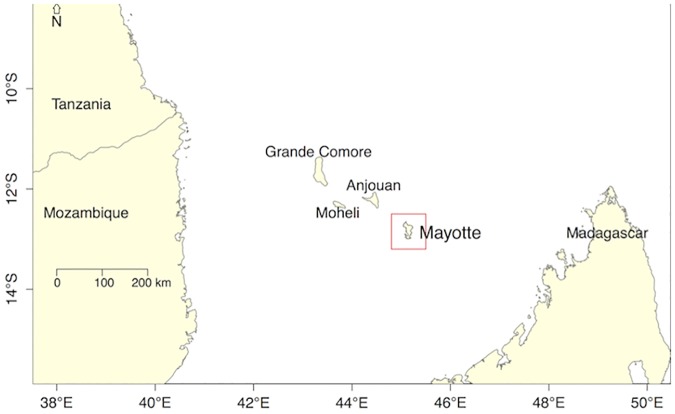
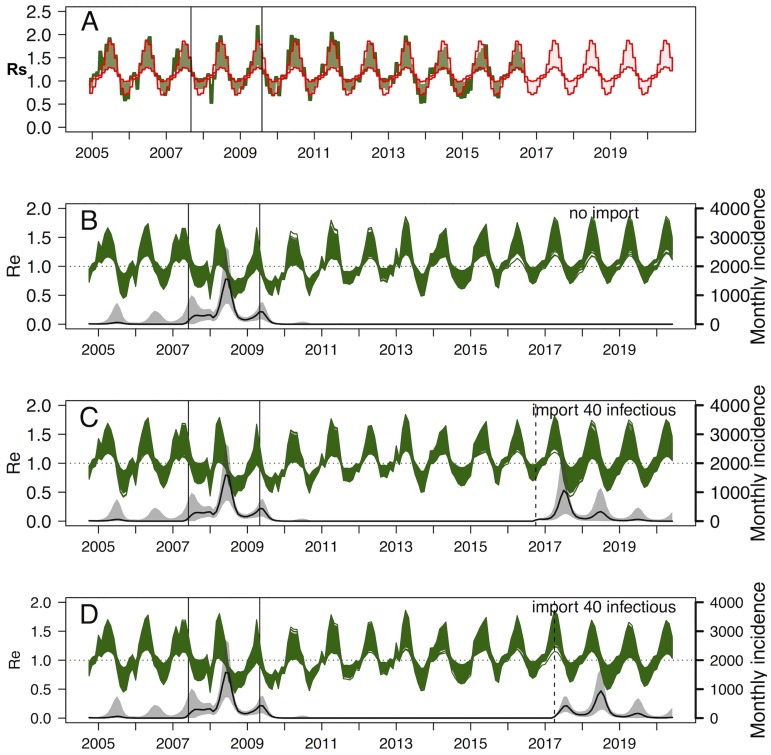
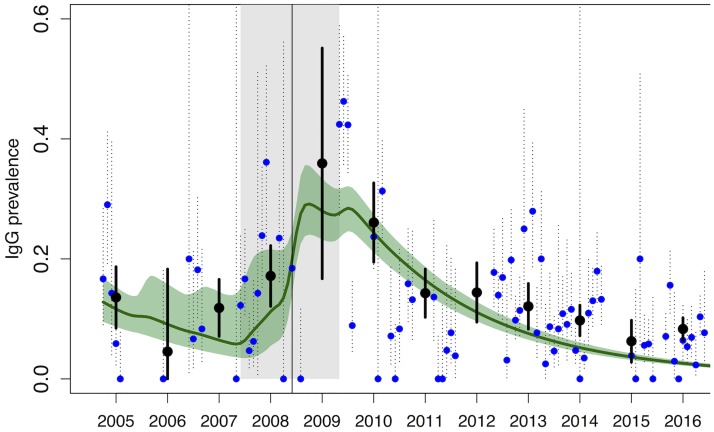
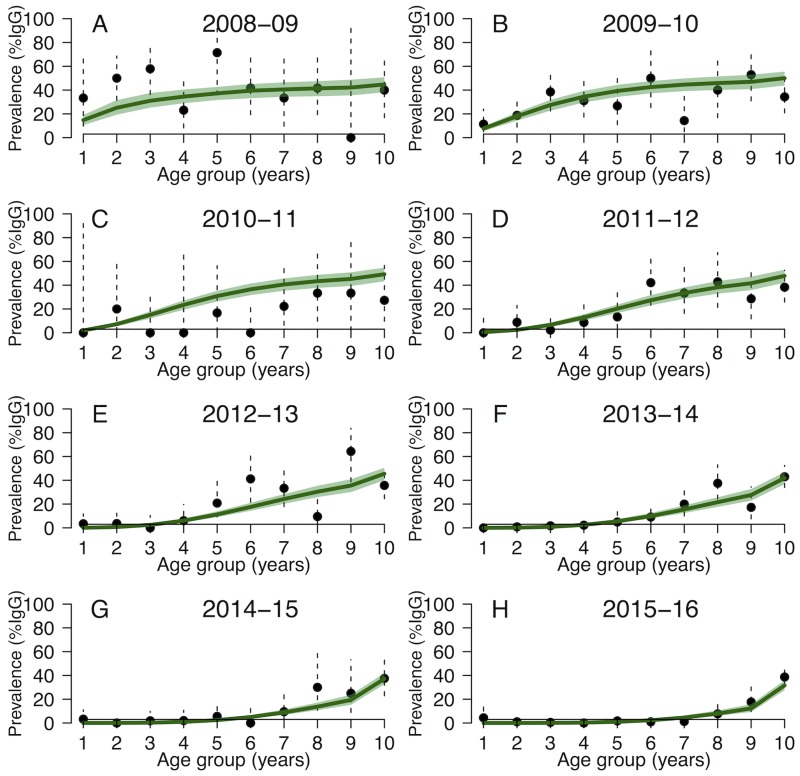
Rift Valley fever (RVF) is a major zoonotic and arboviral hemorrhagic fever. The conditions leading to RVF epidemics are still unclear, and the relative role of climatic and anthropogenic factors may vary between ecosystems. Here, we estimate the most likely scenario that led to RVF emergence on the island of Mayotte, following the 2006-2007 African epidemic. We developed the first mathematical model for RVF that accounts for climate, animal imports and livestock susceptibility, which is fitted to a 12-years dataset. RVF emergence was found to be triggered by the import of infectious animals, whilst transmissibility was approximated as a linear or exponential function of vegetation density. Model forecasts indicated a very low probability of virus endemicity in 2017, and therefore of re-emergence in a closed system (i.e. without import of infected animals). However, the very high proportion of naive animals reached in 2016 implies that the island remains vulnerable to the import of infectious animals. We recommend reinforcing surveillance in livestock, should RVF be reported is neighbouring territories. Our model should be tested elsewhere, with ecosystem-specific data.
裂谷热(RVF)是一种主要的人畜共患虫媒病毒性出血热。导致RVF流行的条件仍不明确,气候和人为因素的相对作用在不同生态系统中可能有所不同。在此,我们估计了2006 - 2007年非洲疫情后马约特岛出现RVF的最可能情况。我们开发了首个考虑气候、动物进口和牲畜易感性的RVF数学模型,并将其拟合到一个12年的数据集。研究发现,RVF的出现是由感染动物的进口引发的,而传播性被近似为植被密度的线性或指数函数。模型预测表明,2017年病毒地方性流行的可能性非常低,因此在封闭系统(即没有感染动物进口)中再次出现的可能性也很低。然而,2016年达到的未感染动物的比例非常高,这意味着该岛仍然容易受到感染动物进口的影响。如果在邻国报告了RVF,我们建议加强对牲畜的监测。我们的模型应使用特定生态系统的数据在其他地方进行测试。