Gachohi John M, Njenga M Kariuki, Kitala Philip, Bett Bernard
School of Public Health, Jomo Kenyatta University of Agriculture and Technology, Juja, Kenya.
International Livestock Research Institute, Nairobi, Kenya.
PLoS Negl Trop Dis. 2016 Dec 14;10(12):e0005049. doi: 10.1371/journal.pntd.0005049. eCollection 2016 Dec.
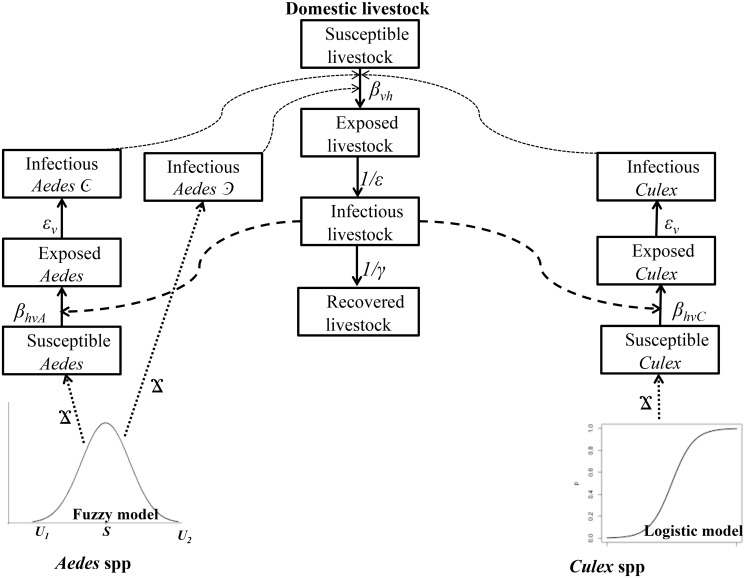
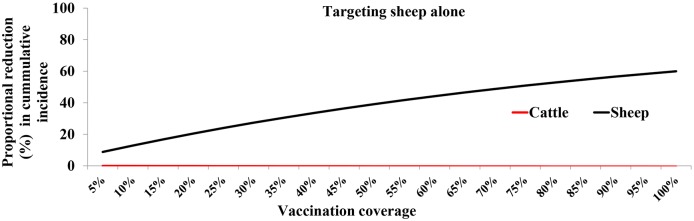
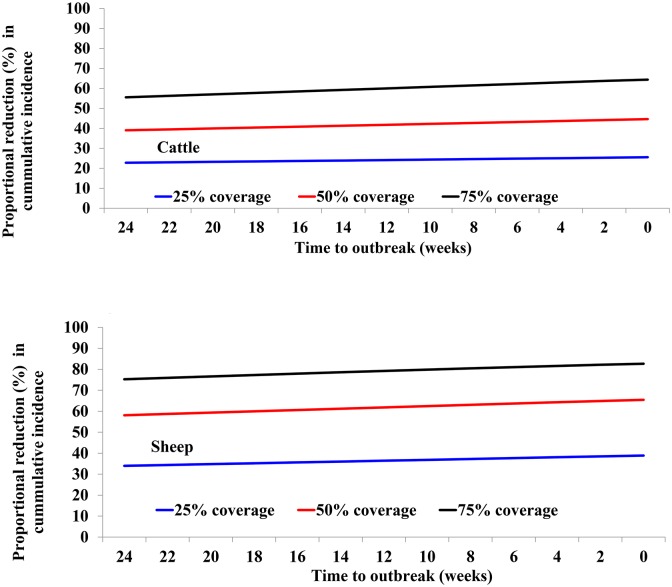
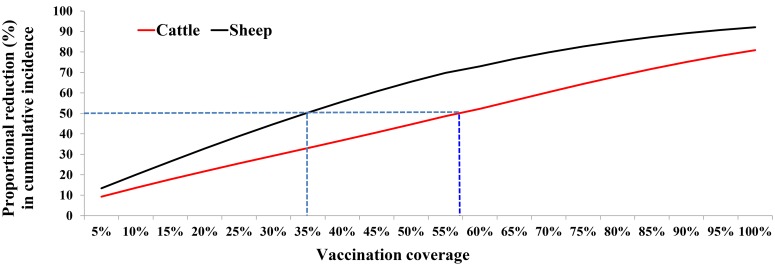
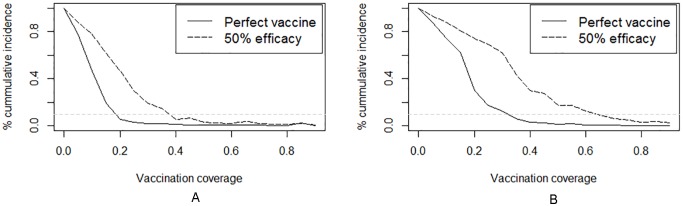
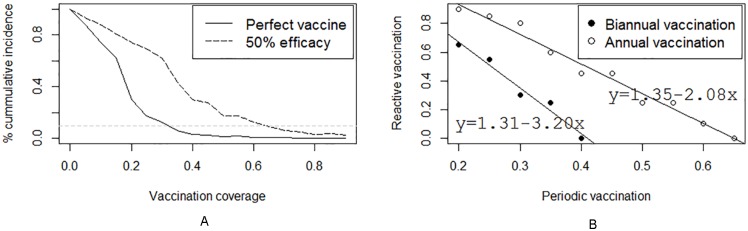
The impacts of vaccination on the transmission of Rift Valley fever virus (RVFV) have not been evaluated. We have developed a RVFV transmission model comprising two hosts-cattle as a separate host and sheep and goats as one combined host (herein after referred to as sheep)-and two vectors-Aedes species (spp) and Culex spp-and used it to predict the impacts of: (1) reactive vaccination implemented at various levels of coverage at pre-determined time points, (2) targeted vaccination involving either of the two host species, and (3) a periodic vaccination implemented biannually or annually before an outbreak.
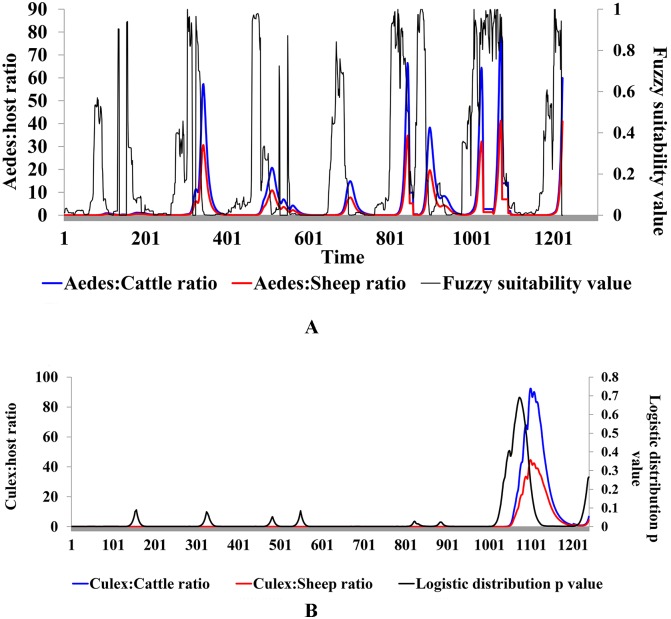
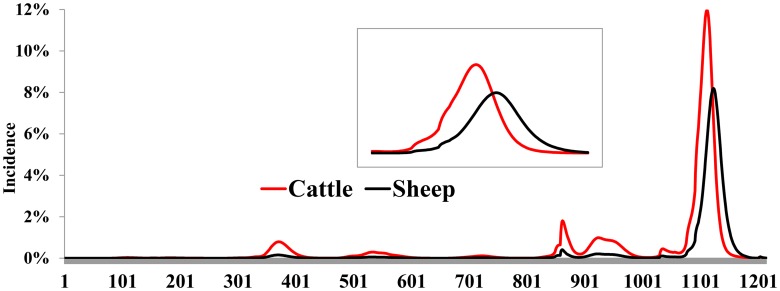
METHODOLOGY/PRINCIPAL FINDINGS: The model comprises coupled vector and host modules where the dynamics of vectors and hosts are described using a system of difference equations. Vector populations are structured into egg, larva, pupa and adult stages and the latter stage is further categorized into three infection categories: susceptible, exposed and infectious mosquitoes. The survival rates of the immature stages (egg, larva and pupa) are dependent on rainfall densities extracted from the Tropical Rainfall Measuring Mission (TRMM) for a Rift Valley fever (RVF) endemic site in Kenya over a period of 1827 days. The host populations are structured into four age classes comprising young, weaners, yearlings and adults and four infection categories including susceptible, exposed, infectious, and immune categories. The model reproduces the 2006/2007 RVF outbreak reported in empirical surveys in the target area and other seasonal transmission events that are perceived to occur during the wet seasons. Mass reactive vaccination strategies greatly reduce the potential for a major outbreak. The results also suggest that the effectiveness of vaccination can be enhanced by increasing the vaccination coverage, targeting vaccination on cattle given that this species plays a major role in the transmission of the virus, and using both periodic and reactive vaccination strategies.
CONCLUSION/SIGNIFICANCE: Reactive vaccination can be effective in mitigating the impacts of RVF outbreaks but practically, it is not always possible to have this measure implemented satisfactorily due to the rapid onset and evolution of RVF epidemics. This analysis demonstrates that both periodic and reactive vaccination ought to be used strategically to effectively control the disease.
疫苗接种对裂谷热病毒(RVFV)传播的影响尚未得到评估。我们开发了一个RVFV传播模型,该模型包含两个宿主——牛作为单独的宿主,绵羊和山羊作为一个组合宿主(以下简称绵羊)——以及两种媒介——伊蚊属和库蚊属——并使用该模型预测以下情况的影响:(1)在预定时间点以不同覆盖率实施的反应性疫苗接种;(2)针对两种宿主物种之一的靶向疫苗接种;(3)在疫情爆发前每半年或每年实施一次的定期疫苗接种。
方法/主要发现:该模型包括耦合的媒介和宿主模块,其中媒介和宿主的动态使用差分方程组进行描述。媒介种群分为卵、幼虫、蛹和成虫阶段,成虫阶段进一步分为三个感染类别:易感、暴露和感染性蚊子。未成熟阶段(卵、幼虫和蛹)的存活率取决于从热带降雨测量任务(TRMM)中提取的肯尼亚裂谷热(RVF)流行地区1827天期间的降雨密度。宿主种群分为四个年龄组,包括幼龄、断奶仔畜、周岁幼畜和成年畜,以及四个感染类别,包括易感、暴露、感染和免疫类别。该模型再现了目标地区实证调查中报告的2006/2007年RVF疫情以及其他被认为在雨季发生的季节性传播事件。大规模反应性疫苗接种策略大大降低了大规模疫情爆发的可能性。结果还表明,通过提高疫苗接种覆盖率、针对牛进行疫苗接种(因为该物种在病毒传播中起主要作用)以及同时使用定期和反应性疫苗接种策略,可以提高疫苗接种的有效性。
结论/意义:反应性疫苗接种在减轻RVF疫情影响方面可能有效,但实际上,由于RVF疫情的快速爆发和演变,并不总是能够令人满意地实施这一措施。该分析表明,应战略性地使用定期和反应性疫苗接种来有效控制该疾病。