Cheng Wei-Tzu, Rosario Roseanne, Muthukaruppan Anita, Wilson Michelle K, Payne Kathryn, Fong Peter C, Shelling Andrew N, Blenkiron Cherie
Department of Obstetrics and Gynaecology, The University of Auckland, Auckland, New Zealand.
Centre for Reproductive Health, Queen's Medical Research Institute, University of Edinburgh, Edinburgh, UK.
Clin Epigenetics. 2017 Jul 21;9:72. doi: 10.1186/s13148-017-0372-0. eCollection 2017.
The aim of this study was to explore the clinical utility of microRNAs (miRNAs) as improved markers of ovarian granulosa cell tumours (GCTs) for cancer diagnosis and prognosis prediction. Current histopathological and genetic markers, such as the presence of a gene mutation to distinguish between the two major subtypes are not wholly accurate and as such novel biomarkers are warranted.
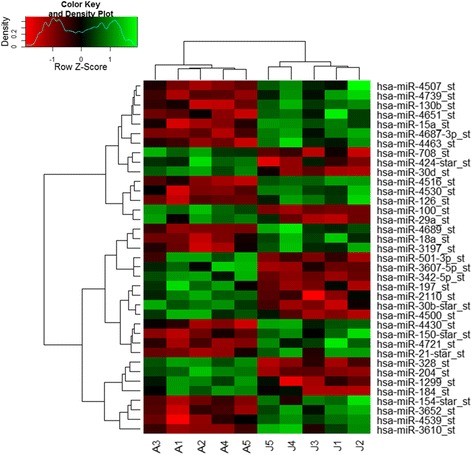
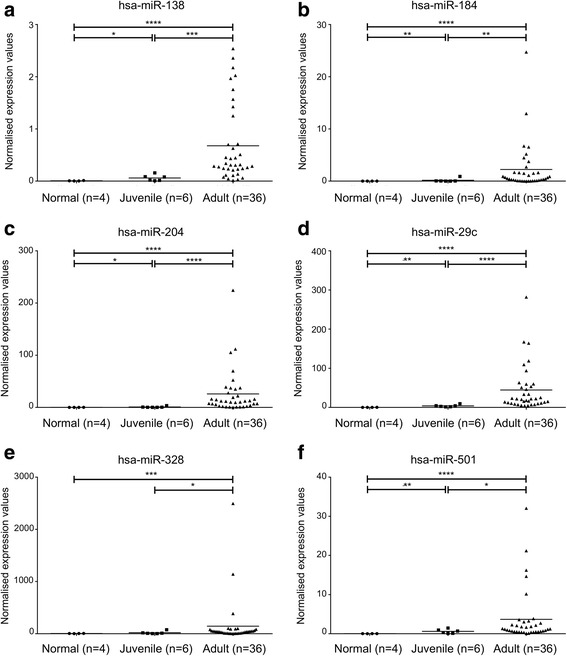
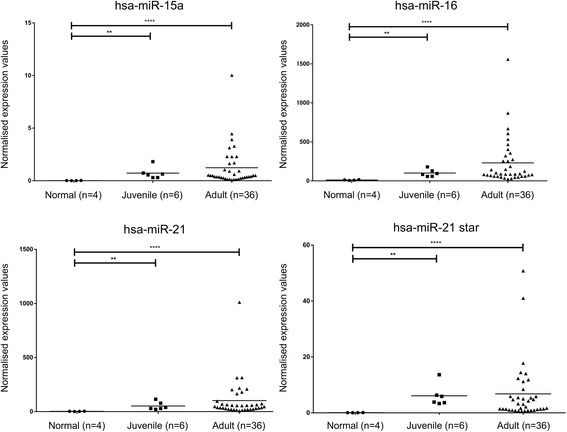
The miRNA expression profiles of five formalin-fixed, paraffin-embedded (FFPE) adult-GCTs and five juvenile-GCTs were assessed using Affymetrix miRNA 3.0 Arrays and compared for differential expression. Ten miRNAs were assessed in an additional 33 FFPE tumours and four normal granulosa cell samples by quantitative RT-PCR, and their expression correlated to clinical information.
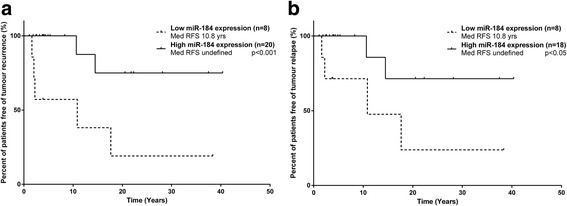
MicroRNA array found 37 miRNAs as differentially expressed between the two GCT subtypes ( < 0.05, fold change ≥2 and among these, miRs -138-5p, -184, -204-5p, -29c-3p, -328-3p and -501-3p were validated by RT-qPCR as differentially expressed between the two GCT subtypes ( < 0.05). In addition, the expression of miR-184 was predictive of tumour recurrence in adult-GCTs, specifically for patients diagnosed with stage I and II and stage I only disease ( < 0.001 and < 0.05, respectively).
This study is the first to report on global miRNA expression profiles of human ovarian GCTs using FFPE tumour samples. We have validated six miRNAs as novel markers for subtype classification in GCTs with low levels of miR-138-5p correlating with early tumour stage. Low miR-184 abundance was correlated with tumour recurrence in early stage adult-GCT patients as a candidate predictive biomarker. Further studies are now needed to confirm the clinical utility of these miRNAs as diagnostic and recurrence markers, and understand their possible roles in the pathogenesis of GCTs.
本研究旨在探讨微小RNA(miRNA)作为卵巢颗粒细胞瘤(GCT)癌症诊断和预后预测改进标志物的临床效用。当前的组织病理学和基因标志物,如用于区分两种主要亚型的基因突变的存在,并不完全准确,因此需要新的生物标志物。
使用Affymetrix miRNA 3.0阵列评估5个福尔马林固定、石蜡包埋(FFPE)成人GCT和5个青少年GCT的miRNA表达谱,并比较差异表达。通过定量RT-PCR在另外33个FFPE肿瘤和4个正常颗粒细胞样本中评估10个miRNA,其表达与临床信息相关。
miRNA阵列发现37个miRNA在两种GCT亚型之间差异表达(P<0.05,倍数变化≥2),其中miR-138-5p、-184、-204-5p、-29c-3p、-328-3p和-501-3p经RT-qPCR验证在两种GCT亚型之间差异表达(P<0.05)。此外,miR-184的表达可预测成人GCT的肿瘤复发,特别是对于诊断为I期和II期以及仅I期疾病的患者(分别为P<0.001和P<0.05)。
本研究首次报道了使用FFPE肿瘤样本的人卵巢GCT的整体miRNA表达谱。我们已经验证了6个miRNA作为GCT亚型分类的新标志物,其中低水平的miR-138-5p与早期肿瘤阶段相关。低miR-184丰度与早期成人GCT患者的肿瘤复发相关,作为候选预测生物标志物。现在需要进一步研究以确认这些miRNA作为诊断和复发标志物的临床效用,并了解它们在GCT发病机制中的可能作用。