Liu Yan, Watson Stella C, Gettings Jenna R, Lund Robert B, Nordone Shila K, Yabsley Michael J, McMahan Christopher S
Department of Mathematical Sciences, Clemson University, Clemson, SC, United States of America.
Department of Molecular and Biomedical Sciences, Comparative Medicine Institute, North Carolina State University, College of Veterinary Medicine, Raleigh, NC, United States of America.
PLoS One. 2017 Jul 24;12(7):e0182028. doi: 10.1371/journal.pone.0182028. eCollection 2017.
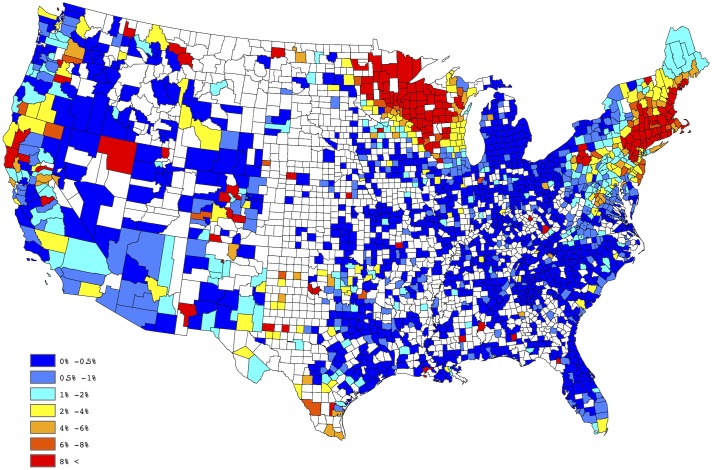
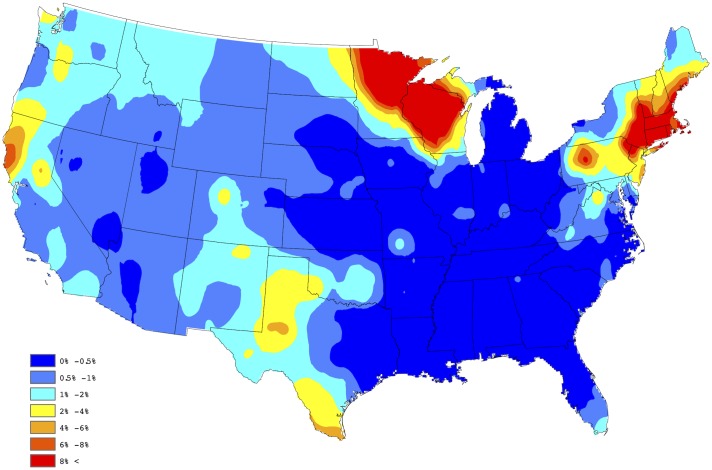
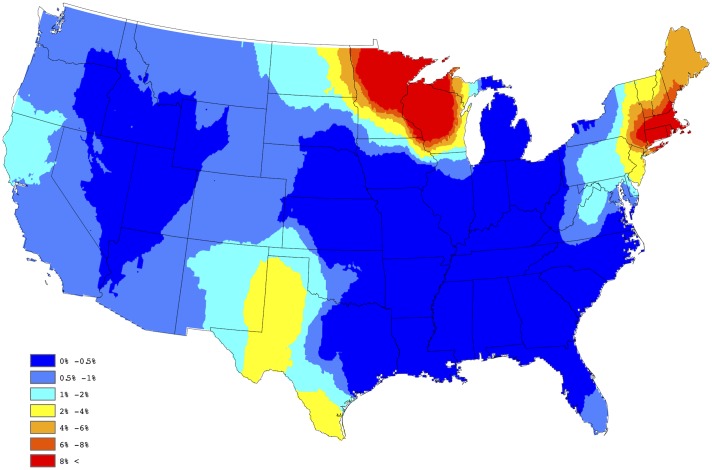
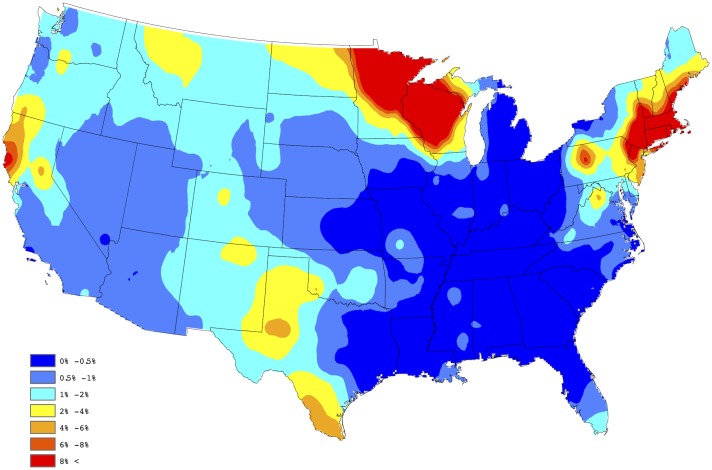
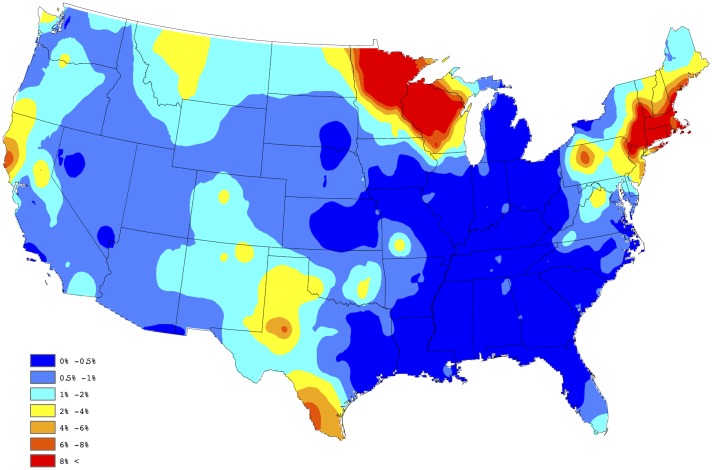
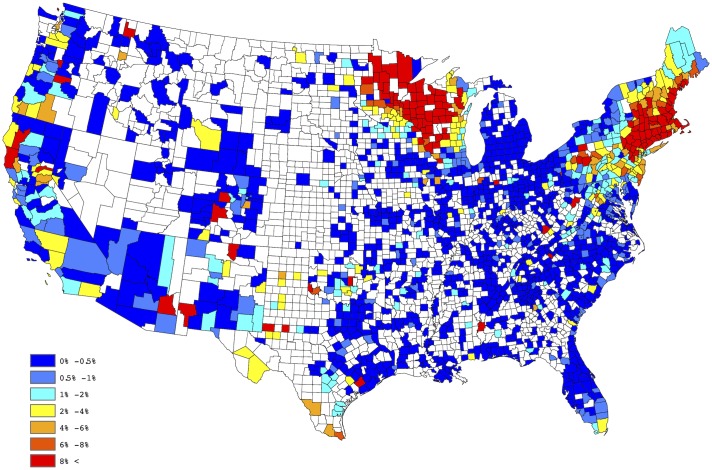
This paper forecasts the 2016 canine Anaplasma spp. seroprevalence in the United States from eight climate, geographic and societal factors. The forecast's construction and an assessment of its performance are described. The forecast is based on a spatial-temporal conditional autoregressive model fitted to over 11 million Anaplasma spp. seroprevalence test results for dogs conducted in the 48 contiguous United States during 2011-2015. The forecast uses county-level data on eight predictive factors, including annual temperature, precipitation, relative humidity, county elevation, forestation coverage, surface water coverage, population density and median household income. Non-static factors are extrapolated into the forthcoming year with various statistical methods. The fitted model and factor extrapolations are used to estimate next year's regional prevalence. The correlation between the observed and model-estimated county-by-county Anaplasma spp. seroprevalence for the five-year period 2011-2015 is 0.902, demonstrating reasonable model accuracy. The weighted correlation (accounting for different sample sizes) between 2015 observed and forecasted county-by-county Anaplasma spp. seroprevalence is 0.987, exhibiting that the proposed approach can be used to accurately forecast Anaplasma spp. seroprevalence. The forecast presented herein can a priori alert veterinarians to areas expected to see Anaplasma spp. seroprevalence beyond the accepted endemic range. The proposed methods may prove useful for forecasting other diseases.
本文根据八个气候、地理和社会因素预测了2016年美国犬无形体属的血清阳性率。描述了该预测的构建过程及其性能评估。该预测基于一个时空条件自回归模型,该模型拟合了2011 - 2015年期间在美国本土48个州进行的超过1100万次犬无形体属血清阳性率检测结果。该预测使用了关于八个预测因素的县级数据,包括年温度、降水量、相对湿度、县海拔、森林覆盖率、地表水覆盖率、人口密度和家庭收入中位数。采用各种统计方法将非静态因素外推至下一年。拟合模型和因素外推用于估计下一年的区域流行率。2011 - 2015年五年期间,观察到的和模型估计的各县无形体属血清阳性率之间的相关性为0.902,表明模型具有合理的准确性。2015年观察到的和预测的各县无形体属血清阳性率之间的加权相关性(考虑不同样本量)为0.987,表明所提出的方法可用于准确预测无形体属血清阳性率。本文提出的预测可以提前提醒兽医注意预计无形体属血清阳性率超出公认地方流行范围的地区。所提出的方法可能被证明对预测其他疾病有用。