Liu Yan, Lund Robert B, Nordone Shila K, Yabsley Michael J, McMahan Christopher S
Department of Mathematical Sciences, Clemson University, Clemson, SC, USA.
Department of Molecular and Biomedical Sciences, Comparative Medicine Institute, North Carolina State University, Raleigh, NC, USA.
Parasit Vectors. 2017 Mar 9;10(1):138. doi: 10.1186/s13071-017-2068-x.
Dogs in the United States are hosts to a diverse range of vector-borne pathogens, several of which are important zoonoses. This paper describes factors deemed to be significantly related to the prevalence of antibodies to Ehrlichia spp. in domestic dogs, including climatic conditions, geographical factors, and societal factors. These factors are used in concert with a spatio-temporal model to construct an annual seroprevalence forecast. The proposed method of forecasting and an assessment of its fidelity are described.
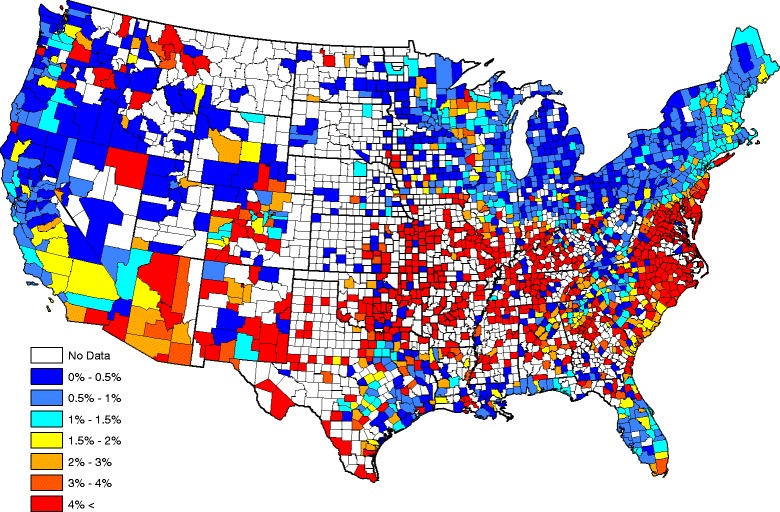
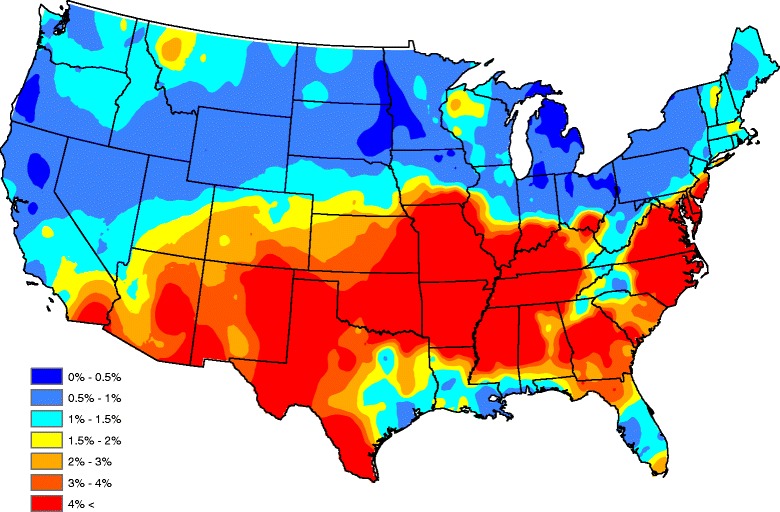
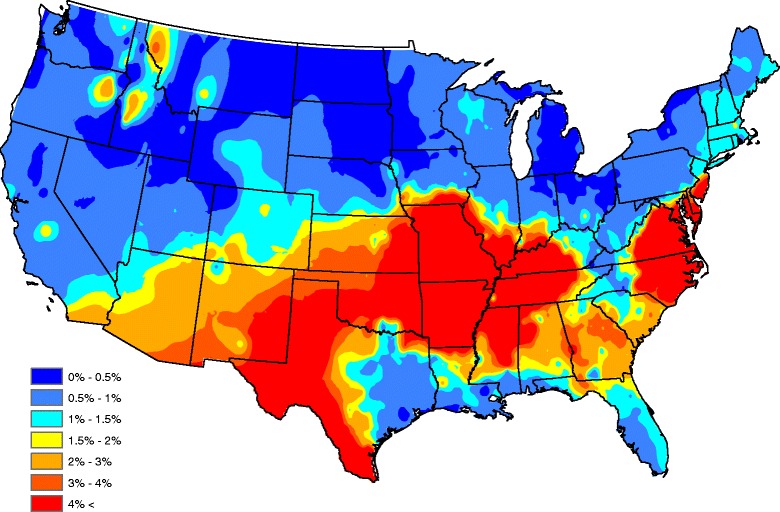
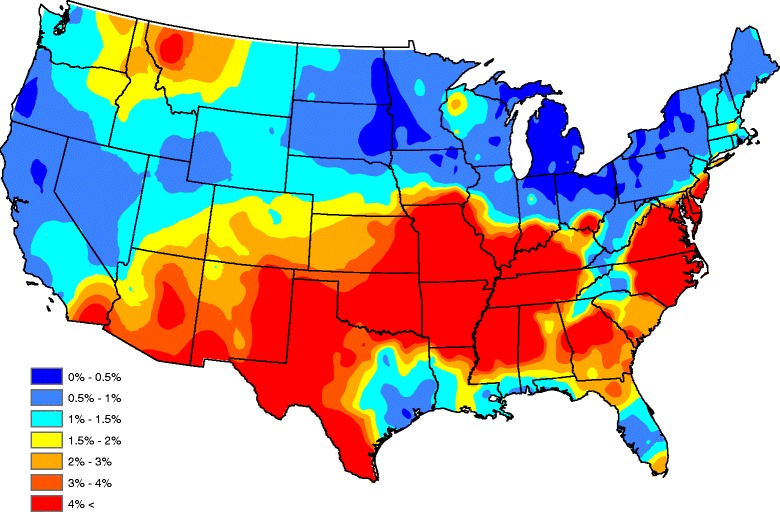
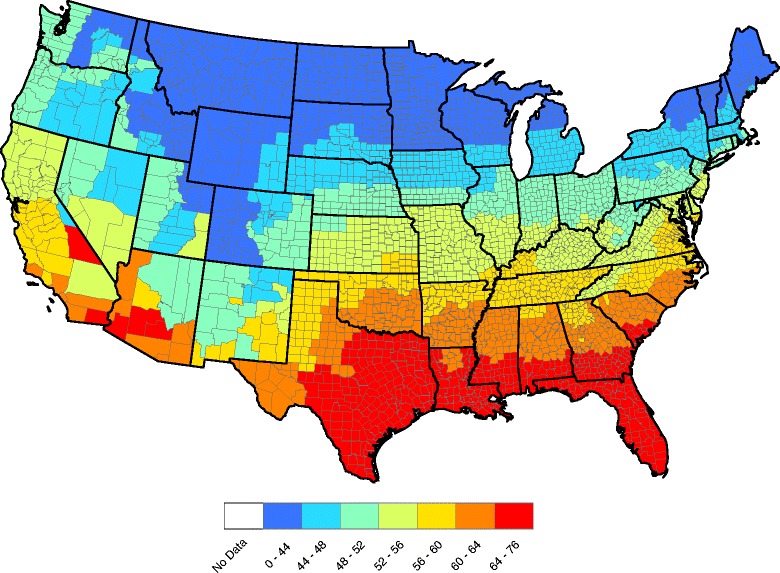
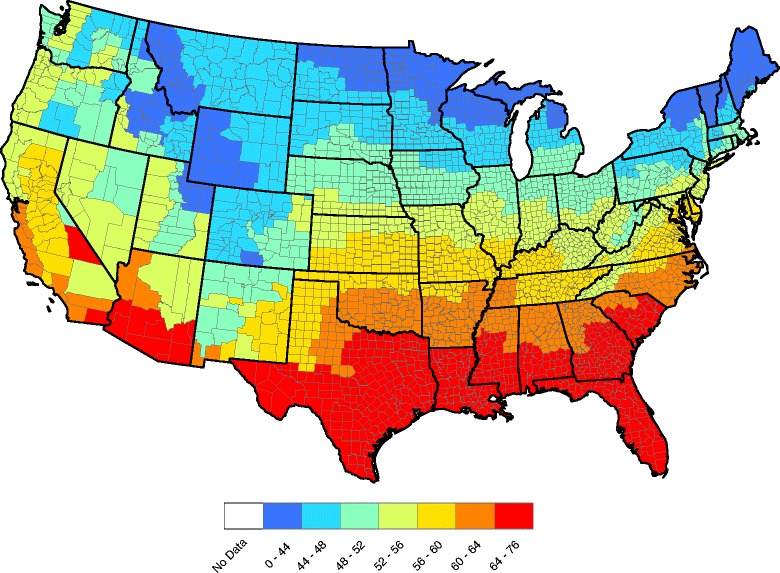
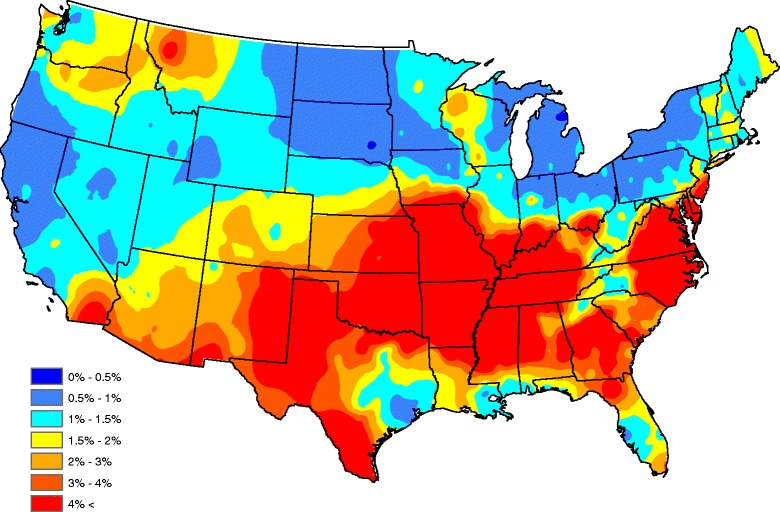
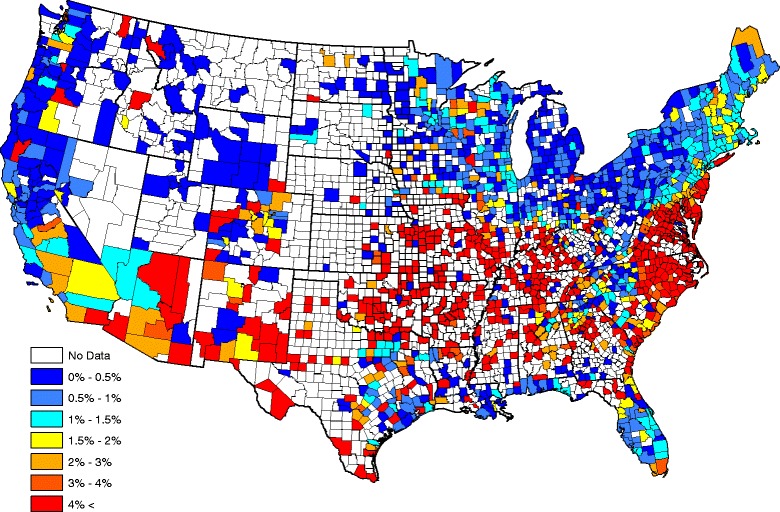
Approximately twelve million serological test results for canine exposure to Ehrlichia spp. were used in the development of a Bayesian approach to forecast canine infection. Data used were collected on the county level across the contiguous United States from routine veterinary diagnostic tests between 2011-2015. Maps depicting the spatial baseline Ehrlichia spp. prevalence were constructed using Kriging and head-banging smoothing methods. Data were statistically analyzed to identify factors related to antibody prevalence via a Bayesian spatio-temporal conditional autoregressive (CAR) model. Finally, a forecast of future Ehrlichia seroprevalence was constructed based on the proposed model using county-level data on five predictive factors identified at a workshop hosted by the Companion Animal Parasite Council and published in 2014: annual temperature, percentage forest coverage, percentage surface water coverage, population density and median household income. Data were statistically analyzed to identify factors related to disease prevalence via a Bayesian spatio-temporal model. The fitted model and factor extrapolations were then used to forecast the regional seroprevalence for 2016.
The correlation between the observed and model-estimated county-by-county Ehrlichia seroprevalence for the five-year period 2011-2015 is 0.842, demonstrating reasonable model accuracy. The weighted correlation (acknowledging unequal sample sizes) between 2015 observed and forecasted county-by-county Ehrlichia seroprevalence is 0.970, demonstrating that Ehrlichia seroprevalence can be forecasted accurately.
The forecast presented herein can be an a priori alert to veterinarians regarding areas expected to see expansion of Ehrlichia beyond the accepted endemic range, or in some regions a dynamic change from historical average prevalence. Moreover, this forecast could potentially serve as a surveillance tool for human health and prove useful for forecasting other vector-borne diseases.
美国的犬类是多种媒介传播病原体的宿主,其中几种是重要的人畜共患病原体。本文描述了被认为与家犬中埃立克体属抗体流行率显著相关的因素,包括气候条件、地理因素和社会因素。这些因素与时空模型协同使用,以构建年度血清流行率预测。本文描述了所提出的预测方法及其准确性评估。
在开发一种贝叶斯方法以预测犬类感染时,使用了约1200万份犬类接触埃立克体属的血清学检测结果。所使用的数据是在2011年至2015年期间从美国本土连续各县的常规兽医诊断测试中收集的。使用克里金法和碰撞平滑法构建了描绘埃立克体属空间基线流行率的地图。通过贝叶斯时空条件自回归(CAR)模型对数据进行统计分析,以确定与抗体流行率相关的因素。最后,基于所提出的模型,使用由伴侣动物寄生虫理事会主办并于2014年发表的一次研讨会上确定的五个预测因素的县级数据,构建了未来埃立克体血清流行率的预测。通过贝叶斯时空模型对数据进行统计分析,以确定与疾病流行率相关的因素。然后,使用拟合模型和因素外推法预测2016年的区域血清流行率。
2011年至2015年五年期间,观察到的和模型估计的各县埃立克体血清流行率之间的相关性为0.842,表明模型具有合理的准确性。2015年观察到的和预测的各县埃立克体血清流行率之间的加权相关性(考虑到样本量不等)为0.970,表明埃立克体血清流行率可以准确预测。
本文提出的预测可以为兽医提供关于预计埃立克体将在公认的地方流行范围之外扩大的地区,或在某些地区从历史平均流行率发生动态变化的地区的先验警报。此外,该预测可能作为人类健康的监测工具,并证明对预测其他媒介传播疾病有用。