Department of General Pathology, Laboratory of Compared Pathology, Biological Science Institute, Federal University of Minas Gerais, 486, 31270-901, Belo Horizonte, Minas Gerais, Brazil.
CAPES Foundation, Ministry of Education of Brazil, Brasilia, DF 70.040-020, Brazil.
Sci Rep. 2017 Jul 24;7(1):6276. doi: 10.1038/s41598-017-06528-x.
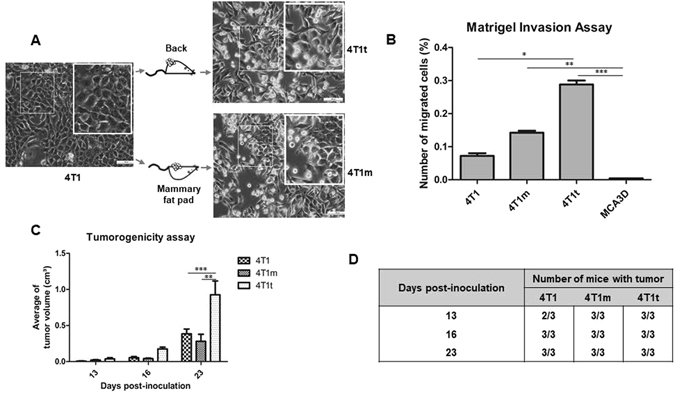
Qa-2 is believed to mediate a protective immune response against cancer; however, little is known about the role of Qa-2 in tumorigenesis. Here, we used 4T1 breast cancer cells to study the involvement of Qa-2 in tumor progression in a syngeneic host. Qa-2 expression was reduced during in vivo tumor growth and in cell lines derived from 4T1-induced tumors. Tumor-derived cells elicited an epithelial-mesenchymal transition associated with upregulation of Zeb1 and Twist1/2 and enhanced tumor initiating and invasive capacities. Furthermore, these cells showed increased stem characteristics, as demonstrated by upregulation of Hes1, Sox2 and Oct3/4, and enrichment of CD44/CD24 cells. Remarkably, Qa-2 cell-surface expression was excluded from the CD44/CD24 subpopulation. Tumor-derived cells showed increased Src activity, and treatment of these cells with the Src kinase inhibitor PP2 enhanced Qa-2 but reduced Sox2 and CD44/CD24 expression levels, suggesting that Src signaling, while positively associated with stemness, negatively regulates Qa-2 expression in breast cancer. Finally, overexpression of the Qa-2 family member Q7 on the cell surface slowed down in vivo tumor growth and reduced the metastatic potential of 4T1 cells. These results suggest an anti-malignant role for Qa-2 in breast cancer development, which appears to be absent from cancer stem cells.
Qa-2 被认为介导了针对癌症的保护性免疫反应;然而,关于 Qa-2 在肿瘤发生中的作用知之甚少。在这里,我们使用 4T1 乳腺癌细胞在同基因宿主中研究 Qa-2 在肿瘤进展中的作用。Qa-2 的表达在体内肿瘤生长过程中和源自 4T1 诱导的肿瘤的细胞系中降低。肿瘤衍生细胞引发上皮-间充质转化,伴随着 Zeb1 和 Twist1/2 的上调以及增强的肿瘤起始和侵袭能力。此外,这些细胞表现出增加的干细胞特征,如 Hes1、Sox2 和 Oct3/4 的上调以及 CD44/CD24 细胞的富集所证明的那样。值得注意的是,Qa-2 细胞表面表达被排除在 CD44/CD24 亚群之外。肿瘤衍生细胞显示出增加的 Src 活性,并且用 Src 激酶抑制剂 PP2 处理这些细胞增强了 Qa-2,但降低了 Sox2 和 CD44/CD24 的表达水平,表明 Src 信号虽然与干细胞特性正相关,但负调节乳腺癌中 Qa-2 的表达。最后,在细胞表面过表达 Qa-2 家族成员 Q7 减缓了体内肿瘤生长并降低了 4T1 细胞的转移潜力。这些结果表明 Qa-2 在乳腺癌发展中具有抗恶性作用,而这种作用似乎不存在于癌症干细胞中。