Center of Biological Sciences and Health, Federal University of the West of Bahia, Barreiras, Brazil.
Instituto de Investigaciones Biomédicas Alberto Sols, Consejo Superior de Investigaciones Científicas, Universidad Autónoma de Madrid, Madrid, Spain.
Front Immunol. 2018 Dec 6;9:2894. doi: 10.3389/fimmu.2018.02894. eCollection 2018.
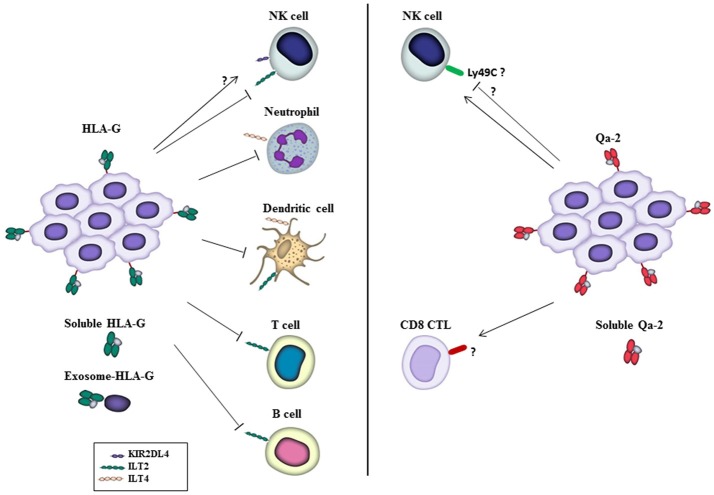
It is well established that the immune system can identify and destroy neoplastic transformed cells in a process known as immunosurveillance. Most studies have focused on the classical major histocompatibility complex (MHC) class Ia molecules, which are known to play an important role on the presentation of tumor antigens to the immune system in order to activate a response against tumor cells. However, a larger family of non-classical MHC class Ib-related molecules has received less attention. In this mini-review, we discuss the role of class Ib murine Qa-2 and its proposed human HLA-G homolog on immunosurveillance during embryogenesis and cancer. Whereas, both HLA-G and Qa-2 are involved in immune tolerance in pregnancy, the current evidence suggests that they play opposite roles in cancer. HLA-G appears to promote tumor progression while Qa-2 acts as a tumor suppressor awaking the immune system to reject tumor cells, as suggested by studies on different cancer cell models, such as melanoma, lymphoma, lung carcinoma, and our own results in mammary carcinoma.
众所周知,免疫系统可以识别和摧毁肿瘤转化细胞,这一过程被称为免疫监视。大多数研究都集中在经典的主要组织相容性复合体(MHC)Ia 类分子上,这些分子在向免疫系统呈递肿瘤抗原以激活针对肿瘤细胞的反应方面发挥着重要作用。然而,人们对更大的非经典 MHC Ib 相关分子家族的关注较少。在这篇迷你综述中,我们讨论了 Ib 类鼠 Qa-2 及其拟议的人类 HLA-G 同源物在胚胎发生和癌症中的免疫监视作用。虽然 HLA-G 和 Qa-2 都参与了妊娠中的免疫耐受,但目前的证据表明,它们在癌症中发挥着相反的作用。HLA-G 似乎促进肿瘤进展,而 Qa-2 则作为肿瘤抑制因子唤醒免疫系统排斥肿瘤细胞,这一点可以从黑色素瘤、淋巴瘤、肺癌等不同的癌细胞模型研究以及我们自己在乳腺癌中的研究结果中得到证实。