Frandsen Stine Krog, Gehl Julie
Center for Experimental Drug and Gene Electrotransfer, Department of Oncology, Herlev and Gentofte Hospital, University of Copenhagen, Herlev, Denmark.
PLoS One. 2017 Jul 25;12(7):e0181839. doi: 10.1371/journal.pone.0181839. eCollection 2017.
Calcium electroporation is a new experimental anti-cancer treatment where calcium is internalized into cells by application of short, high voltage pulses. Calcium electroporation has been shown to induce tumor necrosis associated with ATP depletion while the effect on normal fibroblasts was limited when investigated in a 3D in vitro spheroid model. We aimed to investigate the effect of calcium electroporation in combination with metformin, a drug that affects intracellular ATP level. We also aimed to study the relationship between the viability and intracellular ATP levels after calcium electroporation in vitro.
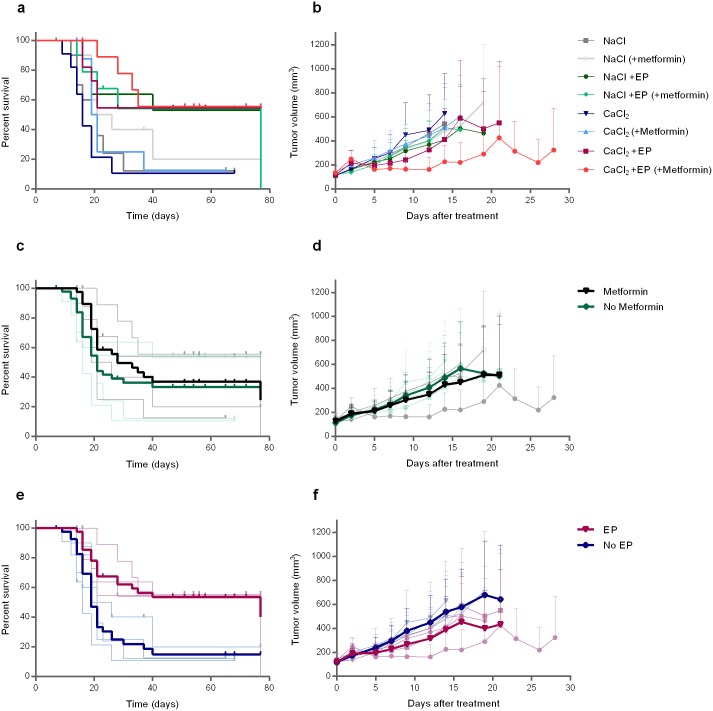
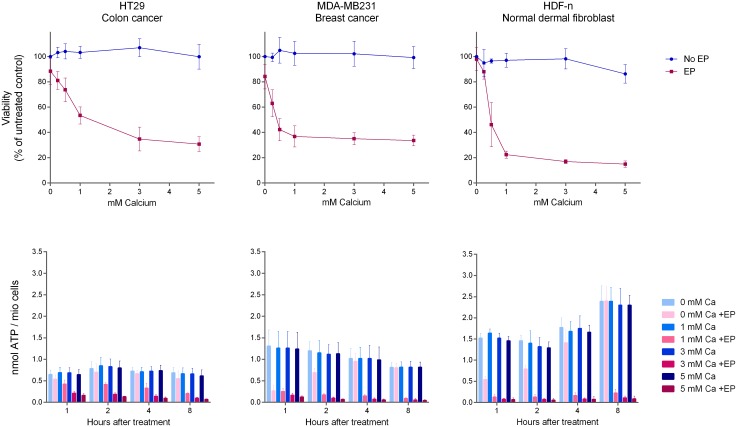
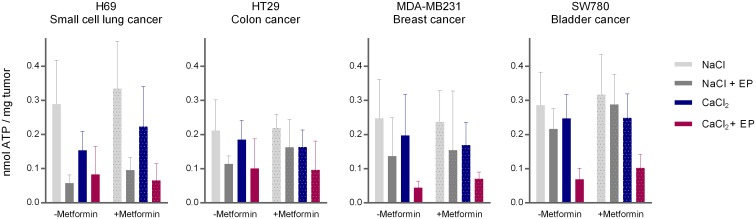
In this study, we investigated the effect of calcium electroporation with metformin on NMRI-Foxn1nu mice in vivo on tumor size, survival, and intracellular ATP. We further investigated viability and intracellular ATP level in vitro after calcium electroporation in two human cancer cell lines: Breast (MDA-MB231) and colon (HT29), and in normal human fibroblasts (HDF-n), as well as investigating viability in human bladder cancer cells (SW780) and human small cell lung cancer cells (H69) where we have previously published intracellular ATP levels.
Calcium electroporation significantly reduced the size and ATP level of bladder cancer tumors treated in vivo but no increased effect of metformin combined with calcium electroporation was shown on neither tumor size, survival, nor ATP level. Calcium electroporation in vitro significantly decreased viability compared with calcium alone (p<0.0001 for calcium concentrations from 0.5 mM for H69, HDF-n, and MDA-MB231; p<0.0001 for calcium concentrations from 1 mM for HT29 and SW780). Intracellular ATP levels decreased significantly after calcium electroporation (p<0.05), however no correlation between intracellular ATP level and viability after treatment was observed.
Calcium electroporation caused reduced tumor size, increased survival, and acute ATP depletion in vivo. This effect was not augmented by metformin. Calcium electroporation is a possible novel anti-cancer treatment that has been shown to cause cell death associated with acute ATP depletion in vitro and in vivo.
钙电穿孔是一种新型的实验性抗癌治疗方法,通过施加短时间的高压脉冲使钙进入细胞内。在三维体外球体模型中进行研究时,钙电穿孔已被证明可诱导与ATP耗竭相关的肿瘤坏死,而对正常成纤维细胞的影响有限。我们旨在研究钙电穿孔联合二甲双胍(一种影响细胞内ATP水平的药物)的效果。我们还旨在研究体外钙电穿孔后细胞活力与细胞内ATP水平之间的关系。
在本研究中,我们研究了钙电穿孔联合二甲双胍对NMRI-Foxn1nu小鼠体内肿瘤大小、生存期和细胞内ATP的影响。我们进一步研究了在两种人类癌细胞系:乳腺癌(MDA-MB231)和结肠癌(HT29)以及正常人成纤维细胞(HDF-n)中进行钙电穿孔后体外的细胞活力和细胞内ATP水平,同时研究了我们之前已发表细胞内ATP水平的人膀胱癌细胞(SW780)和人小细胞肺癌细胞(H69)的细胞活力。
钙电穿孔显著减小了体内治疗的膀胱癌肿瘤的大小并降低了其ATP水平,但未显示二甲双胍联合钙电穿孔对肿瘤大小、生存期或ATP水平有增强作用。与单独使用钙相比,体外钙电穿孔显著降低了细胞活力(对于H69、HDF-n和MDA-MB231,钙浓度为0.5 mM时p<0.0001;对于HT29和SW780,钙浓度为1 mM时p<0.0001)。钙电穿孔后细胞内ATP水平显著降低(p<0.05),然而未观察到治疗后细胞内ATP水平与细胞活力之间的相关性。
钙电穿孔可使体内肿瘤大小减小、生存期延长并导致急性ATP耗竭。二甲双胍并未增强这种作用。钙电穿孔是一种可能的新型抗癌治疗方法,已被证明在体外和体内均可导致与急性ATP耗竭相关的细胞死亡。