Wilder-Smith A, Longini I, Zuber P L, Bärnighausen T, Edmunds W J, Dean N, Spicher V Masserey, Benissa M R, Gessner B D
Lee Kong Chian School of Medicine, Nanyang Technological University, Singapore, Singapore.
Institute of Public Health, University of Heidelberg, Heidelberg, Germany.
BMC Med. 2017 Jul 26;15(1):138. doi: 10.1186/s12916-017-0911-8.
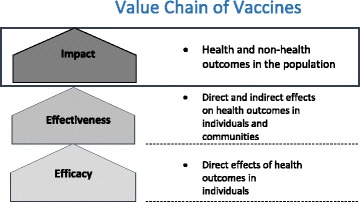
Assessments of vaccine efficacy and safety capture only the minimum information needed for regulatory approval, rather than the full public health value of vaccines. Vaccine efficacy provides a measure of proportionate disease reduction, is usually limited to etiologically confirmed disease, and focuses on the direct protection of the vaccinated individual. Herein, we propose a broader scope of methods, measures and outcomes to evaluate the effectiveness and public health impact to be considered for evidence-informed policymaking in both pre- and post-licensure stages.
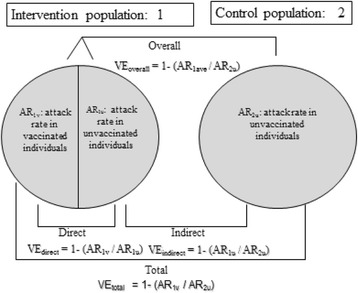
Pre-licensure: Regulatory concerns dictate an individually randomised clinical trial. However, some circumstances (such as the West African Ebola epidemic) may require novel designs that could be considered valid for licensure by regulatory agencies. In addition, protocol-defined analytic plans for these studies should include clinical as well as etiologically confirmed endpoints (e.g. all cause hospitalisations, pneumonias, acute gastroenteritis and others as appropriate to the vaccine target), and should include vaccine-preventable disease incidence and 'number needed to vaccinate' as outcomes. Post-licensure: There is a central role for phase IV cluster randomised clinical trials that allows for estimation of population-level vaccine impact, including indirect, total and overall effects. Dynamic models should be prioritised over static models as the constant force of infection assumed in static models will usually underestimate the effectiveness and cost-effectiveness of the immunisation programme by underestimating indirect effects. The economic impact of vaccinations should incorporate health and non-health benefits of vaccination in both the vaccinated and unvaccinated populations, thus allowing for estimation of the net social value of vaccination.
The full benefits of vaccination reach beyond direct prevention of etiologically confirmed disease and often extend across the life course of a vaccinated person, prevent outcomes in the wider community, stabilise health systems, promote health equity, and benefit local and national economies. The degree to which vaccinations provide broad public health benefits is stronger than for other preventive and curative interventions.
疫苗效力和安全性评估仅获取监管批准所需的最低限度信息,而非疫苗的全部公共卫生价值。疫苗效力衡量疾病减少的比例,通常限于病因确诊的疾病,并侧重于对接种个体的直接保护。在此,我们提出更广泛的方法、措施和结果范围,以评估有效性和公共卫生影响,供许可前和许可后阶段基于证据的决策参考。
许可前:监管要求决定进行个体随机临床试验。然而,某些情况(如西非埃博拉疫情)可能需要新颖的设计,监管机构可认为这些设计对许可有效。此外,这些研究的方案定义分析计划应包括临床以及病因确诊的终点(如所有原因导致的住院、肺炎、急性胃肠炎以及其他与疫苗目标相关的适当终点),并应将疫苗可预防疾病的发病率和“需接种人数”作为结果。许可后:IV期整群随机临床试验具有核心作用,可用于估计人群层面的疫苗影响,包括间接、总体和全面影响。动态模型应优先于静态模型,因为静态模型中假设的恒定感染力通常会低估免疫规划的有效性和成本效益,因为它低估了间接影响。疫苗接种的经济影响应纳入接种和未接种人群中疫苗接种的健康和非健康益处,从而能够估计疫苗接种的净社会价值。
疫苗接种的全部益处不仅在于直接预防病因确诊的疾病,而且往往延伸至接种者的整个生命历程,预防更广泛社区中的不良后果,稳定卫生系统,促进健康公平,并使地方和国家经济受益。疫苗接种提供广泛公共卫生益处的程度比其他预防和治疗干预措施更强。