Kothari Shweta, Singh Archana, Das Utpalendu, Sarkar Diptendra K, Datta Chhanda, Hazra Avijit
Department of Radio Diagnosis, IPGME and R and SSKM Hospital, Kolkata, West Bengal, India.
Department of Surgery, IPGME and R and SSKM Hospital, Kolkata, West Bengal, India.
Indian J Radiol Imaging. 2017 Apr-Jun;27(2):229-236. doi: 10.4103/ijri.IJRI_405_16.
To evaluate the role of exponential apparent diffusion coefficient (ADC) as a tool for differentiating benign and malignant breast lesions.
This prospective observational study included 88 breast lesions in 77 patients (between 18 and 85 years of age) who underwent 3T breast magnetic resonance imaging (MRI) including diffusion-weighted imaging (DWI) using b-values of 0 and 800 s/mm before biopsy. Mean exponential ADC and ADC of benign and malignant lesions obtained from DWI were compared. Receiver operating characteristics (ROC) curve analysis was undertaken to identify any cut-off for exponential ADC and ADC to predict malignancy. value of <0.05 was considered statistically significant. Histopathology was taken as the gold standard.
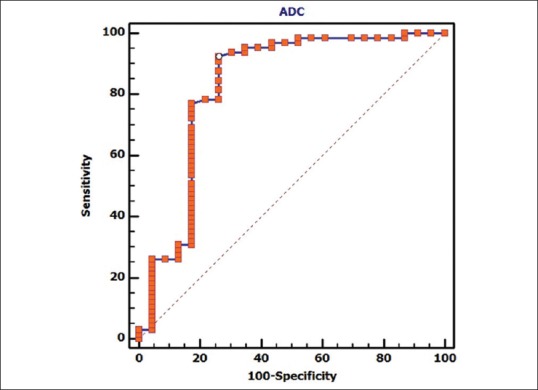
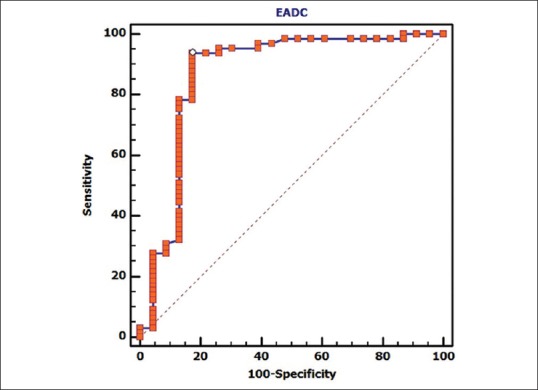
According to histopathology, 65 lesions were malignant and 23 were benign. The mean ADC and exponential ADC values of malignant lesions were 0.9526 ± 0.203 × 10 mm/s and 0.4774 ± 0.071, respectively, and for benign lesions were 1.48 ± 0.4903 × 10 mm/s and 0.317 ± 0.1152, respectively. For both the parameters, differences were highly significant ( < 0.001). Cut-off value of ≤0.0011 mm/s ( < 0.0001) for ADC provided 92.3% sensitivity and 73.9% specificity, whereas with an exponential ADC cut-off value of >0.4 ( < 0.0001) for malignant lesions, 93.9% sensitivity and 82.6% specificity was obtained. The performance of ADC and exponential ADC in distinguishing benign and malignant breast lesions based on respective cut-offs was comparable ( = 0.109).
Exponential ADC can be used as a quantitative adjunct tool for characterizing breast lesions with comparable sensitivity and specificity as that of ADC.
评估指数表观扩散系数(ADC)作为鉴别乳腺良恶性病变工具的作用。
这项前瞻性观察性研究纳入了77例患者(年龄在18至85岁之间)的88个乳腺病变,这些患者在活检前接受了3T乳腺磁共振成像(MRI),包括使用b值为0和800 s/mm²的扩散加权成像(DWI)。比较了从DWI获得的良性和恶性病变的平均指数ADC和ADC。进行了受试者操作特征(ROC)曲线分析,以确定指数ADC和ADC预测恶性肿瘤的任何临界值。P值<0.05被认为具有统计学意义。组织病理学被视为金标准。
根据组织病理学,65个病变为恶性,23个为良性。恶性病变的平均ADC值和指数ADC值分别为0.9526±0.203×10⁻³mm²/s和0.4774±0.071,良性病变分别为1.48±0.4903×10⁻³mm²/s和0.317±0.1152。对于这两个参数,差异均具有高度统计学意义(P<0.001)。ADC的临界值≤0.0011×10⁻³mm²/s(P<0.0001)时,敏感性为92.3%,特异性为73.9%;而对于恶性病变,指数ADC临界值>0.4(P<0.0001)时,敏感性为93.9%,特异性为82.6%。基于各自临界值,ADC和指数ADC在区分乳腺良恶性病变方面的表现相当(P = 0.109)。
指数ADC可作为一种定量辅助工具,用于表征乳腺病变,其敏感性和特异性与ADC相当。