Kast Richard E, Skuli Nicolas, Cos Samuel, Karpel-Massler Georg, Shiozawa Yusuke, Goshen Ran, Halatsch Marc-Eric
IIAIGC Study Center, Burlington, VT, USA.
INSERM, Centre de Recherches en Cancérologie de Toulouse - CRCT, UMR1037 Inserm/Université Toulouse III - Paul Sabatier, Toulouse, France.
Breast Cancer (Dove Med Press). 2017 Jul 11;9:495-514. doi: 10.2147/BCTT.S139963. eCollection 2017.
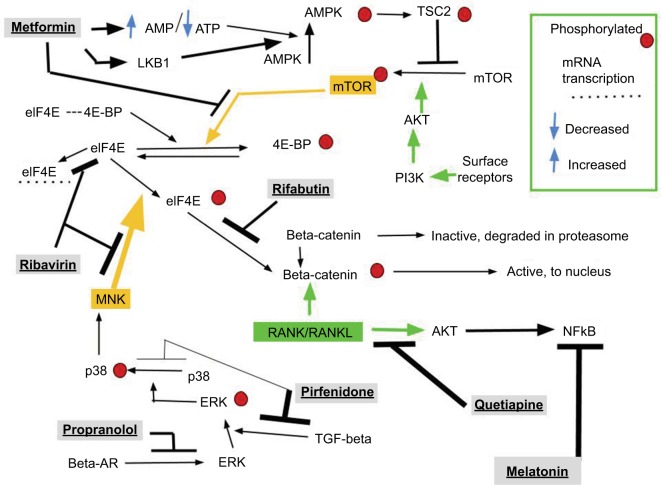
Breast cancer metastatic to bone has a poor prognosis despite recent advances in our understanding of the biology of both bone and breast cancer. This article presents a new approach, the ABC7 regimen (Adjuvant for Breast Cancer treatment using seven repurposed drugs), to metastatic breast cancer. ABC7 aims to defeat aspects of epithelial-to-mesenchymal transition (EMT) that lead to dissemination of breast cancer to bone. As add-on to current standard treatment with capecitabine, ABC7 uses ancillary attributes of seven already-marketed noncancer treatment drugs to stop both the natural EMT process inherent to breast cancer and the added EMT occurring as a response to current treatment modalities. Chemotherapy, radiation, and surgery provoke EMT in cancer generally and in breast cancer specifically. ABC7 uses standard doses of capecitabine as used in treating breast cancer today. In addition, ABC7 uses 1) an older psychiatric drug, quetiapine, to block RANK signaling; 2) pirfenidone, an anti-fibrosis drug to block TGF-beta signaling; 3) rifabutin, an antibiotic to block beta-catenin signaling; 4) metformin, a first-line antidiabetic drug to stimulate AMPK and inhibit mammalian target of rapamycin, (mTOR); 5) propranolol, a beta-blocker to block beta-adrenergic signaling; 6) agomelatine, a melatonergic antidepressant to stimulate M1 and M2 melatonergic receptors; and 7) ribavirin, an antiviral drug to prevent eIF4E phosphorylation. All these block the signaling pathways - RANK, TGF-beta, mTOR, beta-adrenergic receptors, and phosphorylated eIF4E - that have been shown to trigger EMT and enhance breast cancer growth and so are worthwhile targets to inhibit. Agonism at MT1 and MT2 melatonergic receptors has been shown to inhibit both breast cancer EMT and growth. This ensemble was designed to be safe and augment capecitabine efficacy. Given the expected outcome of metastatic breast cancer as it stands today, ABC7 warrants a cautious trial.
尽管近年来我们对骨癌和乳腺癌生物学的理解取得了进展,但转移性乳腺癌的预后仍然很差。本文提出了一种针对转移性乳腺癌的新方法——ABC7方案(使用七种重新利用的药物进行乳腺癌辅助治疗)。ABC7旨在对抗上皮-间质转化(EMT)的某些方面,这些方面会导致乳腺癌扩散至骨骼。作为当前卡培他滨标准治疗的补充,ABC7利用七种已上市的非癌症治疗药物的辅助特性,来阻止乳腺癌固有的自然EMT过程以及作为对当前治疗方式的反应而发生的额外EMT。化疗、放疗和手术通常会在癌症中引发EMT,在乳腺癌中尤其如此。ABC7使用如今治疗乳腺癌时常用的标准剂量的卡培他滨。此外,ABC7还使用:1)一种较老的精神科药物喹硫平,以阻断RANK信号传导;2)抗纤维化药物吡非尼酮,以阻断TGF-β信号传导;3)抗生素利福布汀,以阻断β-连环蛋白信号传导;4)一线抗糖尿病药物二甲双胍,以刺激AMPK并抑制雷帕霉素靶蛋白(mTOR);5)β受体阻滞剂普萘洛尔,以阻断β-肾上腺素能信号传导;6)褪黑素能抗抑郁药阿戈美拉汀,以刺激M1和M2褪黑素能受体;7)抗病毒药物利巴韦林,以防止eIF4E磷酸化。所有这些药物都能阻断RANK、TGF-β、mTOR、β-肾上腺素能受体和磷酸化eIF4E等信号通路,这些信号通路已被证明会触发EMT并促进乳腺癌生长,因此是值得抑制的靶点。MT1和MT2褪黑素能受体激动已被证明可抑制乳腺癌EMT和生长。该组合疗法旨在确保安全并增强卡培他滨的疗效。鉴于目前转移性乳腺癌的预期结果,ABC7值得进行谨慎的试验。