Rhyne Andrew L, Tlusty Michael F, Szczebak Joseph T, Holmberg Robert J
Biology and Marine Biology, Roger Williams University, Bristol, RI, United States; Anderson Cabot Center for Ocean Life, New England Aquarium, Boston, MA, United States.
Anderson Cabot Center for Ocean Life, New England Aquarium, Boston, MA, United States; School for the Environment, University of Massachusetts Boston, Boston, MA, United States.
PeerJ. 2017 Jan 26;5:e2949. doi: 10.7717/peerj.2949. eCollection 2017.
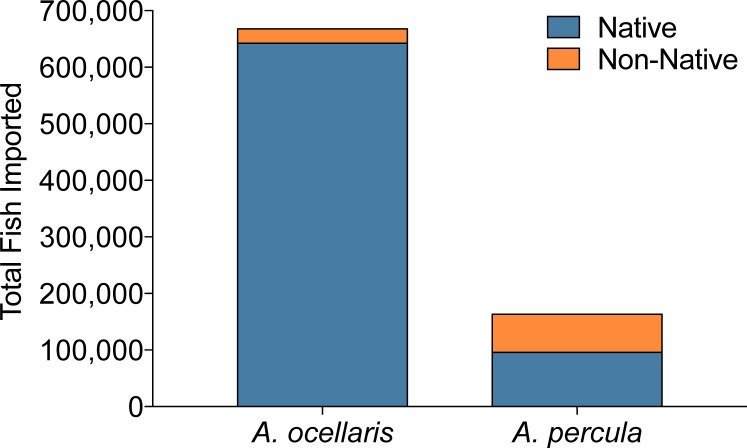
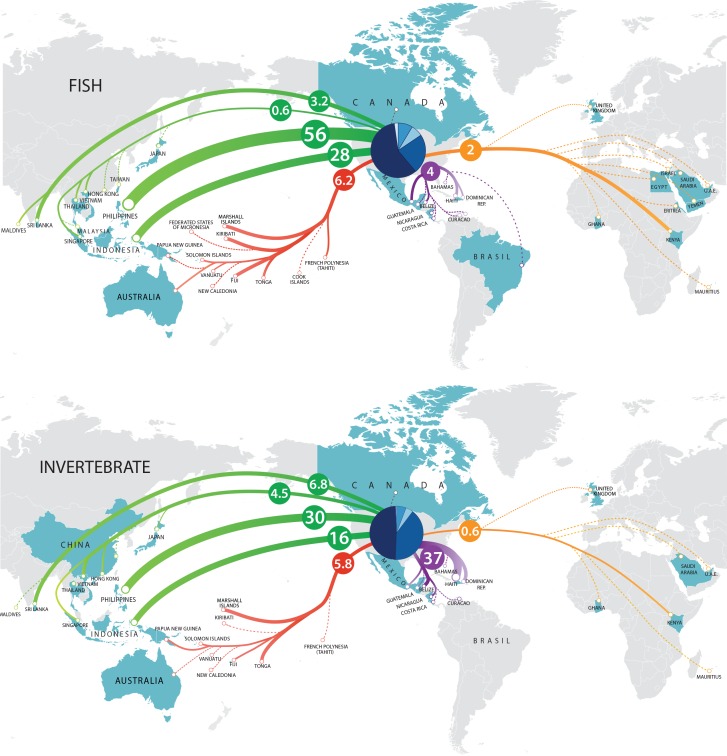
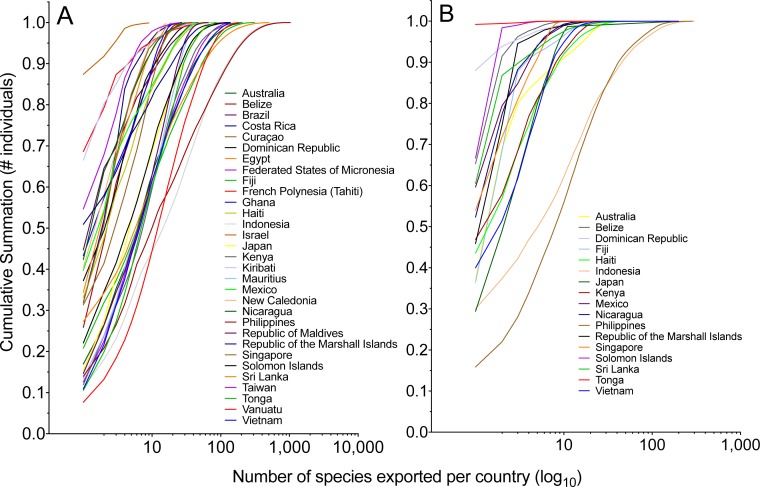
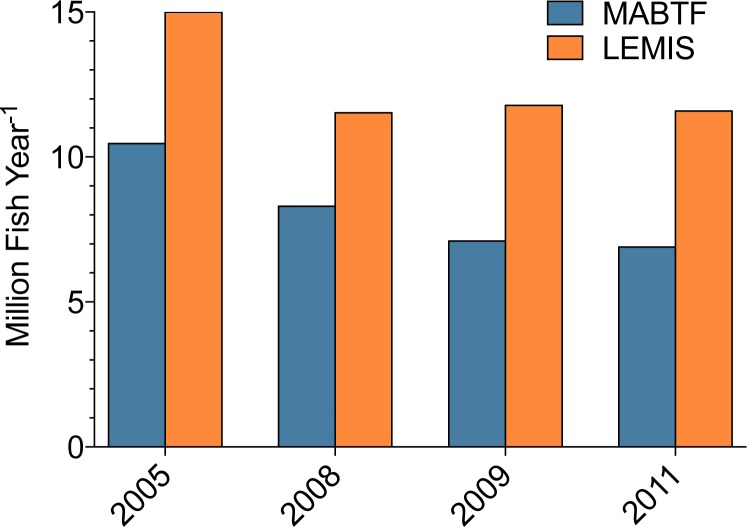
The trade of live marine animals for home and public aquaria has grown into a major global industry. Millions of marine fishes and invertebrates are removed from coral reefs and associated habitats each year. The majority are imported into the United States, with the remainder sent to Europe, Japan, and a handful of other countries. Despite the recent growth and diversification of the aquarium trade, to date, data collection is not mandatory, and hence comprehensive information on species volume and diversity is lacking. This lack of information makes it impossible to study trade pathways. Without species-specific volume and diversity data, it is unclear how importing and exporting governments can oversee this industry effectively or how sustainability should be encouraged. To expand our knowledge and understanding of the trade, and to effectively communicate this new understanding, we introduce the publically-available Marine Aquarium Biodiversity and Trade Flow online database (https://www.aquariumtradedata.org/). This tool was created to communicate the volume and diversity of marine fishes and/or invertebrates imported into the US over three complete years (2008, 2009, and 2011) and three partial years (2000, 2004, 2005). To create this tool, invoices pertaining to shipments of live marine fishes and invertebrates were scanned and analyzed for species name, species quantities, country of origin, port of entry, and city of import destination. Here we focus on the analysis of the later three years of data and also produce an estimate for the entirety of 2000, 2004, and 2005. The three-year aggregate totals (2008, 2009, 2011) indicate that just under 2,300 fish and 725 invertebrate species were imported into the US cumulatively, although just under 1,800 fish and 550 invertebrate species were traded annually. Overall, the total number of live marine animals decreased between 2008 and 2011. In 2008, 2009, and 2011, the total number of individual fish (8.2, 7.3, and 6.9 million individuals) and invertebrates (4.2, 3.7, and 3.6 million individuals) assessed by analyzing the invoice data are roughly 60% of the total volumes recorded through the Law Enforcement Management Information System (LEMIS) dataset. Using these complete years, we back-calculated the number of individuals of both fishes and invertebrates imported in 2000, 2004, and 2005. These estimates (9.3, 10.8, and 11.2 million individual fish per year) were consistent with the three years of complete data. We also use these data to understand the global trade in two species (Banggai cardinalfish, , and orange clownfish, / ) recently considered for Endangered Species Act listing. Aquariumtradedata.org can help create more effective management plans for the traded species, and ideally could be implemented at key trade ports to better assess the global trade of aquatic wildlife.
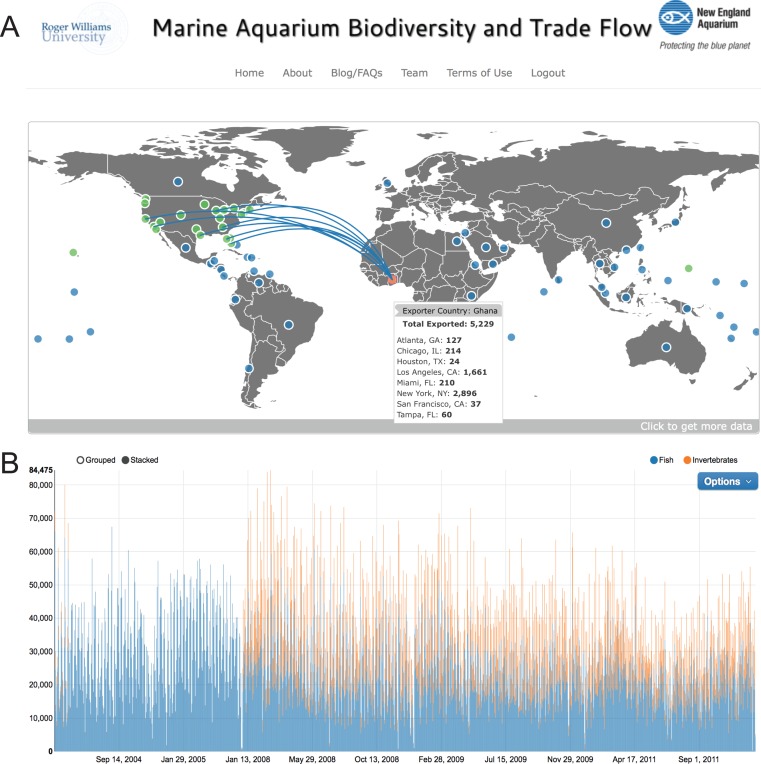
用于家庭和公共水族馆的活体海洋动物贸易已发展成为一个主要的全球产业。每年有数以百万计的海洋鱼类和无脊椎动物从珊瑚礁及相关栖息地被移除。其中大部分被进口到美国,其余则运往欧洲、日本和其他少数国家。尽管水族馆贸易最近有所增长且日益多样化,但迄今为止,数据收集并非强制性的,因此缺乏关于物种数量和多样性的全面信息。这种信息缺失使得研究贸易途径变得不可能。没有特定物种的数量和多样性数据,不清楚进出口国政府如何有效地监管这个行业,也不清楚应如何鼓励可持续性发展。为了扩展我们对该贸易的认识和理解,并有效地传达这种新的理解,我们推出了公开可用的海洋水族馆生物多样性与贸易流动在线数据库(https://www.aquariumtradedata.org/)。这个工具旨在展示在三个完整年份(2008年、2009年和2011年)以及三个部分年份(2000年、2004年、2005年)进口到美国的海洋鱼类和/或无脊椎动物的数量和多样性。为创建这个工具,对与活体海洋鱼类和无脊椎动物运输相关的发票进行了扫描,并分析了物种名称、物种数量、原产国、入境口岸和进口目的地城市。在此我们专注于对后三年数据的分析,并对2000年、2004年和2005年全年的数据进行了估算。三年的总计数据(2008年、2009年、2011年)表明,累计有近2300种鱼类和725种无脊椎动物被进口到美国,尽管每年交易的鱼类和无脊椎动物种类分别略低于1800种和550种。总体而言,2008年至2011年期间,活体海洋动物的总数有所下降。在2008年、2009年和2011年,通过分析发票数据评估的鱼类个体总数(分别为820万、730万和690万)和无脊椎动物个体总数(分别为420万、370万和360万)约为通过执法管理信息系统(LEMIS)数据集记录的总量的60%。利用这些完整年份的数据,我们倒推计算出了2000年、2004年和2005年进口的鱼类和无脊椎动物的个体数量。这些估算值(每年分别为930万、1080万和1120万条鱼类个体)与完整的三年数据一致。我们还利用这些数据来了解最近被考虑列入《濒危物种法》名录的两个物种(邦盖刺尻鱼和橙色小丑鱼)的全球贸易情况。Aquariumtradedata.org可以帮助为贸易物种制定更有效的管理计划,理想情况下可在主要贸易港口实施,以更好地评估水生野生动物的全球贸易。