Ong Hwei Sze, Oettinger-Barak Orit, Dashper Stuart G, Darby Ivan B, Tan Kheng H, Reynolds Eric C
Melbourne Dental School, Oral Health Cooperative Research Centre, Bio21 Institute, The University of Melbourne, Carlton, Australia.
J Oral Microbiol. 2017 Jun 16;9(1):1339579. doi: 10.1080/20002297.2017.1339579. eCollection 2017.
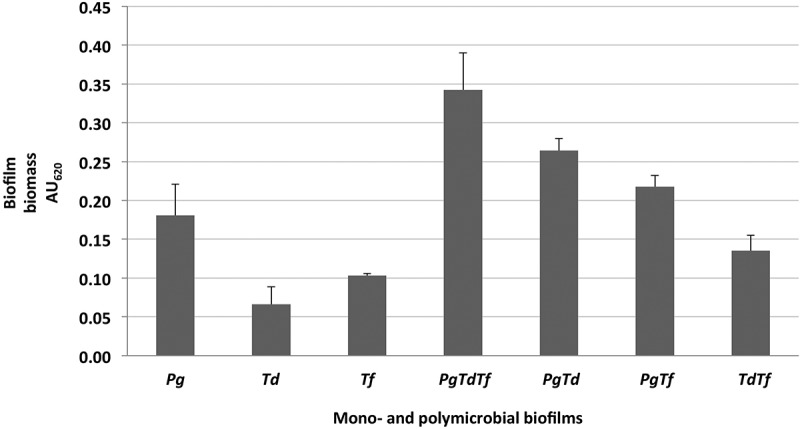
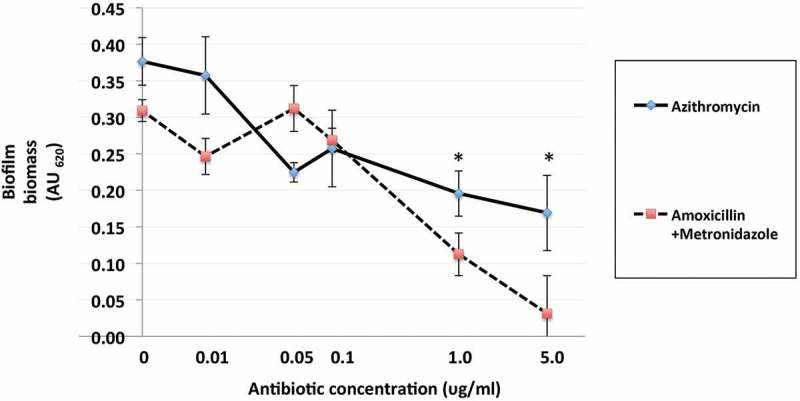
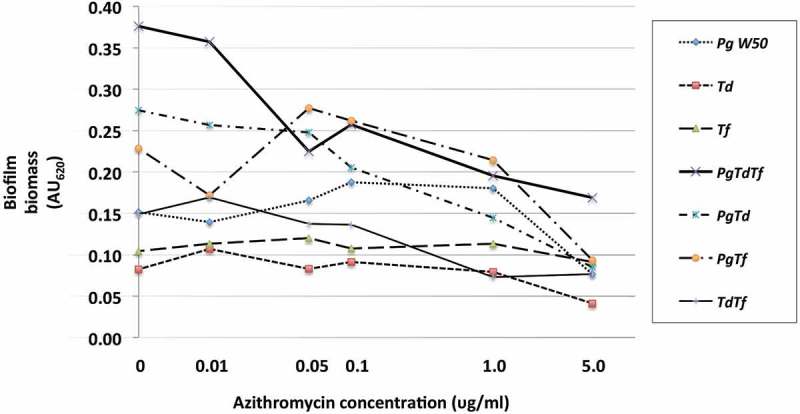
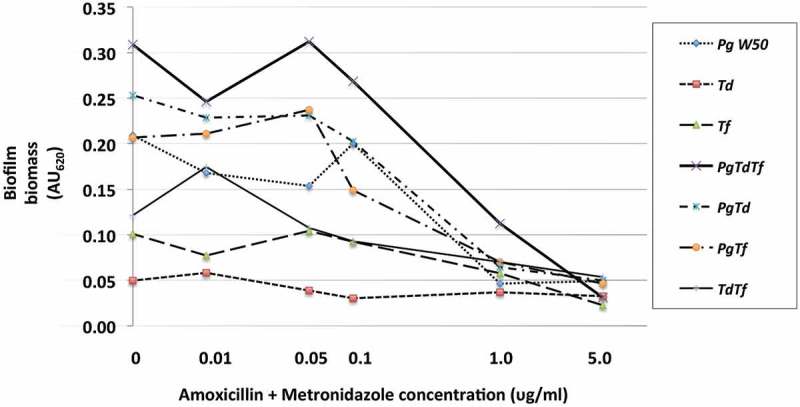
Azithromycin has recently gained popularity for the treatment of periodontal disease, despite sparse literature supporting efficiency in treating periodontal bacterial biofilms. The aim of this study was to evaluate the effect of azithromycin on biofilms comprised of , , and in comparison to an amoxicillin and metronidazole combination. W50, ATCC35405, and ATCC43037 grown under anaerobic conditions at 37°C were aliquoted into 96-well flat-bottom plates in different combinations with addition of azithromycin or amoxicillin + metronidazole at various concentrations. For the biofilm assay, the plates were incubated at 37°C anaerobically for 48 h, after which the biofilms were stained with crystal violet and measured for absorbance at AU. In this model, polymicrobial biofilms of + , + , and + were cultured. Combination of all three bacteria enhanced biofilm biomass. Azithromycin demonstrated a minimal biofilm inhibitory concentration (MBIC) of 10.6 mg/L, while the amoxicillin + metronidazole combination was more effective in inhibiting biofilm formation with a MBIC of 1.63 mg/L. Polymicrobial biofilm formation was demonstrated by combination of all three red complex bacteria. Azithromycin was ineffective in preventing biofilm formation within a clinically achievable concentration, whereas the combination of amoxicillin and metronidazole was more effective for this purpose.
阿奇霉素最近在牙周疾病治疗中受到欢迎,尽管支持其治疗牙周细菌生物膜有效性的文献稀少。本研究的目的是评估阿奇霉素与阿莫西林和甲硝唑联合用药相比,对由[未提及具体细菌名称]、[未提及具体细菌名称]和[未提及具体细菌名称]组成的生物膜的影响。在37°C厌氧条件下培养的[未提及具体细菌名称]W50、[未提及具体细菌名称]ATCC35405和[未提及具体细菌名称]ATCC43037,以不同组合分装到96孔平底培养板中,并添加不同浓度的阿奇霉素或阿莫西林 + 甲硝唑。对于生物膜检测,将培养板在37°C厌氧条件下孵育48小时,之后用结晶紫对生物膜进行染色,并在[未提及具体单位]AU处测量吸光度。在该模型中,培养了[未提及具体细菌名称] + [未提及具体细菌名称]、[未提及具体细菌名称] + [未提及具体细菌名称]和[未提及具体细菌名称] + [未提及具体细菌名称]的多菌种生物膜。三种细菌的组合增强了生物膜生物量。阿奇霉素的最低生物膜抑制浓度(MBIC)为10.6 mg/L,而阿莫西林 + 甲硝唑组合在抑制生物膜形成方面更有效,MBIC为1.63 mg/L。三种红色复合体细菌的组合证明了多菌种生物膜的形成。在临床可达到的浓度范围内,阿奇霉素在预防生物膜形成方面无效,而阿莫西林和甲硝唑的组合在这方面更有效。